A USB-A to USB-C cable supplier can provide the connector combination you need, but that does not automatically mean the cable will deliver the charging, data, durability, or packaging performance your customers expect. I often see importers compare only connector type and unit price. A better approach is to define the application first, then verify specifications, quality controls, MOQ, lead time, and repeat-order capability.
For importers and wholesalers, the right USB-A to USB-C cable supplier is the one that can match a clearly defined use case with documented specifications, consistent production, suitable packaging, and dependable export support. Buyers should confirm charging and data requirements, cable construction, quality inspections, certifications, MOQ, lead time, and after-sales procedures before approving samples or placing bulk orders.
Quick Answer
- Define what the cable must do before asking for a quotation.
- Do not assume that every USB-C connector provides the same charging speed or data performance.
- Ask the supplier for specific, verifiable product specifications and relevant test records.
- Compare MOQ, construction, packaging, inspection, lead time, and replenishment support alongside price.
- Approve a reference sample and written specification before starting mass production.
- Ask a qualified professional to review application-specific requirements when safety or regulatory questions apply.
The connector description is only the starting point. In my work with European and North American retailers, importers, and wholesalers, I have found that the most useful supplier discussions begin with the intended devices and sales channel. The sections below explain how I turn a general inquiry into a practical procurement brief.
What Should a USB-A to USB-C Cable Supplier Actually Provide?
Many buyers begin with a simple request: “Please quote your USB-A to USB-C cables.” The request is understandable, but it leaves several important questions unanswered. If the supplier quotes a general product without clarifying the use case, the buyer may receive a cable that fits physically but does not meet the expected performance or retail position.
A suitable USB-A to USB-C cable supplier should provide more than a connector pairing. The supplier should clarify the cable’s intended charging and data function, construction, length, packaging, inspection process, available customization, MOQ, lead time, and supporting documents. The quotation should match a written specification rather than a vague product name.
Start with the application, not the connector

- Which devices will the cable connect?
- Will the cable mainly support charging, data transfer, or both?
- What charging performance does the customer expect?
- Is the cable for mobile phones, tablets, power banks, accessories, or a mixed retail assortment?
- What length and outer material are required?
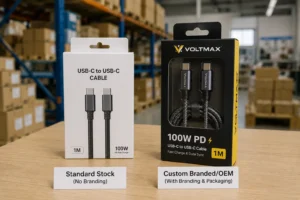
- Will the product be sold under a private label?
- What quantity will the buyer order initially and during replenishment?
A USB-A port on one end and a USB-C connector on the other describe the physical interface. They do not, by themselves, confirm the complete function of the cable.[1] Different internal conductors, connector assemblies, chip arrangements, insulation materials, and manufacturing controls can affect the final product.[2]
| Buyer requirement | What to define before quotation |
|---|---|
| Connector | USB-A type on one end and USB-C type on the other |
| Main use | Charging, data transfer, or charging and data |
| Length | Finished cable length and measurement method |
| Outer material | PVC, TPE, braided textile, or another approved material |
| Reinforcement | Standard strain relief, reinforced joint, or other design |
| Appearance | Color, logo, finish, connector housing, and tolerance |
| Packaging | Polybag, paper box, blister, retail box, or bulk carton |
| Order plan | Sample quantity, initial MOQ, and expected repeat volume |
| Verification | Required sample checks, inspection plan, and documents |
Why “compatible” needs more explanation
The word “compatible” can mean different things to different people. A supplier may use it to describe physical connection. A retailer may understand it as reliable charging with a particular device. A consumer may expect fast charging and dependable data transfer.
I do not treat a general compatibility statement as a complete technical claim. I ask the supplier to state what has actually been checked and under which conditions. If a product page mentions an exact charging capacity, data rate, device list, or standard, I advise the buyer to request product-specific evidence and to verify that the documents apply to the quoted model.
The USB Implementers Forum resources can help buyers understand official USB terminology and documentation. However, general interface information should not be treated as proof that a particular factory product meets every possible performance requirement.
A short example from quotation work
In supplier discussions, I sometimes receive a request such as “USB-C fast charging cable, 1 meter, black, 10,000 pieces.” I cannot responsibly treat that as a complete specification. I would still need to clarify the source charger, target devices, expected output, data requirement, packaging, and whether “fast charging” is a marketing term or a defined performance requirement.
How Can Importers Brief a USB-A to USB-C Cable Supplier?
A weak inquiry often creates a weak comparison. If one supplier assumes a basic charging cable and another assumes a reinforced retail product with customized packaging, their prices will not be meaningfully comparable. A detailed supplier brief helps the buyer receive more relevant samples and quotations.
Importers should send a supplier brief covering the intended devices, charging and data expectations, cable design, length, materials, packaging, branding, quantity, destination market, and required documents. The brief should separate confirmed requirements from points that still need technical review or supplier recommendation.
The five parts of a practical brief
2. Physical design
- Finished length.
- Cable diameter, if important.
- Jacket material.
- Color and surface finish.
- Connector housing design.
- Strain-relief requirements.
- Braided or smooth exterior.
- Logo position and printing method.
- Any preferred reference sample.
3. Packaging and labeling
- Individual packaging type.
- Barcode or SKU requirements.
- Language requirements.
- Carton quantity.
- Master carton markings.
- Country-of-origin information where applicable.
- Warning or instruction content.
- Retail display requirements.
For European and North American shipments, I ask buyers to confirm their own importer, labeling, and market-access responsibilities. A supplier can prepare documents or packaging artwork, but the importer should verify the requirements that apply to the final product and destination.
Use a quotation comparison sheet
| Evaluation point | Supplier A | Supplier B | Supplier C |
|---|---|---|---|
| Quoted model | |||
| Confirmed function | |||
| Length and material | |||
| Sample status | |||
| MOQ | |||
| Unit price | |||
| Packaging included | |||
| Lead time | |||
| Inspection arrangement | |||
| Relevant documents | |||
| Replenishment plan | |||
| After-sales response |
How Should Buyers Compare USB-A to USB-C Cable Supplier Prices?
Price is important for wholesalers because margin, freight, duty, and retail positioning all matter. However, a low unit price can become expensive if the cable needs rework, arrives late, has inconsistent packaging, or cannot be replenished when the buyer’s sales increase.
Buyers should compare the total procurement risk behind each quotation, not only the unit price. A fair comparison includes the same specification, sample approval, packaging, inspection, MOQ, lead time, documentation, payment terms, freight assumptions, and after-sales process.
Why two prices may describe different products
- Different outer materials.
- Different connector housing designs.
- Different internal conductors.
- Different reinforcement levels.
- Different packaging.
- Different production quantity.
- Different inspection scope.
- Different delivery terms.
- Different tolerance for cosmetic variation.
- Different assumptions about charging or data performance.
If a supplier gives a very low price without asking clarifying questions, I become cautious. The supplier may be quoting a standard product that does not match the buyer’s intended specification. The price itself is not proof of poor quality, but the lack of specification control creates risk.
Total landed cost is more useful
| Cost element | Questions to ask |
|---|---|
| Product price | Does the price match the approved specification? |
| Packaging | Is retail packaging included or charged separately? |
| Tooling and artwork | Are logo molds, printing plates, or design fees required? |
| Inspection | Who pays for pre-shipment or third-party inspection? |
| Freight | Is the quotation EXW, FOB, CIF, DDP, or another term? |
| Import charges | What duties, taxes, and local fees apply? |
| Defect handling | What happens if a batch does not meet the agreement? |
| Inventory cost | Will a high MOQ create slow-moving stock? |
| Replenishment | Can the supplier maintain the same model later? |
MOQ and repeat ordering
MOQ deserves special attention from smaller wholesalers and online sellers. A supplier may offer an attractive price at 20,000 pieces but create too much inventory for a buyer who can sell only a few thousand units per quarter.
- Sample quantity: enough to evaluate construction, packaging, and intended use.
- Initial production quantity: realistic for the first market test.
- Replenishment quantity: the likely repeat order if sales perform well.
Do not ignore the cost of unclear claims
A buyer may spend more than expected when a “fast charging” cable does not perform as the retail description suggests. The resulting costs can include customer complaints, returns, relabeling, replacement stock, and damage to the buyer’s brand.
I therefore ask suppliers to define claims in writing. If a claim depends on the charger, device, protocol, or test conditions, the product documentation should state those limitations. Buyers should also obtain professional technical or regulatory advice for claims that have legal or safety consequences.
How Can a USB-A to USB-C Cable Supplier Demonstrate Quality?
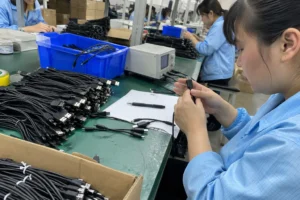
A polished product photograph does not show internal construction or batch consistency. Buyers need a practical quality-control process that connects the approved sample to mass production. This process should cover incoming materials, production checks, finished-product inspection, and corrective action.
A USB-A to USB-C cable supplier can demonstrate quality through a controlled specification, approved sample, traceable materials where available, in-process checks, finished-product testing, visual inspection, packaging verification, and documented handling of nonconforming goods.[7] Buyers should confirm which checks are actually performed for the quoted model.
What I look for in a supplier conversation
- What parts of the cable are inspected before assembly?
- How does the factory verify finished length and appearance?
- Which electrical or functional checks are performed?
- How are connector assemblies checked?
- How does the factory control printing and packaging?
- What happens when a batch contains nonconforming pieces?
- Can the supplier share a sample inspection format?
- Can the supplier keep a sealed reference sample?
Sample approval is not the end of quality control
The buyer and supplier should agree on how the mass-production batch will be compared with the approved sample. If the buyer changes the packaging or cable design after approval, the specification should be revised rather than handled through informal messages.
A simple inspection framework

| Inspection category | Typical buyer concern |
|---|---|
| Quantity | Did the supplier ship the ordered quantity? |
| Appearance | Are there scratches, stains, loose parts, or printing defects? |
| Dimensions | Does the finished cable match the approved length and design? |
| Assembly | Are connectors and strain reliefs properly assembled? |
| Function | Does the cable perform the agreed charging or data task? |
| Packaging | Does each unit have the correct packaging and label? |
| Carton | Are carton quantity and markings correct? |
| Documentation | Are required records available for the actual model? |
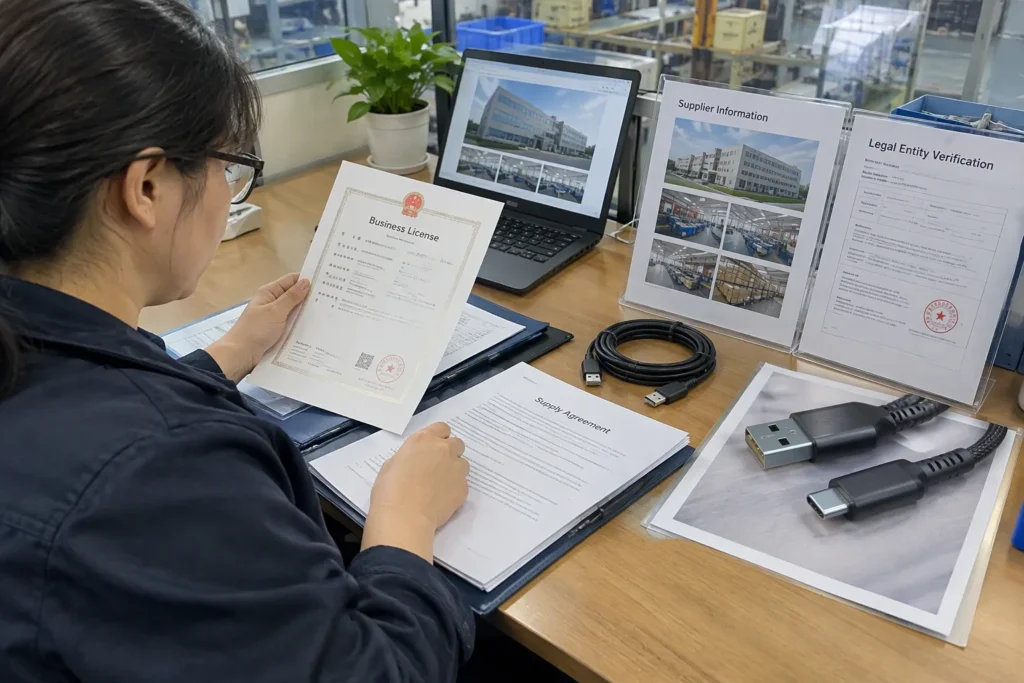
Certification needs careful verification
- Which product does the document cover?
- Who issued the document?
- What test scope or directive does it address?
- Is the model number identical to the quoted cable?
- Is the document current and authentic?
- Does it apply to the destination market and the buyer’s intended claim?
The European Commission’s Access2Markets portal provides useful information about product requirements and import procedures, but the buyer still needs to confirm requirements for the specific product and market. A supplier’s document should be checked against the applicable rules rather than copied into marketing material without review.
Batch consistency matters for repeat orders
A buyer may approve a strong sample and receive a different result in a later batch if the product is not controlled by a stable model and bill of materials.[6] I advise buyers to record the approved version and ask how the supplier handles changes to materials, components, subcontractors, and packaging.
This does not mean every production variation is unacceptable. It means the buyer should know which changes require approval. A controlled change process protects both sides, especially when a wholesaler sells the same SKU over several seasons.
How Do Importers Select a Reliable USB-A to USB-C Cable Supplier?

Supplier selection involves more than checking whether a company has a catalogue. The buyer needs to understand communication quality, production coordination, export experience, customization capability, quality ownership, and the ability to support the business after the first shipment.
Importers can shortlist a reliable USB-A to USB-C cable supplier by reviewing specification discipline, sample accuracy, production communication, quality records, MOQ, lead time, export documentation, customization support, and after-sales procedures. A supplier should answer difficult questions clearly instead of promising every feature without verification.
Assess the supplier before placing a large order
Stage 1: Initial inquiry
Send the same written brief to several suppliers. Compare how each supplier handles missing information. The best response is not always the longest response. I look for a supplier that identifies important questions and separates confirmed specifications from assumptions.
Stage 2: Sample review
If the buyer needs professional electrical verification, the buyer should arrange testing with a qualified laboratory or technical specialist. I can coordinate samples and supplier communication, but I do not position a commercial supplier discussion as an independent laboratory evaluation.
Stage 4: Shipment and replenishment
After shipment, record any issues by batch and SKU. This information helps the buyer decide whether the supplier is suitable for repeat business. A reliable relationship is built through accurate records, not only through friendly communication.
Supplier capability comparison
| Selection factor | Strong indication | Follow-up question |
|---|---|---|
| Technical communication | Supplier asks about actual use | Which requirements remain unconfirmed? |
| Samples | Sample matches the written brief | Is this sample the mass-production version? |
| Quality control | Supplier explains inspection steps | Can you provide a model-specific inspection record? |
| Customization | Artwork and packaging process is clear | What is the MOQ for custom packaging? |
| Delivery | Lead time is stated with conditions | What could delay this schedule? |
| Export support | Documents and carton marks are organized | Which documents are included in the quotation? |
| After-sales | Responsibility and response time are clear | How are defects investigated and resolved? |
| Replenishment | Supplier can maintain the approved model | How are component or material changes communicated? |
Consider the supplier’s role carefully
- Who manufactures the cable?
- Who controls the final inspection?
- Who issues the commercial documents?
- Who handles changes or complaints?
- Can the same specification be maintained if the production partner changes?
- What information is shared with the buyer?
In my own work as a Shenzhen-based OEM/ODM consumer-electronics supplier, I coordinate customer requirements, samples, production details, quality control, and export arrangements with manufacturing partners. I explain this structure to buyers because transparency is more useful than pretending that every trading or sourcing company owns every production line.
When a supplier is not the right fit
- Avoids specific answers about the quoted model.
- Changes the specification between sample and quotation.
- Cannot explain the meaning of a performance claim.
- Provides documents that do not identify the product.
- Pushes a high MOQ without discussing the buyer’s sales plan.
- Refuses reasonable inspection arrangements.
- Gives inconsistent answers through different contacts.
- Treats packaging and labeling as an afterthought.
- Promises an unusually short lead time without discussing capacity.
What Should a Wholesale Order Agreement Include?
Even a good supplier relationship needs written confirmation. Informal messages can help with discussion, but the final product should be controlled by a quotation, purchase order, specification, approved artwork, and inspection agreement.
A wholesale USB-A to USB-C cable order should define the model, function, construction, length, packaging, quantity, price, delivery terms, inspection method, documentation, change-control process, and remedy for nonconforming goods. Written details reduce disputes when the order moves from sample approval to mass production.
Define what happens if the batch is not acceptable
The remedy may involve replacement, credit, rework, sorting, or another agreed action. I do not recommend using a vague promise such as “we guarantee quality.” The buyer should define what evidence is needed and how quickly the issue will be reviewed.
Plan for product changes
Materials and components can change over time. A supplier may face a component shortage or packaging change. The buyer should ask for advance notice and approval when a change affects the agreed specification, product appearance, performance, documents, or retail claim.
How Can Buyers Prepare for Private-Label USB-A to USB-C Cable Orders?

Private-label work can create better market differentiation, but it also adds responsibilities. A supplier must coordinate the cable, logo, packaging, barcode, carton, artwork, and production schedule. A small artwork error can affect thousands of retail units.
Buyers should prepare private-label USB-A to USB-C cable orders by approving the physical product and artwork separately, confirming print positions and colors, checking barcode and language details, and requesting a pre-production packaging sample. The buyer should also confirm MOQ, tooling, lead time, and ownership of artwork.
Typical customization questions
- Is the logo printed, embossed, laser-marked, or placed on the packaging?
- Is a custom connector housing required?
- Is a custom color required?
- What is the MOQ for each color?
- Is new tooling required?
- How long does artwork approval take?
- Is there a setup charge?
- Can the supplier keep the same packaging for repeat orders?
- Who owns the artwork and tooling?
Retail presentation and wholesale efficiency
| Packaging option | Possible advantage | Buyer should check |
|---|---|---|
| Individual polybag | Low packaging cost and compact shipping | Retail presentation and labeling |
| Paper card or sleeve | Simple shelf presentation | Print durability and barcode placement |
| Paper box | More protection and branding space | Box cost and carton volume |
| Blister pack | Visible product presentation | Material, recycling, and packing cost |
| Bulk carton | Efficient for wholesale handling | Individual unit protection and SKU control |
Frequently Asked Questions
Does every USB-A to USB-C cable support fast charging?
No. The connector combination does not establish a universal charging speed.[3] Performance depends on the cable design, source charger, connected device, charging protocol, and other conditions.[4] I recommend asking the supplier to define the exact claim and verifying it against product-specific records.
Can a USB-A to USB-C cable transfer data?
It may support data transfer, but buyers should confirm the intended data function for the exact model.[5] Some products may be positioned mainly for charging, while others are designed for charging and data. I advise importers to test or professionally verify the required use before making retail claims.
What MOQ should an importer expect?
MOQ varies according to construction, packaging, customization, color, tooling, and production planning. Standard cables may have a lower MOQ than fully customized products. I recommend asking for both the standard-product MOQ and the customized-product MOQ so that the commercial difference is clear.
Should I choose a factory or an export supplier?

The correct choice depends on the buyer’s need for customization, communication, quality coordination, export documents, and order management. A qualified export supplier may coordinate manufacturing partners effectively. I suggest evaluating responsibility, transparency, sample accuracy, and after-sales support rather than relying only on the company label.
Which documents should I request before importing?
Request documents that apply to the exact model and intended market, such as a product specification, relevant test records, inspection records, and applicable declaration or certification documents. Buyers should verify authenticity, scope, model number, and current status.[8] A qualified compliance professional should review requirements for regulated or safety-sensitive applications.
Conclusion
Choosing a USB-A to USB-C cable supplier is not simply a matter of finding a connector match or the lowest quotation. I recommend defining the cable’s real charging and data task, preparing a detailed supplier brief, approving a reference sample, and comparing quality control, MOQ, packaging, lead time, documentation, and after-sales support. A clear specification protects the importer, the supplier, and the final customer. If you need help developing a bulk cable specification, custom packaging plan, or supplier quotation, contact my Shenzhen OEM/ODM team to discuss your target market and order requirements.
Sources
- USB Charger (USB Power Delivery)", A USB specification distinguishes the physical USB connector and interface from the power-delivery and data capabilities supported by a particular cable assembly and connected equipment
- Determination of Tensile Characteristics and Electrical ... - PMC", Engineering studies of cable assemblies associate conductor and contact characteristics, material selection, and manufacturing variation with electrical performance and service reliability
- Test Procedure for External Power Supplies", USB technical documentation indicates that charging capability depends on the applicable power and charging specifications and on the capabilities of the connected source, sink, and cable, rather than on connector geometry alone
- USB Charger (USB Power Delivery)", Technical analyses of USB charging describe delivered power as a function of source and sink capabilities, cable electrical limits, protocol negotiation, and operating conditions
- How to easily tell whether a USB-C cable is data-only ...", USB documentation distinguishes cable assemblies by their supported data and power capabilities; therefore, matching USB-A and USB-C connectors alone does not identify a cable's data-transfer function
- VOTING MACHINES: QUALITY AND CONFIGURATION ...", Quality-management literature identifies configuration control, approved bills of materials, and documented change procedures as measures for maintaining conformity between released designs and subsequent production
- Metrological Traceability: Frequently Asked Questions and ...", Quality-management guidance treats documented requirements, inspection and testing, traceability where appropriate, and control of nonconforming outputs as established elements of production and conformity control
- Conformity assessment", Conformity-assessment guidance requires technical and declaration documents to be associated with the relevant product or model and applicable requirements before they are used to substantiate compliance