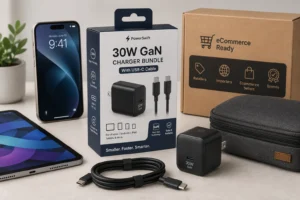
Quick Answer
A USB-C charger spec sheet template helps buyers avoid a common mistake: choosing a product by its headline wattage alone. In my work with European and North American 3C buyers, I see how missing output conditions create listing errors, compatibility questions, and returns. A structured sheet turns scattered supplier data into a practical purchasing document.
A USB-C charger spec sheet should include input ratings, total power, port-level output, charging protocols, PDO tables, cable conditions, multi-port power rules, operating limits, and supporting documents. Buyers should compare these fields with the target device requirements and verify the actual model’s test reports and certifications before approval.
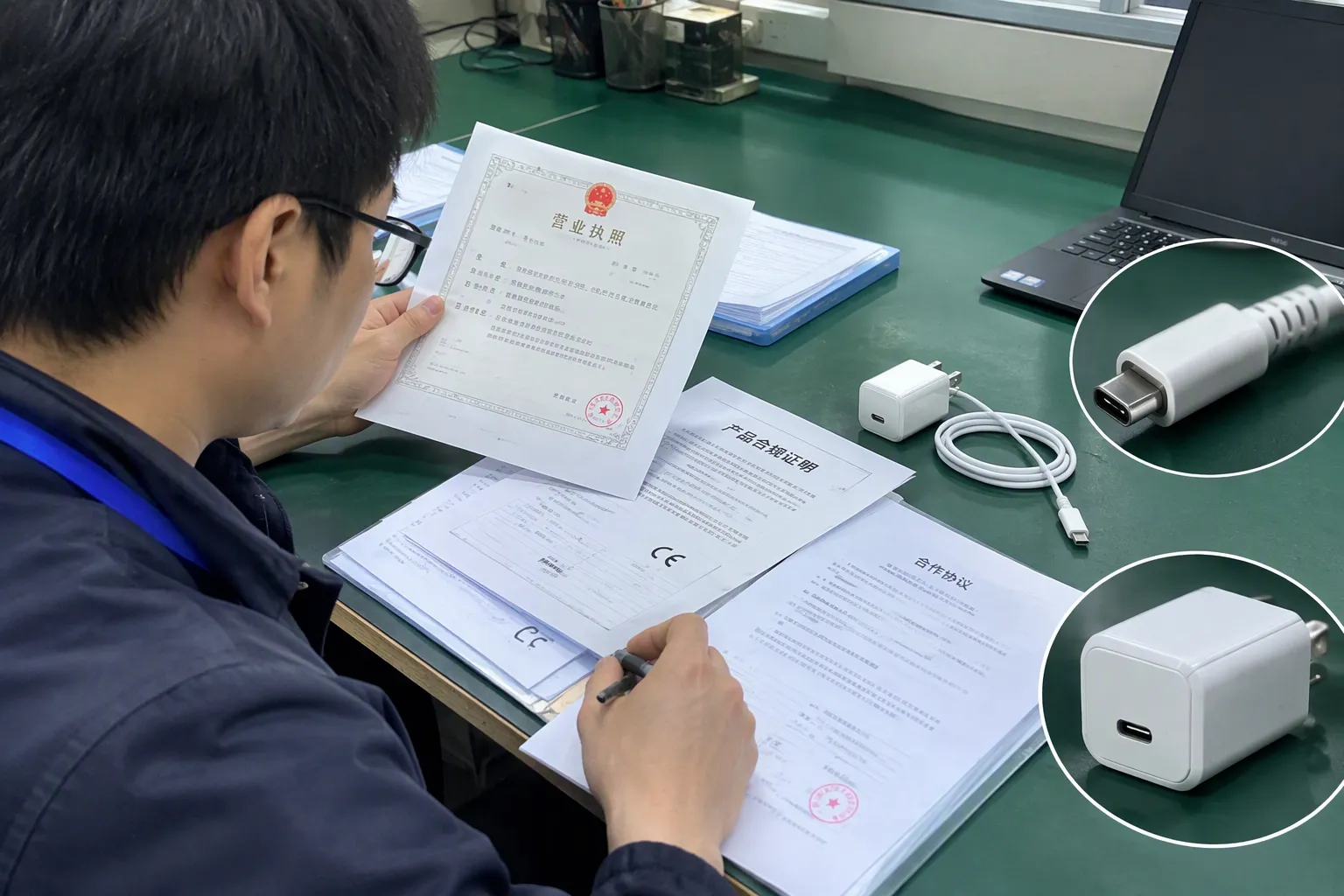
A useful sheet does more than describe what a charger can theoretically support. It explains how the charger behaves in a real buying situation, including single-port use, simultaneous charging, negotiated USB Power Delivery profiles, and regional documentation. The sections below show how I would organize and review this information.
What should a USB-C charger spec sheet template include?
A weak charger sheet may show only “USB-C PD” and “65W.” That information is not enough for procurement, marketplace listings, or customer support. I recommend using a USB-C charger spec sheet template that separates electrical input, usable output, protocol behavior, physical features, compliance documents, and commercial conditions.
A complete USB-C charger spec sheet should identify the exact model, input range, rated output, port configuration, supported protocols, PDO or power-profile table, simultaneous-use limits, operating conditions, dimensions, packaging, and available certification or test documents. The sheet should also state which claims require verification for the production version.
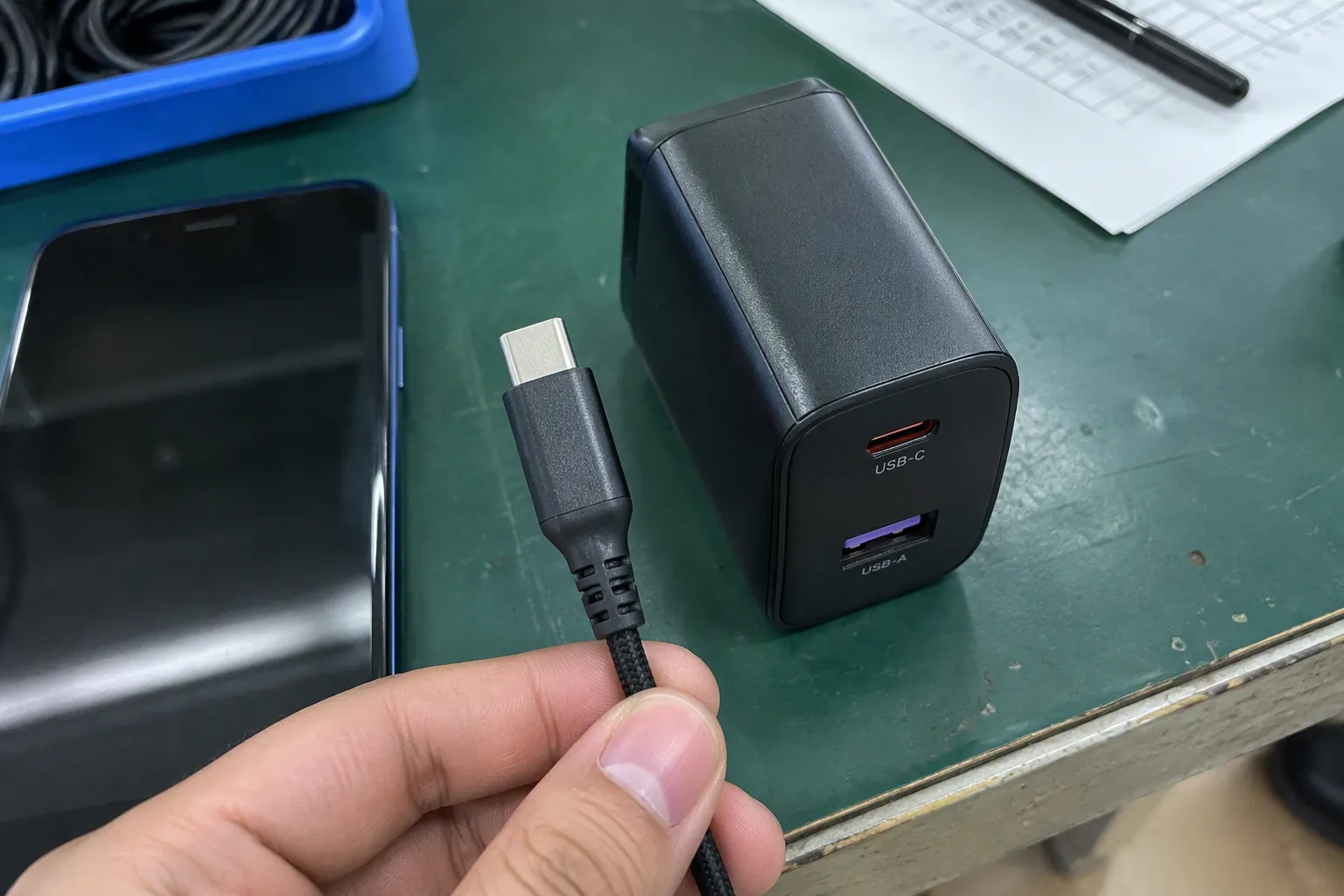
Why does the exact model number matter?
A supplier may offer several chargers with similar housing designs and different internal boards. One version may support a particular PD profile, while another may have a lower power rating or different port-sharing behavior. I therefore place the exact model number, hardware version, and revision date at the top of every document.
A buyer should not approve a generic family name when the purchase order concerns one specific SKU. The following fields create a useful identification block:
| Field | What I would request | Why it matters |
|---|---|---|
| Brand or factory name | Legal supplier or manufacturer name | Supports traceability |
| Product model | Exact model and suffix | Prevents version confusion |
| Hardware revision | Board or engineering revision, if used | Links the sheet to test evidence |
| Rated power | Declared total output | Supports product comparison |
| Port layout | Number and type of ports | Defines the use case |
| Sheet revision | Date and document version | Shows which data was approved |
| Sample status | Engineering sample, pilot, or production | Separates provisional data from final data |
I have found that revision control becomes especially important when a buyer prepares product pages before mass production. A supplier may update a component, firmware setting, or power-allocation table without changing the outside housing. A document date and approval signature can reduce that risk.
How should input ratings be listed?
Input ratings describe how the charger receives electricity from the wall. They do not prove how much power a USB-C port can deliver to a device. This distinction is basic, but many commercial sheets blur it.
A clear input section may include:
- Rated input voltage or voltage range
- AC frequency range
- Maximum input current
- Input power, if measured or declared
- No-load power consumption, where relevant
- Plug type and regional version
- Operating temperature and humidity
- Protection features, if documented
- Applicable safety or efficiency requirements
For example, a sheet might state that a model accepts a certain AC voltage range and frequency range. I would still ask whether the values apply to every regional plug version and whether the input current is a maximum value, a typical value, or a test result.
Input current also should not be used to calculate guaranteed USB output without considering conversion efficiency, thermal conditions, power factor, and design limits.[7] Buyers should treat it as an input-side parameter.
How should usable output be separated from total rated power?
The output section should answer the buyer’s real question: What can each port provide, under which conditions?
I recommend separating these fields:
- Total rated output power
- Maximum output from each port when used alone
- Available voltage and current combinations
- Output limits when multiple ports operate together
- Protocol support
- Cable or accessory conditions
- Thermal or environmental restrictions
A 100W label, for example, does not automatically mean that every port can provide 100W.[8] The total may apply only to one USB-C port, while another port has a lower limit. It may also apply only when the first port is unused.
A practical output table can look like this:
| Use condition | Port 1 | Port 2 | Port 3 | Total limit |
|---|---|---|---|---|
| Single-port use | Verify actual model | Verify actual model | Verify actual model | Model-specific |
| Two-port use | Profile or allocation | Profile or allocation | Not applicable | Model-specific |
| All ports in use | Allocation rule | Allocation rule | Allocation rule | Model-specific |
| Thermal protection active | Reduced or interrupted output may apply | Reduced or interrupted output may apply | Reduced or interrupted output may apply | Confirm with supplier |
I would not allow a supplier to replace this table with the phrase “intelligent power distribution.” That phrase may describe a useful feature, but it does not tell a buyer how much power remains available to each device.
What should a PDO table show?
A PDO, or Power Data Object, table presents the power profiles that a USB Power Delivery charger can advertise during negotiation.[4] Depending on the product design, the table may contain fixed voltage and current combinations and, where supported, adjustable or programmable ranges.
The sheet should identify:
- The relevant USB-C port
- The profile type
- Nominal voltage
- Maximum current
- Maximum power calculated from the profile
- Whether the profile is fixed, adjustable, or otherwise defined
- Conditions that affect availability
- Whether the table applies to one-port or shared use
- The document or test source used for verification
The table is useful because it makes negotiation data visible. However, it is not a universal compatibility promise. A device may request a profile that the charger does not advertise.[5] A cable may have its own power limit.[6] A phone, tablet, notebook, or accessory may accept a lower profile than the charger offers.
I treat a PDO table as a technical reference for comparison, not as a certification report or laboratory performance result. The buyer should confirm the table against the actual firmware, production sample, and relevant test documentation.
What is the difference between USB-C, USB PD, PPS, and other protocols?
“USB Power Delivery” describes a power negotiation system used over compatible USB-C connections.[2] PPS, or Programmable Power Supply, can allow supported devices and chargers to negotiate power within a defined adjustable range.[3] Other charging protocols may also appear on a product sheet, especially for USB-A ports or legacy devices.
A buyer should ask the supplier to identify protocol support by port rather than listing protocols only in marketing copy.
| Specification item | What it tells the buyer | What it does not prove |
|---|---|---|
| USB-C connector | Physical connection format | Maximum charging power |
| USB PD | Supported negotiation method | Compatibility with every USB-C device |
| PPS | Adjustable charging option where supported | That every fast-charging phone uses it |
| Maximum wattage | Stated output ceiling | Actual device charging speed |
| PDO table | Advertised power profiles | Real-world performance in every condition |
| Cable rating | Cable power capability | That the included cable has that rating unless stated |
In customer communication, I usually translate “Will it fully charge my device?” into five questions:
- What power does the device require?
- Which charging protocol does it use?
- Which profiles does the charger advertise?
- Can the cable carry the required power?
- Does the charger keep that profile available when other ports are used?
That checklist is more reliable than repeating a maximum wattage claim.
How should multi-port power sharing be documented?
Port sharing is one of the most important fields for a wholesale buyer. Customers often connect a phone and a laptop at the same time. If the charger reduces the first port when the second port is connected, the product listing needs to explain that behavior accurately.
I would request a mode table for every common combination:
| Connected ports | Required information |
|---|---|
| USB-C only | Maximum profile and conditions |
| USB-A only | Maximum profile and protocol behavior |
| USB-C plus USB-A | Power allocation for both ports |
| Two USB-C ports | Allocation and priority rules |
| All ports | Per-port output and total output |
| New device connected | Whether output renegotiates |
| Device disconnected | Whether the remaining port restores a higher profile |
The sheet should also explain whether the charger uses fixed priority, dynamic allocation, or a pre-defined maximum for each combination. A statement such as “power may be intelligently distributed” leaves too much room for misunderstanding.
I have seen this issue create unnecessary after-sales work. A buyer may publish the highest single-port wattage, while the end customer uses two ports and sees a lower charging rate. The product may be operating as designed, but the listing has not described the design.
Which physical and commercial fields belong in the template?
Technical electrical information is essential, but procurement teams also need practical product data. I include the following fields in the same document or in linked appendices:
- Product dimensions and net weight
- Plug type and whether the plug is fixed or detachable
- Housing material
- Color and finish
- Port labels
- Cable inclusion and cable length
- Packaging dimensions and gross weight
- Carton quantity
- Minimum order quantity
- Sample lead time
- Production lead time
- Warranty or after-sales policy
- Logo, color, packaging, and labeling options
The business context matters because a charger for a European retail chain may need different packaging, markings, language, and plug arrangements from a charger for a North American online seller. I would not treat customization as a final detail. Packaging artwork, labeling, and certification scope can affect the approval timeline.
A procurement-ready template can use this field order:
- Product identity
- Input ratings
- Port and output information
- PDO and protocol tables
- Safety and protection information
- Physical specifications
- Packaging and customization
- Quality-control records
- Certification and test-document register
- Commercial terms and approval notes
This order follows the buyer’s normal review process. It starts with identification, moves into performance, and ends with evidence and purchasing conditions.
What evidence should support the specification sheet?
A specification sheet is a supplier declaration unless another document supports a particular claim. Buyers should request documents that match the exact model and market version. They should also check document dates, applicant names, model numbers, ratings, and test conditions.
Depending on the market and product design, supporting material may include:
- Safety test reports
- EMC test reports
- Efficiency or energy-related test records
- Relevant declarations of conformity
- Product photographs and label artwork
- Factory quality-control records
- Sample inspection reports
- Component or material declarations, where applicable
- USB-related testing or listing evidence, if claimed by the supplier
I do not treat a logo or a certificate number in a sales presentation as sufficient evidence. The buyer should verify the document through the appropriate issuing organization or qualified compliance professional when necessary. Requirements can vary by destination, product configuration, plug type, and sales channel.
The document register can be simple:
| Claim | Supporting document | Model match | Date checked | Buyer status |
|---|---|---|---|---|
| Input safety rating | Test report or declaration | Yes or no | Date | Pending or approved |
| Output profile | Engineering or test record | Yes or no | Date | Pending or approved |
| Protocol support | Relevant test evidence | Yes or no | Date | Pending or approved |
| Regional compliance | Applicable document set | Yes or no | Date | Pending or approved |
This approach keeps commercial communication accurate. It also gives customer-service staff a source to consult when a buyer asks about charging behavior.
What common mistakes should buyers remove from a charger sheet?

The most common problem is not always a wrong number. It is an incomplete number that appears more certain than it really is.
I would review the sheet for these issues:
- The total wattage appears without per-port output.
- Input current is presented as if it were output capacity.
- The PDO table does not identify the port.
- Protocol names appear without conditions.
- Multi-port output is omitted.
- Cable requirements are not stated.
- The model number differs between the sheet and test report.
- “Fast charging” is used without a defined protocol or profile.
- The sheet does not identify whether values are maximum, nominal, typical, or tested.
- Certification claims are not linked to documents.
- The production version is not distinguished from the sample.
- The supplier does not state what happens during thermal protection.
The buyer should not fill missing fields with assumptions. The buyer should mark them as “to be verified” and ask focused questions. A short clarification request can prevent a much longer dispute after shipment.
How can buyers compare two charger suppliers?
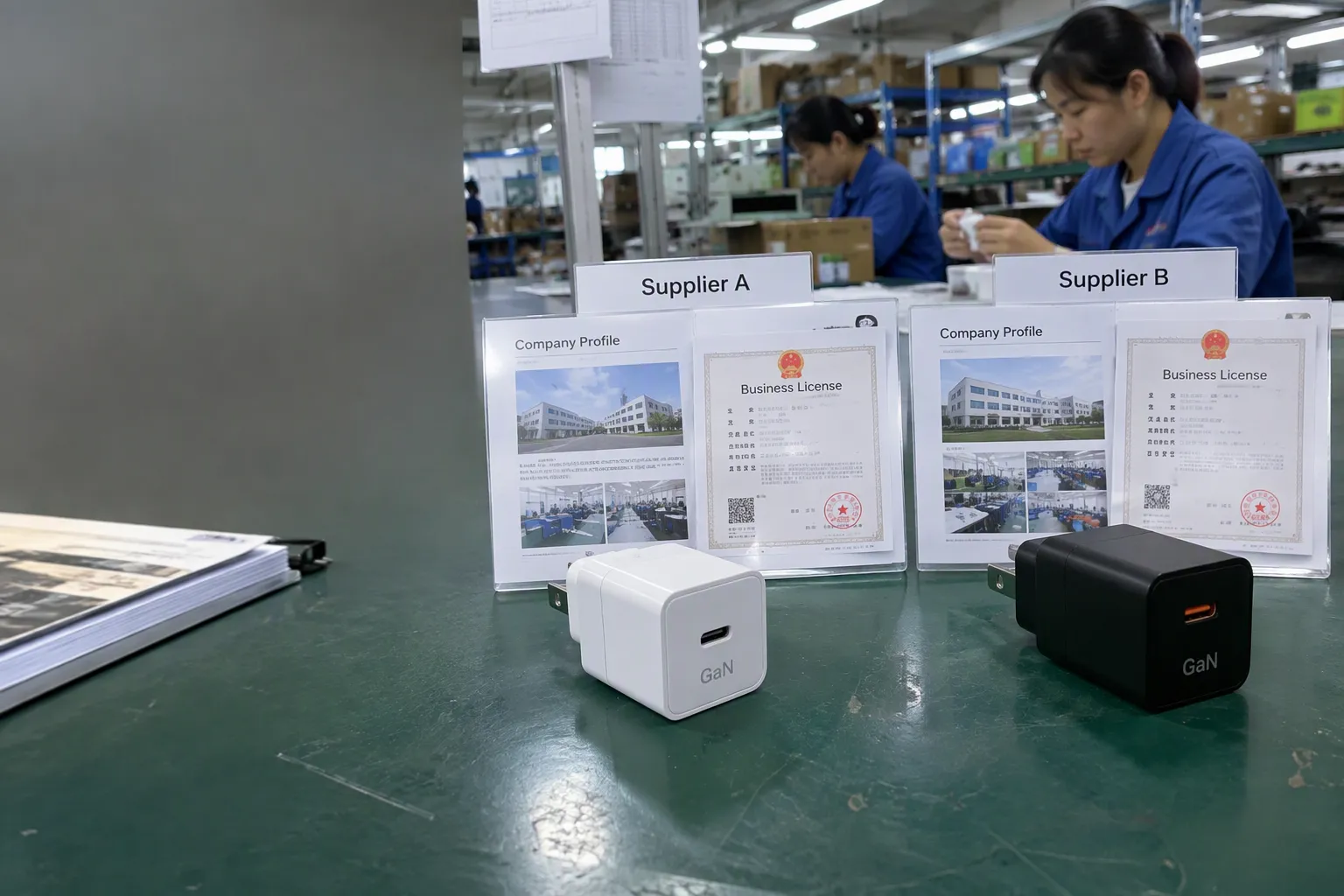
I recommend scoring suppliers on both the product and the quality of the information. A lower price may not be attractive if the supplier cannot explain port behavior or provide traceable documents.
A simple comparison framework can include:
| Evaluation area | Questions to ask |
|---|---|
| Specification completeness | Does the sheet show input, output, PDO, and sharing rules? |
| Model traceability | Do the sample, label, report, and production SKU match? |
| Quality control | Can the supplier explain incoming, in-process, and final checks? |
| Documentation | Are relevant documents available for the target market? |
| Sample process | Can the buyer test the exact proposed version? |
| Delivery | Is the lead time based on confirmed components and packaging? |
| MOQ and customization | Can the supplier support the required order size and branding? |
| After-sales support | Is there a defined process for defects and technical questions? |
In my export work, customers often value a clear answer more than a long technical brochure. A supplier that openly states a limit is easier to evaluate than one that uses broad claims but avoids the details.
What should a final buyer approval checklist contain?
Before approving a charger for purchase or listing, I would ask the buyer team to confirm the following:
- The exact model and revision are recorded.
- The target devices and use cases are defined.
- Input ratings match the intended market version.
- Each port has a documented maximum output.
- PDO tables are complete and model-specific.
- Protocol claims are identified by port.
- Cable requirements are clear.
- Multi-port power allocation is documented.
- Thermal and protection behavior is understood.
- Product labels and packaging match the approved data.
- Supporting documents are checked for model and market relevance.
- A qualified professional has reviewed application-specific compliance questions where needed.
- The production sample has been compared with the approved specification.
A buyer should also test representative devices rather than only measuring an empty port. A practical evaluation may include a phone, tablet, notebook, wearable, or other target product from the intended sales range. The buyer should record the cable, starting battery condition, connected ports, and test environment because charging behavior depends on the complete system.
The test does not replace professional laboratory evaluation. It simply helps the commercial team understand whether the product description reflects the expected customer use.
Frequently Asked Questions
Is a USB-C charger spec sheet the same as a test report?
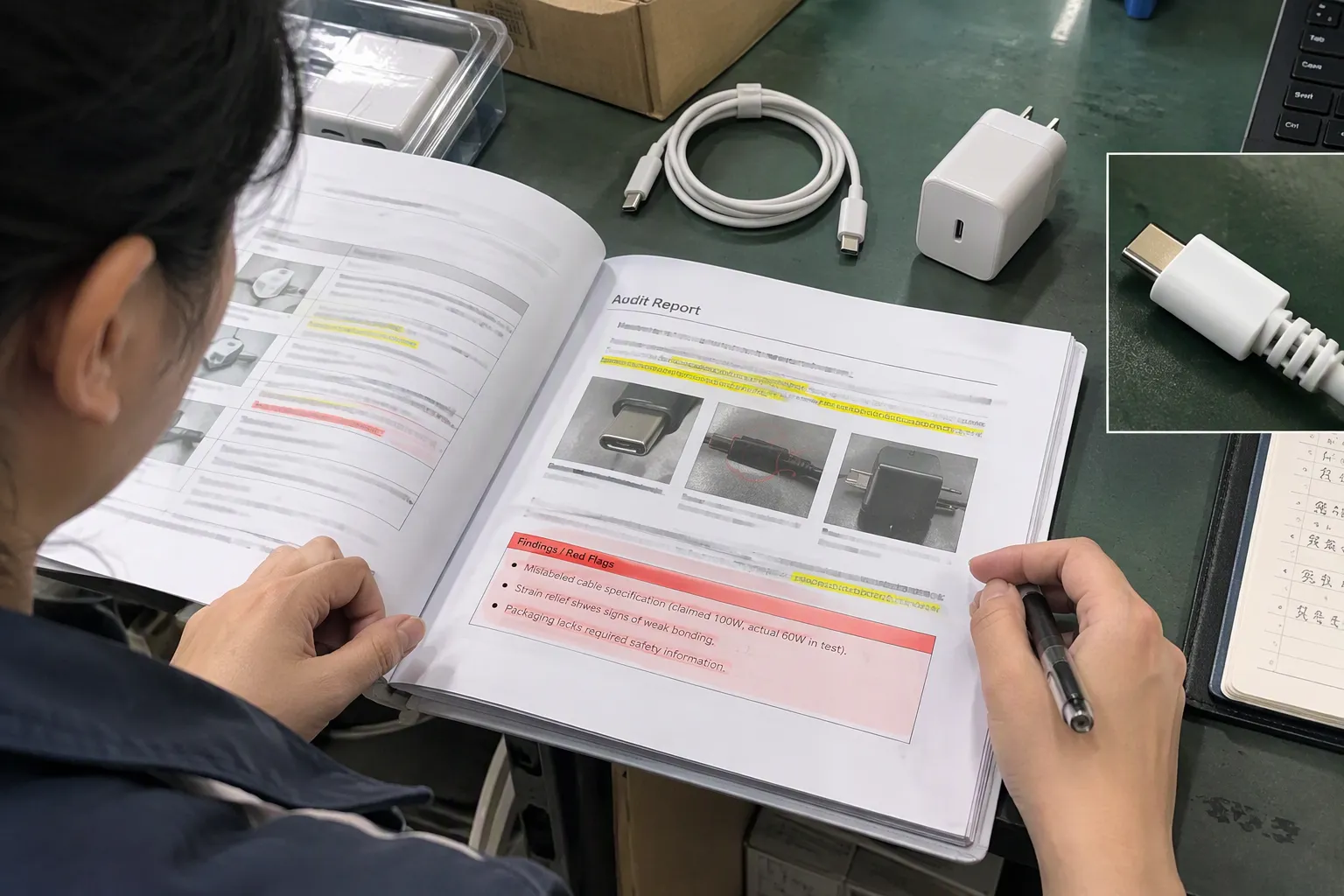
No. A USB-C charger spec sheet normally summarizes supplier-declared product information. A test report records a defined evaluation under stated conditions. Buyers should use the sheet for comparison and request relevant reports or declarations to support safety, compliance, and performance claims.
Does a higher charger wattage charge every device faster?
No. The device, charger, protocol, cable, and operating conditions all affect charging. A device may accept less power than the charger offers. A device may also request a profile that the charger does not advertise. Buyers should compare the target device requirements with the actual output and PDO data.
Why should input ratings and output ratings be shown separately?
Input ratings describe the electricity drawn from the wall. Output ratings describe the power delivered to connected devices. The two values answer different questions. A charger’s input current does not prove its per-port output or its performance when several ports operate simultaneously.
What does a PDO table tell a buyer?
A PDO table shows the power profiles that a USB PD charger advertises for negotiation. It helps buyers compare voltage and current options by port. It does not guarantee that every device will use every profile, and it does not replace a certification document or laboratory test.
What should I do if a supplier provides only a total wattage?
I would request a complete output table before approval. The supplier should identify single-port performance, simultaneous-use limits, protocol support, PDO options, cable conditions, and any thermal restrictions. If the supplier cannot provide this information, I would treat the product as a higher documentation and after-sales risk.
Conclusion
A well-built USB-C charger spec sheet template helps me turn a broad marketing claim into a document that a buyer can actually use. The most important fields include input ratings, per-port output, PDO tables, protocol conditions, cable capability, and multi-port power sharing. Buyers should match those details with their target devices, verify supporting documents, and review the exact production model. If you are sourcing chargers for retail, wholesale, or e-commerce, I can help you compare suitable 3C products, clarify MOQ and lead time, and prepare a specification package for supplier approval.
Sources
- Universal Serial Bus Type-C Cable and Connector ...", A USB Type-C connection defines the connector and interface system, whereas supported power levels depend on the applicable power-delivery and device capabilities described by the relevant specifications
- USB PD Power Negotiations", USB Power Delivery defines a protocol through which compatible source and sink devices negotiate an operating power contract over a USB connection
- What is the difference between PD and PPS?", In USB Power Delivery, Programmable Power Supply operation permits a compatible source to provide negotiated, adjustable voltage and current values within specified limits rather than only fixed power profiles
- USB Power Delivery Power Data Objects", Power Data Objects are USB Power Delivery data structures that describe available power-supply capabilities exchanged during negotiation, including fixed or adjustable profiles where supported
- (PDF) USB Type-C Cable and Connector Specification", USB Power Delivery negotiation is constrained by the source capabilities presented to the sink; a sink request must correspond to a capability the source has advertised under the protocol
- USB 3.1 Type-C to C Passive E-Marker Cable VL151 Chip ...", USB Type-C cable assemblies are subject to defined current-carrying classifications, so the cable assembly can limit the power available even when the source and sink support higher capabilities
- Two-Stage Isolated Switch-Mode Power Supply With High ...", The output power of an AC-to-DC supply cannot be inferred from input current alone because conversion efficiency, input power factor, operating temperature, and rated design limits affect the power delivered to the load
- A New Multi-Output DC-DC Converter for Electric Vehicle ...", For a multi-output power supply, the product’s aggregate rating and the maximum rating of an individual output are separate specifications; the aggregate rating does not imply that every output can simultaneously deliver that value