A professional USB Cable Manufacturer and supplier in China can help me reduce compatibility problems, inconsistent batches, and delivery risk. However, a low quotation may hide weak testing, unclear specifications, or limited after-sales support. I recommend evaluating the supplier’s product-matching process, documents, samples, production control, and communication before I compare unit prices.
A professional USB cable manufacturer and supplier in China should match the cable to the device, connector, charging requirement, data function, market documentation, and packaging plan. I should verify samples, specifications, certification scope, MOQ, lead time, batch controls, and after-sales responsibilities before placing a production order. The best supplier is not always the cheapest supplier.
Quick Answer
- I should first explain the device combinations, connector types, charging power, data needs, and target market.
- I should ask for a scenario-based recommendation instead of accepting a general “fast charging” claim.
- I should compare samples, technical documents, packaging, MOQ, lead time, and replenishment support.
- I should verify that certificates and test reports apply to the exact product and market.
- I should confirm who takes responsibility when a batch has compatibility, quality, or delivery problems.
When I handle USB cable inquiries, the first mistake I try to prevent is treating every cable as a simple commodity. Connector shape, wire construction, charging capacity, data performance, device compatibility, packaging, and compliance documents can all affect the final buying decision. The following guide explains how I evaluate a supplier before recommending a product to a retailer, wholesaler, e-commerce seller, or brand customer.
Why Does Choosing a Professional USB Cable Manufacturer and Supplier in China Matter?
A USB cable may look simple, but a poor match can create slow charging, unstable data transfer, customer complaints, returns, and replenishment problems. I have learned that buyers need more than a product photograph and a low price. They need a controlled supply process that connects product performance with their sales channel.
A professional USB cable manufacturer and supplier in China matters because the supplier should help reduce compatibility risk, documentation uncertainty, batch variation, delivery delays, and unclear after-sales responsibility. I evaluate the complete purchasing process rather than one attractive quotation.
Price Is Only One Part of Purchasing Risk
- Does the cable fit the intended devices?
- Does it provide the required charging or data function?
- Can the supplier document the relevant technical claims?
- Will mass production match the approved sample?
- Can the supplier meet the required delivery and replenishment schedule?
- Does somebody take clear responsibility after shipment?
A lower unit price can become expensive if a retailer receives repeated returns. The buyer may also need to pay for replacement stock, customer service, relabeling, or urgent freight. I do not assume that a low-cost cable will create these problems, but I treat missing information as a purchasing risk.
Supplier Expertise Should Be Visible in the Process
- Asking about the customer’s devices and use case.
- Explaining which specifications still need confirmation.
- Providing samples before mass production.
- Sharing applicable test reports or certificates for verification.
- Confirming packaging, labeling, and barcode requirements.
- Explaining MOQ, lead time, payment terms, and replenishment options.
- Keeping a record of the approved specification and sample.
- Responding clearly when a quality or delivery issue appears.
Our Shenzhen trading business has 15 years of export experience, and our work often involves matching products, communicating with customers, coordinating supply, and handling after-sales or replenishment questions. That experience does not replace laboratory testing or professional engineering review. It does show me why supplier communication is part of quality control.
What Buyers Should Ask at the Beginning
- What connector is on each end?
- Which phones, tablets, computers, chargers, or accessories will the cable connect?
- Does the customer need charging only, charging and data, or a specific data speed?
- What charging power or current does the application require?
- Is the cable intended for a consumer package, a retail display, or bulk distribution?
- What are the target market, packaging language, and labeling requirements?
- What quantity will the buyer order initially?
- What is the expected monthly or seasonal replenishment?
- Does the buyer need a custom length, color, logo, braid, connector housing, or package?
- Which documents does the buyer’s compliance team require?
How Should I Match a USB Cable to Charging and Data Requirements?
I should treat “fast charging USB cable” as a matching question, not as a complete specification. The correct choice depends on the source charger, receiving device, connector combination, cable construction, power requirements, and relevant charging protocols.[1] I should verify the whole system before I describe a product as suitable for a specific application.
Connector Type Does Not Define Full Performance
A USB-A to USB-C cable and a USB-C to USB-C cable are different purchasing choices. The connector shape tells me how the cable may connect, but it does not automatically tell me the charging capacity, data performance, electronic components, or protocol support.
| Buyer requirement | Information I should confirm |
|---|---|
| Charging only | Device combination, current requirement, cable length, and intended charger |
| Charging plus data | Data function, expected transfer performance, and device compatibility |
| USB-C to USB-C | Charger output, device input, cable rating, and any required identification components |
| USB-A to USB-C | Source port capability, device requirement, charging limitation, and data function |
| Laptop or monitor use | Power delivery needs, display or data requirements, and application-specific compatibility |
| Retail replacement cable | Common device coverage, packaging, labeling, and return-risk considerations |
“Fast Charging” Needs Specific Evidence
- What is the charger’s rated output?
- What is the device’s input requirement?
- Is the requested power level supported by the full setup?
- Is the cable intended for a particular protocol?[3]
- Does the cable need an identification component?[4]
- Is the cable length likely to affect the application?[5]
- Does the buyer need charging performance verified by a test laboratory?
- Does the product description need a conservative claim for retail packaging?
Data Cables Require Separate Attention
Some cables charge devices but offer limited or no data function.[2] Other cables support data transfer, but the buyer still needs to confirm the applicable performance level and device compatibility. A retailer selling a cable for phones may have different requirements from a seller offering cables for storage devices, monitors, or laptops.
- Connector combination.
- Cable length and tolerance.
- Outer material and color.
- Conductor or construction information where relevant.
- Charging function and verified rating.
- Data function and verified performance.
- Connector housing and strain-relief requirements.
- Applicable test documents.
- Packaging and labeling.
- Approved sample reference.
Technical Claims Need Document Control
- The approved sample photographs.
- The final product specification.
- Test reports or certificates.
- Packaging artwork.
- Label and barcode information.
- Inspection records.
- Purchase order and shipment details.
- Any approved deviation.
For official USB-related technical information, buyers can review resources from the USB Implementers Forum. For European market responsibilities, buyers should also consult official information from the European Commission and obtain qualified compliance advice for the exact product and market.
How Can I Verify a Professional Cable Manufacturer Supplier in China?
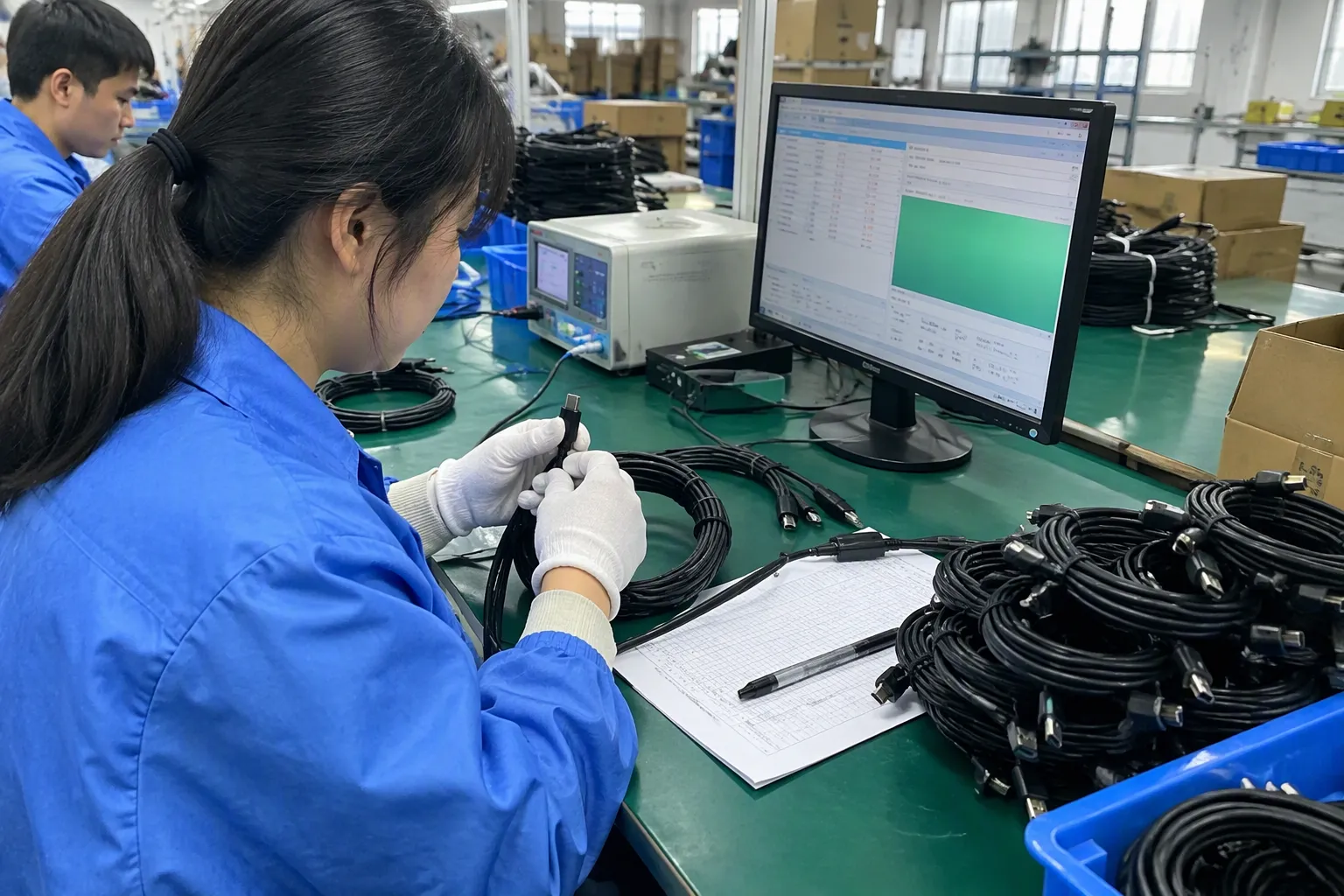
I can verify a professional cable supplier by combining commercial documents, technical information, samples, communication quality, and production evidence. No single certificate or factory photograph proves that a supplier is suitable. I need to connect the evidence to the exact SKU, order, market, and responsibility terms.
Start With a Structured Supplier Questionnaire
| Verification area | Questions for the supplier |
|---|---|
| Business identity | What is the legal company name, address, and sales contact? |
| Supply role | Is the company a manufacturer, trading company, or a combination of both? |
| Product range | Which USB cable types and connector combinations are regularly supplied? |
| Quality process | What incoming, in-process, and final checks are used? |
| Documents | Which reports or certificates apply to the exact SKU? |
| Sample control | How will the approved sample be recorded and retained? |
| Production | What is the normal MOQ and lead time for the requested configuration? |
| Packaging | Can the supplier meet language, barcode, carton, and retail requirements? |
| Service | What is the procedure for defects, shortages, or replenishment? |
I do not see a trading company as automatically unsuitable. A capable trading supplier may offer product matching, factory coordination, export documentation, multilingual communication, and after-sales support. However, the supplier should be transparent about its role and should not claim in-house manufacturing without factual proof.
Check Certification Scope, Not Just Certificate Names
- The legal name of the certificate holder.
- The product model or family covered.
- The test standard and test date.
- The issuing laboratory or certification body.
- Whether the document applies to the exact construction.
- Whether the document covers the intended destination market.
- Whether any component, material, or packaging condition affects its scope.
For chemical and product compliance topics in the European Union, buyers can consult the official European Chemicals Agency information on REACH. For U.S. consumer product compliance questions, buyers should consult the U.S. Consumer Product Safety Commission. I recommend qualified compliance advice because requirements depend on the product, claims, packaging, importer role, and destination.
Samples Are a Commercial Test
- Connector fit and insertion feel.
- Strain relief and housing finish.
- Cable flexibility and surface condition.
- Markings and labeling.
- Charging behavior with the intended equipment.
- Data behavior when data is required.
- Length and dimensional consistency.
- Packaging quality.
- Any odor, discoloration, exposed material, or visible defect.
Look for Consistent Answers
Supplier verification includes communication. If a supplier answers every question with “yes” but cannot provide a specification, sample, or document, I treat that as a warning sign. A professional supplier may say that a requirement needs further confirmation. That answer is more useful than an unsupported promise.
In my experience, the best early sign is often a supplier’s willingness to identify limitations. For example, the supplier may explain that a cable supports charging but that the requested data function needs a different construction. This protects the buyer from approving an unsuitable SKU.
Which USB Cable Supplier Factors Affect Total Cost?
The total cost of a USB cable includes more than the quoted unit price. I calculate the commercial impact of samples, packaging, inspection, freight, customs, inventory, returns, customer support, and replenishment. A slightly higher product price may be reasonable if it reduces preventable problems and supports stable retail operations.[8]
Compare Suppliers on Equal Specifications
| Factor | Supplier A | Supplier B | Supplier C |
|---|---|---|---|
| Connector combination | Confirm | Confirm | Confirm |
| Length and tolerance | Confirm | Confirm | Confirm |
| Charging requirement | Documented | Documented | Unclear |
| Data function | Confirm | Not included | Confirm |
| Sample status | Approved | Pending | Approved |
| MOQ | Record | Record | Record |
| Production lead time | Record | Record | Record |
| Packaging cost | Included or separate | Included or separate | Included or separate |
| Inspection plan | Defined | Unclear | Defined |
| Defect responsibility | Written | Verbal | Written |
| Replenishment support | Confirm | Unclear | Confirm |
MOQ and Lead Time Influence Stock Planning
Packaging Is Part of Product Quality
- Retail box, blister, paper sleeve, or polybag packaging.
- Required language versions.
- Barcode placement.
- Carton marks.
- Country-of-origin information where required.
- Recycling or disposal marks where applicable.
- Tamper evidence.
- Package dimensions for shelf or warehouse planning.
After-Sales Terms Should Be Specific
- How the buyer reports a suspected defect.
- What evidence is needed.
- Whether the supplier investigates samples or the full batch.
- How shortages are handled.
- How replacement or credit is calculated.
- Who pays for transport in an agreed claim.
- What time limit applies.
- How future replenishment is controlled.
How Does a Professional USB Cable Supplier Control Mass Production?
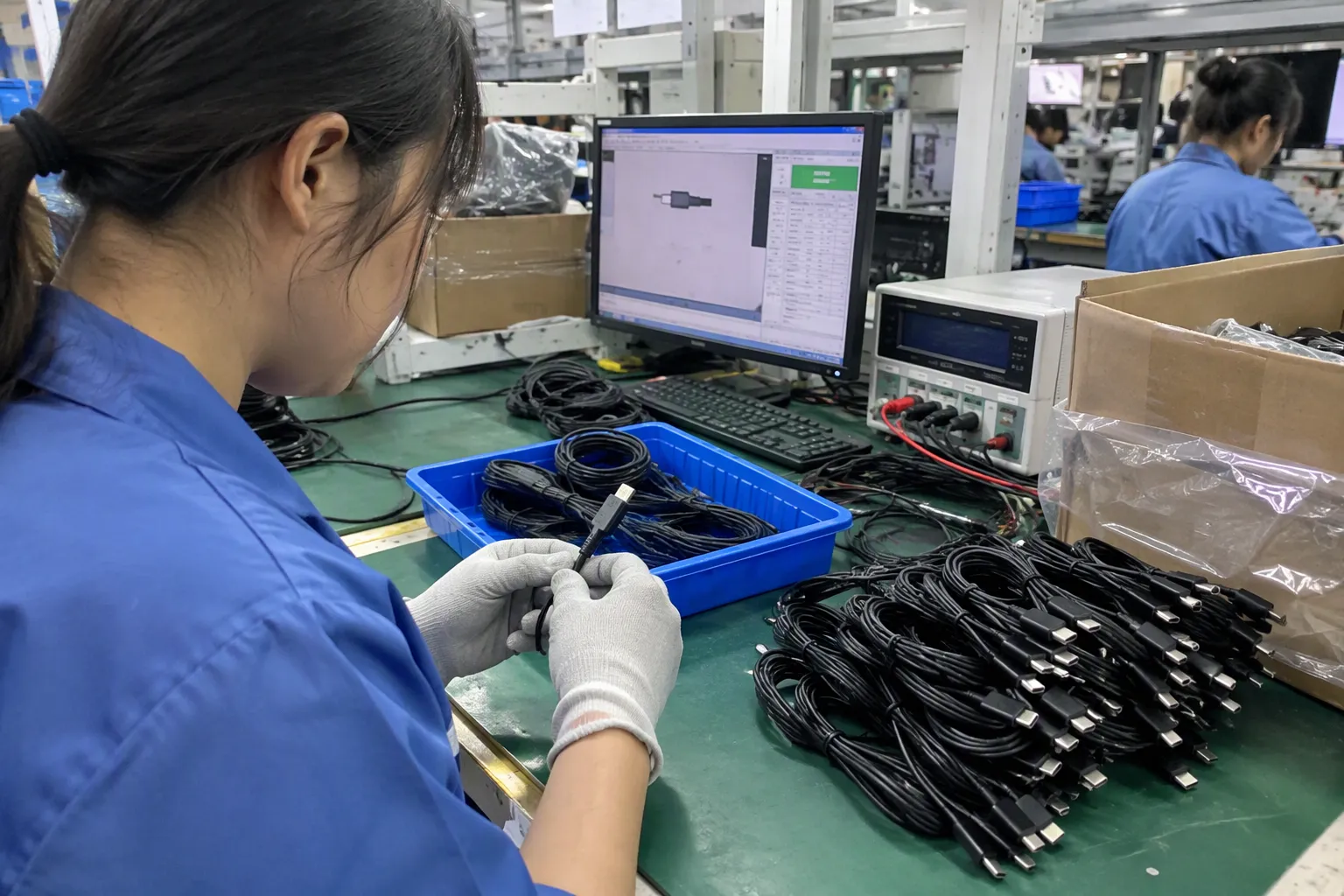
A professional USB cable supplier should control the transition from sample to production. The main purchasing risk appears when the approved sample looks good but the delivered batch uses a different material, construction, component, package, or production method.[7]
Lock the Product Specification Before Ordering
- Product code and revision number.
- Connector type on each end.
- Cable length and tolerance.
- Outer jacket material and color.
- Connector appearance.
- Markings and logo position.
- Charging and data claims.
- Packaging version.
- Applicable documents.
- Sample reference.
- Inspection requirements.
I also ask whether any part of the product is sourced from a different supplier. A supplier does not need to disclose every commercial relationship, but the buyer should understand which characteristics are controlled and how substitutions are approved.
Use Quality Gates
- Pre-production review: Confirm the specification, artwork, materials, and production schedule.
- First-piece check: Review an early production sample before the whole order continues.
- In-process inspection: Check dimensions, assembly, appearance, and identified performance points.
- Final inspection: Inspect finished goods, packaging, carton quantity, labels, and agreed functional tests.
- Shipment release: Confirm that the inspection result and documents are complete.
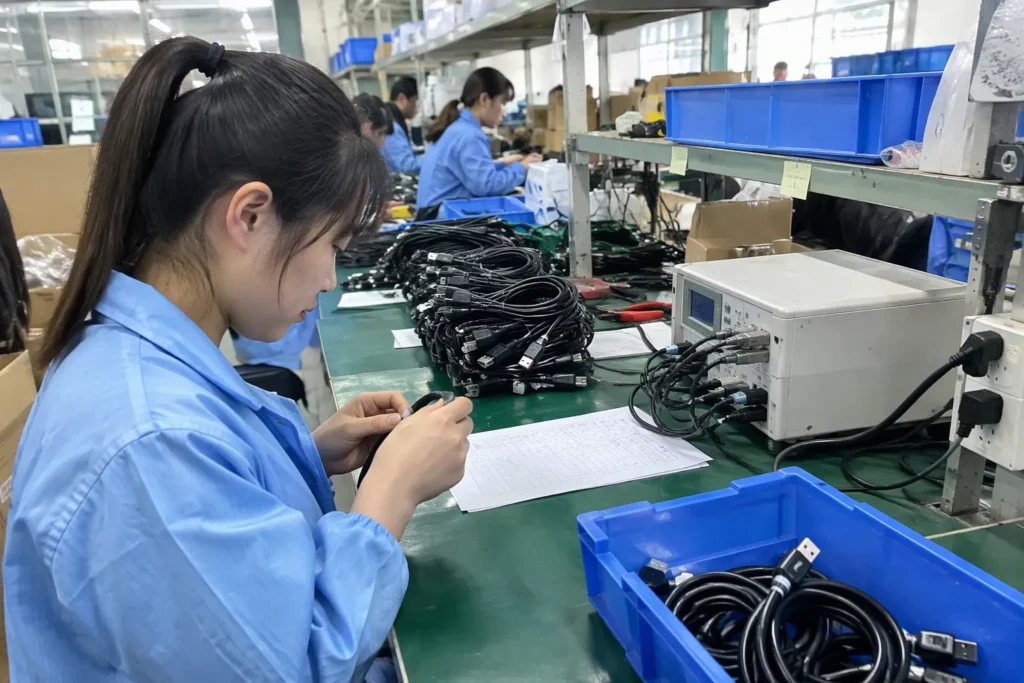
The exact testing method should depend on the cable design and intended application. A visual inspection alone cannot prove every electrical or data claim.[6] A qualified testing organization may be appropriate when the risk or customer requirement justifies it.
Batch Consistency Matters to Retail Buyers
Keep Evidence for Complaints
How Should European and U.S. Buyers Select a Long-Term Supplier?
European and U.S. buyers should select a supplier that can support their complete sales process, from product definition to replenishment. I look for stable communication, clear documentation, realistic lead times, transparent sourcing, and responsibility after shipment. The supplier should understand that retail and e-commerce buyers need predictable operations, not only a one-time transaction.
Match the Supplier to the Sales Channel
| Buyer type | Common priorities |
|---|---|
| Retail chain | Packaging consistency, barcode control, delivery planning, documentation, and replenishment |
| E-commerce seller | Product accuracy, images, customer complaint reduction, small-batch flexibility, and fast restocking |
| Wholesaler | Competitive landed cost, mixed SKUs, stable supply, and carton efficiency |
| Consumer-electronics brand | Custom design, confidentiality, quality records, compliance review, and change control |
| Grocery or general merchandise importer | Simple assortment, strong packaging, reliable MOQ, and clear shipment documents |
Review Export and Communication Capability
Our Shenzhen team works mainly with European and U.S. customers, so I understand that communication often involves time-zone differences, different product terminology, and several internal decision-makers. I try to confirm important matters in writing rather than relying on informal messages.
Plan Replenishment Before the First Shipment
- Can the supplier reserve or plan materials?
- What is the standard replenishment lead time?
- Can the buyer mix colors or lengths?
- Will the supplier retain the approved packaging artwork?
- Is the original sample still available for comparison?
- What happens if a component becomes unavailable?
- Can the supplier support seasonal demand?
- What is the minimum order for repeat production?
Evaluate Responsibility, Not Just Responsiveness
- Who owns the product specification?
- Who checks production quality?
- Who approves substitutions?
- Who communicates delays?
- Who investigates customer complaints?
- Who authorizes replacement or credit?
- Who maintains the replenishment record?
What USB Cable Supplier Checklist Should I Use Before Ordering?
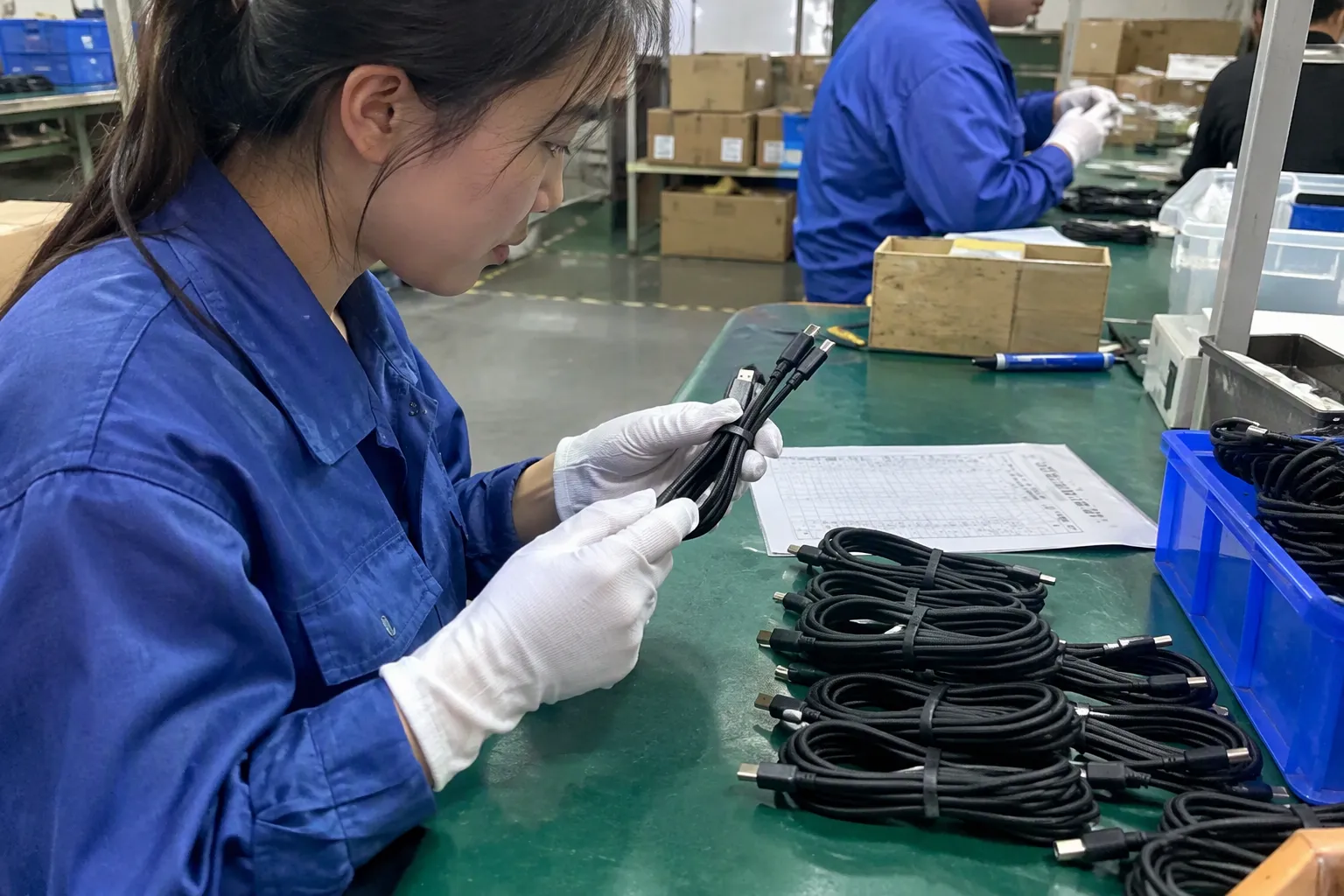
I should use a written checklist before approving a USB cable supplier. The checklist should cover product fit, documents, samples, quality controls, commercial terms, packaging, delivery, and after-sales support. It should help me identify missing information before money and inventory become committed.
Product and Technical Checklist
- [ ] Connector combination is confirmed.
- [ ] Intended devices and chargers are identified.
- [ ] Charging function is defined.
- [ ] Data function is defined or excluded.
- [ ] Length, color, material, and appearance are approved.
- [ ] Performance claims have supporting information.
- [ ] The supplier has identified any compatibility limitations.
- [ ] Sample testing uses suitable equipment.
- [ ] The approved sample has a reference number or record.
Compliance and Documentation Checklist
- [ ] The supplier has provided documents relevant to the exact SKU.
- [ ] Certificate scope and model details have been reviewed.
- [ ] Test reports identify the product and issuing organization.
- [ ] Packaging claims match the technical evidence.
- [ ] The importer understands its market responsibilities.
- [ ] A qualified professional reviews application-specific requirements where necessary.
- [ ] The supplier will inform the buyer about relevant product changes.
Commercial and Operations Checklist
- [ ] MOQ is confirmed for standard and custom versions.
- [ ] Sample cost and sample lead time are confirmed.
- [ ] Mass-production lead time is written.
- [ ] Peak-season capacity has been discussed.
- [ ] Packaging cost and artwork requirements are clear.
- [ ] Carton size and quantity are available.
- [ ] Inspection responsibilities are defined.
- [ ] Payment and shipping terms are documented.
- [ ] Replenishment terms are discussed.
- [ ] Defect, shortage, and replacement procedures are written.
Supplier Decision Matrix
| Evaluation factor | Suggested question | Score |
|---|---|---|
| Technical matching | Did the supplier identify the correct application? | 1–5 |
| Sample quality | Does the sample meet the agreed requirement? | 1–5 |
| Documentation | Are relevant documents available for verification? | 1–5 |
| Production control | Is the batch-control process clear? | 1–5 |
| Lead time | Can the supplier meet the required schedule? | 1–5 |
| MOQ flexibility | Does the MOQ fit the sales plan? | 1–5 |
| Packaging support | Can the supplier meet retail requirements? | 1–5 |
| Communication | Are answers accurate and timely? | 1–5 |
| After-sales | Are claim and replenishment terms clear? | 1–5 |
| Price | Is the total cost competitive at equal specifications? | 1–5 |
I use this matrix to support a decision, not to create a false sense of precision. A supplier with a slightly lower score may still be suitable if the weak area is not important for the application. However, I do not ignore a serious weakness in technical matching, documentation, or responsibility.
A Practical Approval Sequence
- I collect the buyer’s product brief.
- I ask the supplier for a scenario-based recommendation.
- I compare specifications and documents.
- I test or review samples.
- I confirm packaging and labeling.
- I agree on MOQ, lead time, inspection, and after-sales terms.
- I approve a written specification.
- I monitor production and inspect before shipment.
- I record the shipment for future replenishment.
Frequently Asked Questions
Is a USB cable manufacturer always better than a trading supplier?
Not automatically. A manufacturer may provide direct production control, while a capable trading supplier may provide product matching, factory coordination, export experience, and broader sourcing support. I evaluate the supplier’s transparency, technical process, documents, samples, quality controls, and responsibility instead of relying on its business label.
How do I know whether a USB cable supports fast charging?
I should confirm the charger, device, connector combination, required power, current, and relevant charging protocol. I should request technical evidence for the exact cable model and test the complete charging setup when possible. “Fast charging” by itself is not a sufficiently precise product specification.
What documents should I request from a USB cable supplier?
I can request the product specification, applicable test reports or certificates, material information where relevant, packaging details, inspection records, and commercial documents. I should verify the model, scope, date, issuing organization, and destination-market relevance. A qualified compliance professional should review application-specific requirements.
What is a reasonable MOQ for USB cables?
There is no universal reasonable MOQ. Standard products usually have different MOQ conditions from custom colors, logos, lengths, and retail packaging. I should compare MOQ with expected sales, cash flow, storage, and replenishment needs. I should also ask whether the supplier can support a smaller trial order.
How can I reduce USB cable returns?
I can reduce returns by matching the cable to the intended device and charger, using accurate product descriptions, avoiding unsupported performance claims, testing representative samples, and maintaining batch records. I should also give customers clear information about charging and data limitations rather than suggesting universal compatibility.
Conclusion
A professional USB cable manufacturer and supplier in China should help me control more than purchase price. I need accurate product matching, verifiable documents, representative samples, consistent production, suitable packaging, realistic delivery planning, and clear after-sales responsibility. I should evaluate the supplier through a written checklist and an approved specification before I place a larger order. If I am sourcing USB cables for a European or U.S. retail, wholesale, e-commerce, or brand business, I can contact our Shenzhen team to discuss the application, MOQ, customization, delivery plan, and supplier verification requirements.
Sources
- Test Procedure for External Power Supplies", USB power-delivery documentation describes charging behavior as dependent on coordinated capabilities of the power source, receiving device, cable, and applicable protocol, supporting a system-level approach to cable selection
- USB Charger (USB Power Delivery)", Technical descriptions of USB cabling distinguish power conductors from data signaling conductors, and some cable designs omit or do not support the latter; consequently, charging capability does not by itself establish data-transfer capability
- USB Charger (USB Power Delivery)", USB technical specifications define protocol-specific signaling and power-negotiation behavior, so a cable's suitability can depend on whether its construction and identification features support the protocol used by the connected equipment
- Universal Serial Bus Type-C Cable and Connector ...", USB Type-C and USB Power Delivery documentation specifies electronically marked cable assemblies for communicating certain cable characteristics and supporting defined higher-power or performance conditions
- Temperature dependence of USB charging-cable ...", Studies and USB engineering specifications identify cable length as a factor that can increase resistance and signal attenuation and thereby constrain performance in particular power or data configurations
- USB Cable Inspection: Voltage Drop, Current Load & Bend ...", Quality-assurance literature and USB compliance procedures distinguish visual inspection from electrical and functional testing, indicating that appearance checks cannot establish all claimed power or data characteristics
- ISO 9001:2015 - Quality management systems", Quality-management guidance treats documented specifications, controlled changes, and production verification as mechanisms for maintaining conformity between an approved design or sample and delivered production
- Supply Chain Management | NIST", Research on the economics of quality distinguishes purchase price from prevention and failure costs, supporting evaluation of supplier choices through total cost rather than unit price alone