A Lightning-Compatible Charging Cable Manufacturer can look attractive when a buyer needs a low price, quick quotation, and modern retail packaging. However, unclear compatibility wording can create complaints, returns, and marketplace problems. I have seen buyers focus first on the unit price, while the safer starting point is verifying what the cable supports, which documents apply, and how the supplier manages commercial risk.
The best Lightning-compatible charging cable manufacturer is not simply the supplier offering the lowest quotation. I recommend choosing a supplier that defines compatibility accurately, provides documentation for the exact product and market, controls sample-to-batch consistency, and offers clear support for complaints, replenishment, packaging changes, and returns. Buyers should verify every claim before placing a commercial order.
Quick Answer
- Clarify the word “compatible” before comparing price or performance.
- Ask for the exact supported device range, cable model, connector details, and intended sales wording.
- Check whether test reports and certifications apply to the exact product, packaging, market, and sales channel.
- Compare MOQ, lead time, quality-control records, replacement policy, and complaint response.
- Request samples and review the supplier’s documentation before approving a retail order.
- Treat supplier selection as a way to reduce returns, delisting risk, and customer complaints.
When I handle inquiries from European and North American buyers, the same issue appears in different forms. One buyer asks whether a cable is “official.” Another asks whether it works with every iPhone. A third asks for a certificate without identifying the sales market. These questions show why supplier verification must come before a simple price comparison.
What Does “Lightning-Compatible” Actually Mean?
The phrase “Lightning-compatible” can describe a cable designed to connect with certain devices that use a Lightning connector. It does not automatically mean that the cable is an Apple original product, Apple-authorized, or suitable for every device or function.[1] I recommend that buyers request precise compatibility wording before they approve listings or packaging.
Why the wording matters
The word “compatible” sounds simple, but it can create different expectations among a factory, importer, retailer, and end customer. A supplier may use it to describe the physical connector. A retailer may assume it confirms charging performance, data transfer, broad device support, and reliable long-term use. The end customer may interpret it as an official product relationship.
- Which device models has the supplier identified as supported?
- Does the cable support charging only, or charging and data transfer?
- Does the supplier make any claim about accessory recognition?
- Does the product require a particular internal component or design?
- Does the supplier restrict the wording used on packaging and online listings?
- Has the stated compatibility been tested by the supplier, an independent laboratory, or both?
Compatibility is not the same as authorization
A buyer should avoid using “Apple original,” “Apple-authorized,” or similar wording unless the business has independently verified the legal and commercial basis for that claim. A cable that physically connects to a Lightning port is not automatically an original Apple accessory.
The Made for iPhone and related accessory programs are separate matters from a general supplier statement.[2] Buyers can consult Apple’s official accessory information and request evidence that is relevant to the specific product, supplier, and sales arrangement. I do not treat a logo printed on a quotation as sufficient evidence.
The buyer also needs to consider market language. A product description that seems acceptable in one sales channel may create a problem in another. Marketplaces can review product claims, brand references, and customer complaints.[3] Retail chains may require an approved compliance file before accepting the item.
Build a compatibility statement
How Should I Verify a Lightning-Compatible Charging Cable Manufacturer?
I verify a Lightning-compatible charging cable manufacturer through a structured review of product identity, documentation, samples, manufacturing controls, and commercial support. I do not rely on a company profile, certification logo, or attractive catalog alone. The evidence should relate to the exact model that the buyer intends to import and sell.
Start with the exact product identity
A buyer should first establish which product is being discussed. The supplier should provide a model number or internal product code. The quotation should identify the cable length, connector arrangement, outer material, color, packaging, and intended functions.
A general factory catalog is not enough because one supplier may show several visually similar cables with different internal constructions or target markets. I have found that a clear model number reduces confusion during sampling, production, and reordering.
| Item to confirm | Why it matters |
|---|---|
| Supplier model number | Links the quotation, sample, and production order |
| Cable length and tolerance | Supports accurate packaging and listing information |
| Connector arrangement | Prevents confusion between USB-A, USB-C, and other versions |
| Charging or data claim | Sets the correct customer expectation |
| Material and finish | Helps compare samples with production |
| Packaging version | Connects compliance information to the retail unit |
| Target market | Determines which documents and labeling may apply |
Review documents as evidence
I treat certifications, declarations, and test reports as evidence to examine, not automatic guarantees of quality. A document should identify the relevant product, model, applicant or manufacturer, test standard, issue date, and laboratory or issuing organization where applicable.
- Does the document name the same legal entity as the seller?
- Does the model number match the sample and purchase order?
- Does the report cover the complete product or only a component?
- Is the report current enough for the intended order?
- Does the document apply to the destination market?
- Does the packaging carry claims that the document does not support?
- Can the supplier explain any differences between the report and the final product?
A CE marking, for example, should not be treated as a universal quality certificate.[4] The European Commission explains that CE marking relates to applicable EU product requirements and manufacturer responsibilities[5]; it is not a general approval mark for every characteristic. Buyers should consult official EU guidance and identify the directives or regulations relevant to the product and use case.
For materials and substances, buyers may need additional evidence depending on the product, packaging, market, and customer requirements.[6] I recommend involving a qualified compliance professional when the application or destination rules are unclear. My role in supplier communication is to organize the evidence and identify questions, not to replace legal or laboratory evaluation.
Use samples for commercial verification
- Connector fit and visible finishing.
- Strain relief appearance.
- Cable flexibility and surface consistency.
- Printing, logos, and model identification.
- Packaging accuracy.
- Included accessories or instructions.
- Charging and data behavior under an agreed test method.
- Any warning or limitation that should appear in the listing.
For technical testing, I recommend that buyers use a qualified laboratory or an experienced internal quality team. The test plan should reflect the actual sales claim. A buyer who sells a cable as a data cable should not test only basic charging. A buyer who sells a retail multipack should inspect the pack as well as the individual cable.
Look for consistency in communication
Supplier communication provides useful evidence. I pay attention to whether the sales contact, factory contact, quotation, sample label, and compliance file use the same model identity. A supplier does not need to answer every question instantly, but the supplier should be willing to clarify uncertainty.
A response such as “all cables are the same” is not enough for a commercial order. Different lengths, connector types, chip arrangements, packaging versions, or production lines can change the evidence required. I prefer a supplier that records the agreed details and confirms them again before production.
Which Documents and Claims Should Buyers Check?
Buyers should check documents against the exact cable model, production arrangement, target market, and packaging. I recommend reviewing applicable safety, electromagnetic, environmental, chemical, and labeling requirements rather than collecting certificates as decoration. The supplier should explain what each document covers and what it does not cover.
Separate product evidence from supplier evidence
| Evidence group | Examples | Buyer’s question |
|---|---|---|
| Supplier evidence | Business registration, factory information, management certificates | Is this a credible and accountable supplier? |
| Product evidence | Test reports, declarations, material information | Does this exact model meet relevant requirements? |
| Order evidence | Inspection report, approved sample, batch records | Did the delivered goods match the approved product? |
Consider the target market
European and North American buyers may have different customer requirements, labeling expectations, and retailer approval processes.[7] The applicable obligations can also depend on whether the cable is sold alone, included with a charger, bundled with another product, or imported under a private label.
I ask the supplier to identify the intended market in the quotation. I also ask whether the supplier has prepared documents for that market before. That answer is only a starting point, not proof. The importer or brand owner may still carry responsibilities that cannot be transferred through a supplier email.[8]
- European Commission guidance on CE marking
- European Commission information on product safety
- U.S. Consumer Product Safety Commission
- Federal Trade Commission guidance on advertising and product claims
Check brand and compatibility language
Brand references deserve careful review. Product titles, packaging, instruction sheets, online listings, and photographs should use language that the seller can support. The seller should not imply an official relationship through a logo, “original” wording, or an unclear badge.
- Does the title identify the product without implying authorization?
- Does the description define the supported use?
- Does the packaging avoid universal performance promises?
- Does the supplier permit the buyer to use the proposed wording?
- Can the supplier support any performance statement with relevant evidence?
I also recommend keeping a record of approved artwork. Packaging changes can occur during replenishment, especially when a supplier updates a design or changes a production source. The buyer should require advance notice and approval for changes that affect claims, model identity, materials, or compliance information.
Do not confuse a certificate with a quality plan
- Incoming connector and cable materials.
- Assembly and soldering processes.
- Connector appearance and fit.
- Electrical or functional checks.
- Label and packaging accuracy.
- Final quantity and carton condition.
- Nonconforming product and rework.
How Can I Compare Suppliers Beyond Unit Price?
I compare suppliers by calculating commercial risk as well as purchase price. A lower unit cost can become expensive when the product generates returns, negative reviews, emergency replacements, or marketplace questions. I therefore compare documentation quality, response speed, production consistency, MOQ, lead time, and after-sales support together.
Use a weighted evaluation
A buyer can score suppliers using a simple evaluation table. The weights should reflect the sales channel. A chain retailer may give more weight to documentation and packaging control. An e-commerce seller may focus more on complaint rates, replenishment speed, and listing accuracy.
| Evaluation area | Suggested question | Risk if weak |
|---|---|---|
| Compatibility clarity | Can the supplier define supported use without absolute claims? | Misleading listings and returns |
| Product evidence | Does documentation match the exact model? | Compliance delays or buyer rejection |
| Sample quality | Does the sample meet the agreed description? | Poor product-market fit |
| Batch control | Can the supplier explain inspection and records? | Sample-to-batch variation |
| MOQ | Does the minimum order fit the sales forecast? | Excess inventory |
| Lead time | Can the supplier give a realistic production schedule? | Stockouts and missed launches |
| Complaint handling | Is there a written replacement or credit process? | Slow dispute resolution |
| Packaging control | Can artwork and labeling changes be controlled? | Retail approval problems |
| Replenishment | Can the supplier maintain the approved model? | Inconsistent repeat orders |
Calculate total landed risk
- Product cost.
- Packaging cost.
- Inspection cost.
- Freight and customs cost.
- Testing or document review.
- Expected replacement cost.
- Customer service time.
- Marketplace or retailer penalties.
- Inventory held because of uncertain claims.
- Cost of changing a listing or packaging design.
A supplier with a slightly higher price may create a lower total cost if the supplier communicates clearly and maintains consistent production. I cannot promise that a higher quotation means better quality. I can say that price alone does not provide enough information for a responsible decision.
Ask commercial questions early
- What is the MOQ for standard packaging and private label packaging?
- What changes the lead time?
- How long does a repeat order usually require after artwork approval?
- What happens if the approved model changes?
- How does the supplier handle a batch that fails agreed inspection?
- Can the supplier provide replacement units or a credit?
- Who owns the final artwork and technical records?
- How quickly can the supplier send revised documents?
- Can the supplier maintain the same model for future replenishment?
Consider retail and e-commerce exposure
A retail buyer may face a formal approval process, while an online seller may face sudden customer feedback. Both channels need accurate claims. A cable can be visually attractive and competitively priced, yet still create a problem if customers believe it is an official accessory or expect support for every device.
I recommend keeping the product page aligned with the approved wording. I also recommend collecting complaint details by model, batch, and device type. Complaints can show whether the problem is a defective product, an unclear listing, an unsuitable device expectation, or a packaging error.
For related procurement guidance, I also suggest reading my USB cable supplier evaluation checklist and how to compare private-label charger suppliers. The same principles apply: define the product, verify evidence, and control the commercial handover.
What Should a Buyer Ask Before Placing an Order?
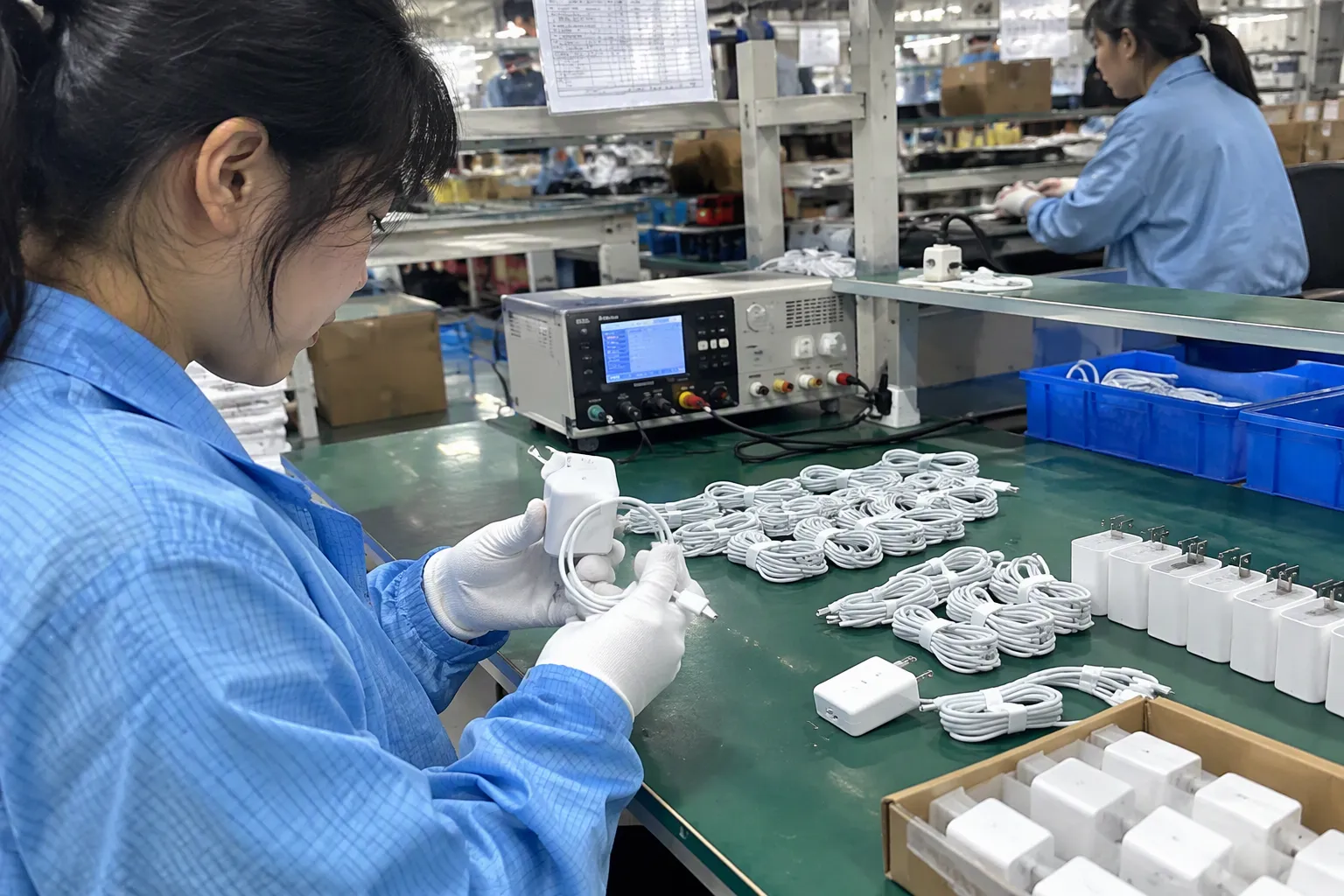
Before placing an order, I recommend asking for a written supplier checklist that covers compatibility, evidence, production, logistics, packaging, and after-sales responsibility. A buyer should not depend on informal chat messages when the product will enter a chain store, wholesale network, or public marketplace.
Product and compatibility questions
- What exact connector and cable models are available?
- Which functions does each model support?
- Which devices or device categories has the supplier identified?
- What compatibility wording may appear on the package?
- What claims does the supplier refuse to make?
- Are there different internal versions under the same appearance?
- How will the model be identified on the quotation and carton?
Quality and production questions
- Approved product sample.
- Approved packaging sample or artwork.
- Model number and version.
- Agreed cable length and appearance.
- Function requirements.
- Applicable document list.
- Carton packing information.
- Inspection method.
- Defect handling process.
- Change-notification requirement.
Order and after-sales questions

| Question | Why I ask it |
|---|---|
| What is the trial-order MOQ? | Limits initial inventory exposure |
| What is the repeat-order MOQ? | Supports future replenishment planning |
| When does lead time start? | Avoids confusion about artwork or deposit timing |
| What causes a delay? | Helps the buyer build a realistic schedule |
| What is the inspection window? | Defines when issues must be reported |
| What remedy is available? | Reduces uncertainty after delivery |
| How are replacement units shipped? | Clarifies freight and timing |
| What records are retained? | Supports future complaint investigation |
The agreement should define the remedy in practical terms. “We will solve any problem” is friendly but not precise. The buyer should know whether the supplier offers replacement, credit, rework, refund, or another remedy, and which evidence is required.
A practical pre-order checklist
- [ ] The supplier’s legal identity is clear.
- [ ] The exact model number appears on the quotation.
- [ ] Compatibility wording is limited and supportable.
- [ ] The sample matches the proposed product description.
- [ ] The packaging does not imply unauthorized brand affiliation.
- [ ] Applicable documents have been reviewed for relevance.
- [ ] MOQ and lead time fit the buyer’s plan.
- [ ] Inspection responsibility is agreed.
- [ ] Complaint and replacement terms are written.
- [ ] Future product or packaging changes require notice.
- [ ] The buyer has confirmed destination-market responsibilities.
- [ ] A qualified professional will review uncertain technical or regulatory issues.
How Can a Shenzhen Trading Company Support Supplier Selection?

A Shenzhen trading company can help overseas buyers organize supplier communication, product comparison, quotation requests, samples, documentation, and export coordination. I see this support as a practical bridge between a buyer’s commercial requirements and a supplier’s production information. I do not present trading support as a substitute for independent compliance or laboratory review.
Turning a broad request into a clear inquiry
Coordinating samples and documents
A buyer may receive a sample from one contact and a document from another. I try to connect the sample, model number, quotation, and document into one record. If the information does not match, I ask the supplier to explain the difference before the buyer proceeds.
My experience is strongest in communication, document collection, market suitability, and export purchasing decisions. I do not claim to perform laboratory certification or engineering validation. When a buyer needs technical confirmation, I recommend an appropriate qualified testing organization or compliance adviser.
Our company has 15 years of export experience in 3C products, including USB cables, chargers, GaN chargers, TWS earphones, and smartwatches. We mainly serve buyers in Europe and North America. That background helps me understand recurring concerns around MOQ, delivery, private labeling, documentation, and after-sales support. It does not remove the buyer’s responsibility to verify the final product.
Supporting customization without losing control
Customization can include color, cable length, logo, packaging, insert cards, barcode, and carton design. Each change can affect the product record. I recommend that buyers use a version number for artwork and keep the approved file with the purchase order.
- Buyer sends the brand and packaging requirements.
- Supplier confirms feasibility and MOQ.
- Supplier provides a quotation tied to the requested model.
- Buyer reviews artwork and product claims.
- Supplier sends a pre-production sample when necessary.
- Buyer approves the sample and documents.
- Supplier confirms any change before production.
- Buyer or inspection party checks the finished order.
Reducing communication gaps
I have found that many purchasing problems begin with an assumption rather than a deliberate false statement. A buyer assumes “compatible” means universal. A supplier assumes the buyer understands a limitation. A packaging designer copies a phrase from an old product. Written confirmation can prevent these gaps.
Frequently Asked Questions
Is a Lightning-compatible cable an Apple original cable?
No. “Lightning-compatible” generally describes intended connector compatibility and should not be presented as Apple original or Apple-authorized without specific, verifiable evidence. I recommend using neutral product wording and checking any brand or authorization claim with the relevant rights holder and qualified advisers.
What documents should I request from a cable supplier?
I would request product-specific test reports, declarations, material information, and any market documents relevant to the intended sale. The buyer should check the model number, legal entity, product scope, date, and target market. A certification logo alone does not prove that the exact delivered cable meets every requirement.
Can I sell the same compatible cable in Europe and North America?
Possibly, but the buyer should not assume that one document or label covers both markets. Requirements can differ according to product design, packaging, claims, importer role, and sales channel. I recommend reviewing the destination-market obligations and obtaining professional advice when the product or claim is uncertain.
Should I order samples before checking compliance documents?
I recommend doing both in parallel. A sample shows the physical product, while documents show what the supplier claims to have assessed. The buyer should compare the sample, model number, packaging, and documents before approving a commercial order.
What is more important: MOQ, price, or lead time?
The answer depends on the buyer’s business model, but I would not evaluate these items separately from quality and documentation. A low MOQ may help a trial order, while an unrealistic lead time can cause stockouts. A low unit price can also become expensive if the product creates returns or delisting risk.
Conclusion
Choosing a Lightning-Compatible Charging Cable Manufacturer requires more than comparing quotations. I recommend clarifying the meaning of compatibility, identifying the exact model, checking documents against the product and market, reviewing samples, and agreeing on inspection and after-sales procedures. Buyers should also control packaging language and future specification changes. Our Shenzhen trading company supports European and North American 3C buyers with supplier communication, quotations, samples, customization, and export coordination. Contact me with your target market, quantity, packaging needs, and required documents so I can help create a practical supplier shortlist.
Sources
- Accessory Search - MFi Licensee App", Apple's documentation on the Made for iPhone/iPad/iPod program describes licensing requirements for accessories designed to connect to Apple products, supporting the distinction between program authorization and a general compatibility statement
- About Made for iPhone, iPad, and iPod touch accessories", Apple's description of the Made for iPhone program identifies it as a formal accessory-licensing framework, which supports treating that status as distinct from an unverified supplier claim of compatibility
- The role of online marketplaces in protecting and ...", Government and regulatory guidance on online marketplaces describes duties or procedures concerning unsafe products, misleading commercial information, and intellectual-property complaints, supporting the article's general account of marketplace scrutiny
- CE marking – obtaining the certificate, EU requirements", European Commission guidance states that CE marking signifies a manufacturer's declaration that the product complies with applicable European Union requirements; it is not a general quality seal or approval of every product characteristic
- CE marking - Internal Market, Industry, Entrepreneurship and ...", European Commission guidance explains that the manufacturer is responsible for assessing conformity with applicable EU legislation and affixing the CE marking where required, supporting the stated relationship between the mark and manufacturer responsibilities
- Learn about Polychlorinated Biphenyls", European Union materials on RoHS and REACH describe restrictions and information duties concerning substances in electrical and electronic products and articles, supporting the need to consider product- and market-specific material evidence
- EU - Labeling/Marking Requirements", EU and United States government guidance documents describe separate product-safety, conformity, labeling, and importer obligations, supporting the contextual claim that requirements and approval expectations may differ between the two markets
- General Use Products: Certification and Testing", Official EU and US compliance guidance assigns defined product-safety and conformity responsibilities to manufacturers, importers, or other responsible businesses, supporting the proposition that a supplier's email does not automatically transfer all obligations