An online bulk cable company can offer attractive prices, but a low quote does not solve compatibility, quality, delivery, or after-sales problems. I have seen buyers focus on unit cost first and discover later that the specification, packaging, or production consistency did not match their retail needs. A more careful evaluation helps reduce avoidable supply risk.
Quick Answer
- Confirm the cable type, connector combination, charging or data requirements, and target devices before requesting prices.
- Compare quality controls, test documents, certification records, MOQ, lead time, packaging, and after-sales support.
- Ask whether the quoted specification applies to the exact model and whether supporting documents are available for that model.
- Request samples and a clear written specification before placing a production order.
- Give the supplier your destination market, estimated quantity, packaging needs, and delivery target so the quotation is realistic.
The best online bulk cable company is not necessarily the one with the lowest unit price. I recommend choosing the supplier that can clearly match the cable to your application, maintain consistent production, provide relevant documents, meet your delivery plan, and support your business after shipment.
When I review a cable inquiry, I do not begin with the price alone. I first try to understand what the cable must do, which devices it must support, how it will be sold, and what commercial conditions the buyer requires. The sections below explain the questions I use when evaluating an online bulk cable company.
What Should I Confirm Before Contacting an Online Bulk Cable Company?
A vague inquiry usually produces a vague quotation. Buyers may write “USB cable, 1 meter, 10,000 pieces,” but that description leaves many commercial and technical questions unanswered. If I quote too early, I may compare products that appear similar but are not suitable for the same retail application.
Before contacting an online bulk cable company, I confirm the connector type, intended devices, length, charging or data requirements, materials, packaging, target market, estimated volume, and delivery expectations. These details allow the supplier to recommend a suitable model instead of sending an unreliable price for an unclear product.
Start with the intended use
I ask where the cable will be used because the application changes the buying decision. A cable for a phone charging display in a supermarket may have different requirements from a cable bundled with a power bank or sold as a premium data accessory.
- Which devices will customers connect?
- Will the cable be used mainly for charging, data transfer, or both?
- Does the buyer need USB-A, USB-C, Lightning-compatible, Micro-USB, or another connector combination?
- What length does the retail market normally expect?
- Will customers use the cable at home, in a vehicle, in an office, or while travelling?
- Does the cable need a braided jacket, reinforced joints, a specific color, or a private label?
- Will the customer sell it in the European Union, the United Kingdom, the United States, or another market?
I also ask whether the buyer has an existing product specification. A procurement team may already define conductor construction, jacket material, connector finish, packaging dimensions, label language, and required test documents. If that specification exists, I need to work from the document rather than rely on a product photograph.
Separate appearance from performance
| Buyer requirement | Questions to clarify |
|---|---|
| Connector type | Which plug and device-end connector are required? |
| Cable length | Is the length measured from end to end or between connector housings? |
| Main function | Charging, data transfer, or both? |
| Construction | PVC, silicone, nylon braid, flat cable, round cable, or another design? |
| Reinforcement | Is strain relief needed for frequent bending? |
| Packaging | Polybag, paper box, blister, hang tag, or custom retail packaging? |
| Branding | Logo, color, label, barcode, and language requirements? |
| Market | Which country or region will receive the goods? |
| Order plan | Trial quantity, regular replenishment, or seasonal purchase? |
Prepare a useful inquiry
- Product type: For example, USB-C to USB-C or USB-A to USB-C.
- Required lengths: List each length separately if the order contains several versions.
- Function: Charging only, data use, or a defined performance requirement.
- Quantity: Include trial order quantity and expected repeat volume when possible.
- Packaging: Standard export packaging or a retail-ready custom design.
- Destination: Country, port, or delivery address where relevant.
- Target timing: Sample approval date and required shipment window.
- Documents: Any specific declarations, reports, labels, or market requirements.
- Commercial terms: Preferred Incoterm, payment expectations, and quotation currency.
How Can I Compare Cable Specifications Instead of Comparing Prices?
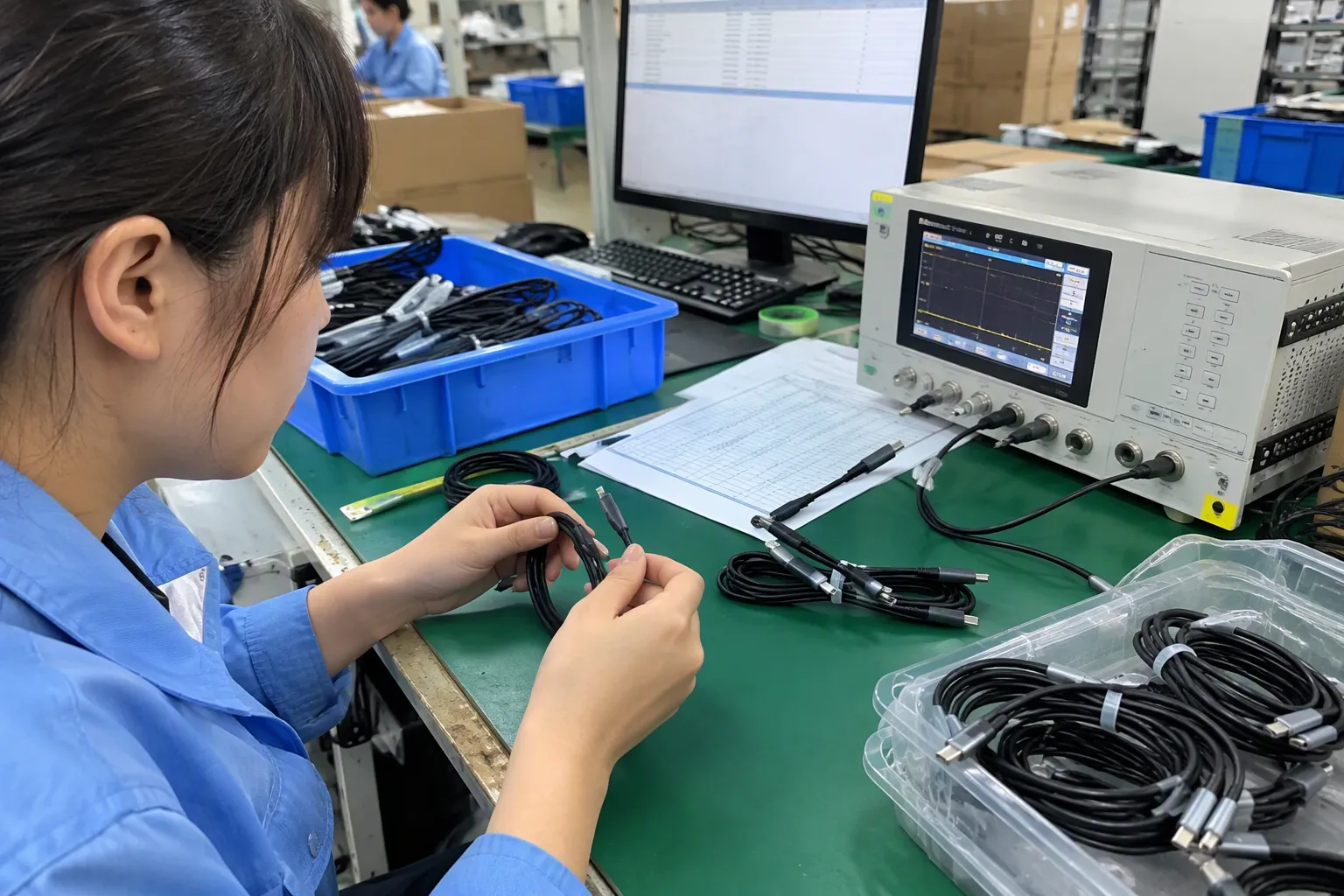
Price comparison becomes misleading when the products do not have the same specification. A cable with a lower price may have a different jacket, conductor design, connector housing, packaging method, or production tolerance. I recommend making the comparison line by line.
I compare cable specifications by creating a written matrix that covers function, construction, dimensions, packaging, documents, quantity, and commercial terms. I then check the sample against that matrix before approving production. This method makes differences visible and prevents a low price from hiding a product mismatch.
Charging and data requirements need careful wording
Many buyers use broad terms such as “fast charging cable.” That phrase may not define the exact result they expect. The actual experience can depend on the cable, charger, device, power-management system, and other parts of the charging setup.[1]
- Is the cable intended for use with a particular charger family?
- Does the buyer require data transfer, or is charging the only purpose?
- Does the customer need a particular USB connector arrangement?
- Does the retailer have a written electrical or performance specification?
- Does the cable need to support a named ecosystem or device group?
- Does the buyer require evidence from a recognized testing or certification program?
The USB Implementers Forum certification information is a useful reference for buyers checking USB-related compliance programs and terminology. I still advise buyers to verify whether any document applies to the exact model under discussion. A general company statement is not the same as model-specific evidence.
Compare construction details
- Jacket material: PVC and braided constructions can offer different appearances and handling characteristics.[2]
- Strain relief: The connector transition should suit the expected bending and handling conditions.
- Connector housing: The shape must fit the intended use and packaging.
- Cable flexibility: A very soft cable and a more rigid cable may suit different retail positions.
- Color consistency: This matters when a buyer sells several products under one brand.
- Labeling: The cable and package may need model identification, barcode, importer details, or language information.
- Packaging protection: Retail packaging should protect the product during transport and display.
Use a comparison matrix
| Evaluation point | Supplier A | Supplier B | Supplier C |
|---|---|---|---|
| Exact connector combination | Confirmed / unclear | ||
| Intended function | |||
| Sample available | |||
| Written specification | |||
| Model-specific documents | |||
| MOQ | |||
| Sample lead time | |||
| Production lead time | |||
| Retail packaging | |||
| Customization | |||
| Quality inspection plan | |||
| After-sales process | |||
| Total delivered cost |
What Hidden Costs Can Come From the Cheapest Cable Quote?
A cheap cable quote can be commercially useful when the specification is genuinely equivalent. The risk appears when the low price reflects a different product, less packaging, incomplete documentation, unstable materials, or an unrealistic delivery assumption. I have handled inquiries where the price looked attractive until the buyer clarified what the product actually needed to do.
The hidden cost of the cheapest cable quote can include unsuitable samples, rework, relabeling, customer complaints, returns, delayed replenishment, and lost retail space.[3] I evaluate total landed and operating cost, not only the factory price, before recommending a supplier or product.
A common price-first pattern
- The buyer sends a short description.
- Several suppliers return different prices.
- The buyer selects the lowest offer.
- The sample or production item reveals specification differences.
- The buyer must decide whether to accept the difference, revise the order, or restart sourcing.
I am deliberately not attaching a customer name, order size, saving figure, or specific failure rate to this pattern. The important lesson is not one dramatic case. The lesson is that the initial comparison was incomplete. The buyer compared numbers before confirming whether the products were equivalent.
- New artwork or packaging costs.
- Additional inspection work.
- Delayed launch dates.
- Extra warehouse handling.
- Customer service tickets.
- Retailer penalties or missed promotions.
- Slow-moving stock if the product does not meet customer expectations.
Calculate total cost more broadly
Not every buyer can calculate each item precisely. However, I still ask which costs are known and which are uncertain. A supplier with a moderately higher quote may be more economical if the supplier provides a clearer specification, better packaging control, and a more dependable replenishment process.
| Cost factor | Why I include it |
|---|---|
| Unit price | It affects gross margin but does not describe the entire offer. |
| MOQ | It affects cash flow and the risk of excess stock. |
| Freight volume | Packaging size can change transport cost. |
| Lead time | A late shipment can affect promotions and replenishment. |
| Inspection | Buyers may need independent or internal checks. |
| Defect handling | The buyer needs a clear process for claims and replacements. |
| Packaging approval | Artwork changes can create extra time and expense. |
| Documentation | Missing records can delay market or retailer approval. |
MOQ can create a hidden inventory problem
Quality instability costs more than one defective piece
A buyer may tolerate an isolated defect more easily than a pattern of inconsistent quality.[4] Inconsistent connector fit, printing, cable color, packaging, or assembly can make retail returns difficult to diagnose. A business buyer should ask how the supplier controls repeat production.
- The approved sample or “golden sample.”
- The written specification.
- Inspection points.
- Acceptable workmanship standards.
- Packaging and carton marks.
- The claim process and evidence required.
- The response time for quality problems.
How Do I Evaluate an Online Bulk Cable Company?
I evaluate an online bulk cable company through evidence and communication, not presentation alone. A polished website can introduce a supplier, but it does not prove that the supplier can maintain the exact product specification for a particular order. I want to see how the supplier responds to practical questions.
I evaluate a cable supplier across product fit, quality consistency, documents, production capacity, communication, MOQ, lead time, customization, and after-sales support. I give each area a simple score and investigate weak or unclear answers before moving to a purchase order.
Check whether the supplier understands the application
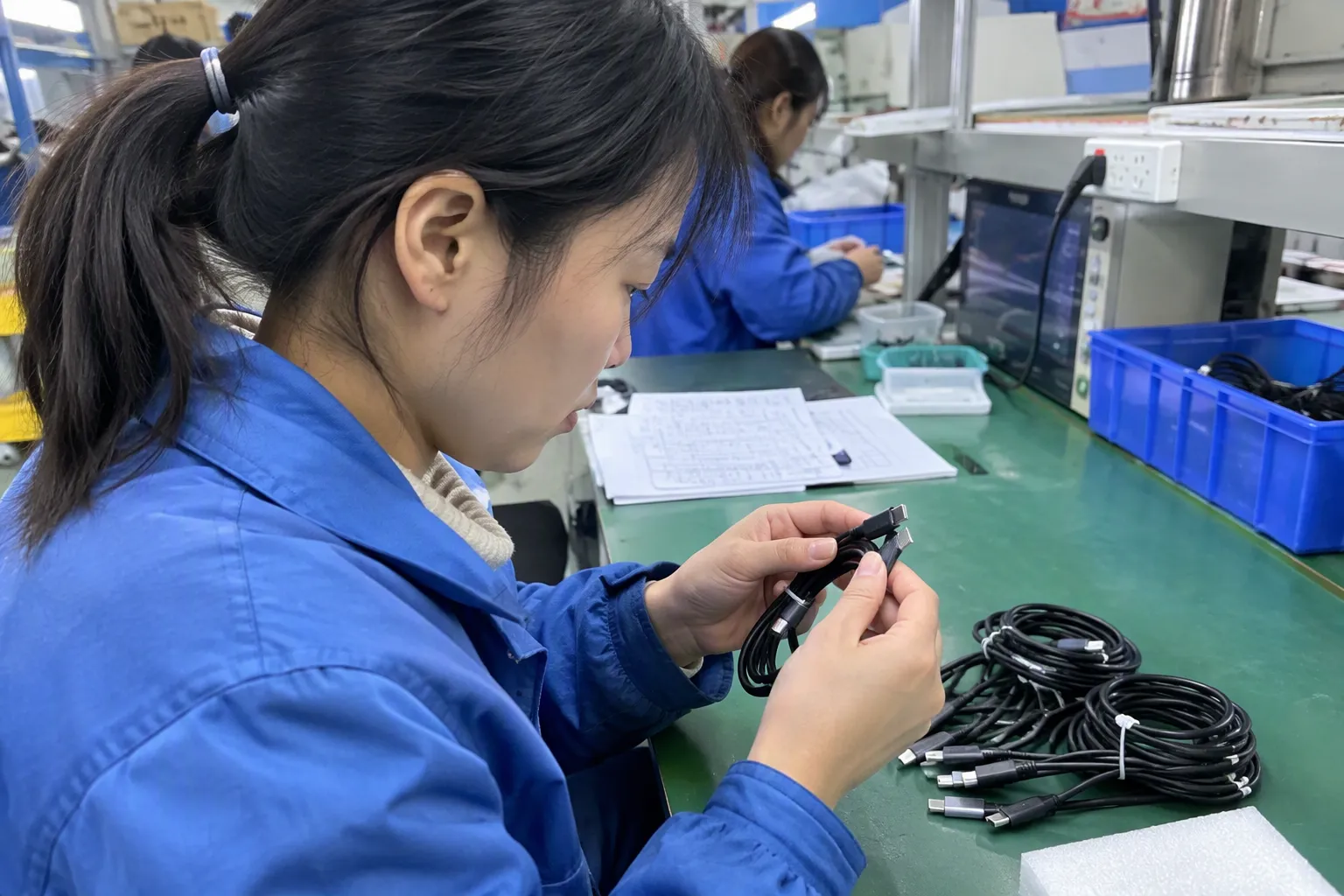
I notice the questions a supplier asks. A responsible quotation process should clarify the connector combination, intended use, target market, packaging, quantity, and delivery plan.[6] If a supplier gives a confident price without asking anything important, I treat that as a reason to request more detail.
- Is the supplier a manufacturer, trading company, or a combination of both?
- Which product categories does the supplier handle regularly?
- Who will manage quality communication?
- Who will confirm packaging artwork?
- Who will manage production updates?
- What information does the supplier need before confirming a delivery date?
There is no universal rule that one business type is always better.[5] A trading company may coordinate multiple product categories, while a factory may have stronger control over a particular production line. The buyer should evaluate the actual supply arrangement and accountability.
Review quality controls
I ask what happens before, during, and after production. The answer may include incoming material checks, assembly checks, appearance inspection, function checks, packaging inspection, or final sampling.[7] I do not assume that a supplier follows the same process for every order, so I ask how the process applies to the specific model.
- How the approved sample is identified.
- How production materials are matched to the specification.
- How defects are recorded.
- Whether pre-shipment inspection is available.
- How cartons and labels are checked.
- How the supplier handles a nonconforming batch.
Verify documents and certifications carefully
- The exact product model.
- The document holder and issuing organization.
- The test or certification scope.
- The report date and validity where applicable.
- The destination market.
- Whether the document applies to the final configuration and packaging.
- Whether the buyer, importer, or retailer has additional requirements.
For European market questions, buyers can consult official EU information about RoHS legislation. For United States regulatory questions, buyers should review relevant information from the U.S. Consumer Product Safety Commission and consult qualified compliance professionals where needed.
Use a supplier scorecard
| Category | Suggested buyer question |
|---|---|
| Product fit | Does the proposed model match the intended devices and use? |
| Quality | How does the supplier control repeat production? |
| Documents | Are relevant records available for the exact model? |
| Communication | Does the supplier answer clearly and consistently? |
| MOQ | Does the minimum quantity match the buyer’s sales plan? |
| Lead time | Is the schedule based on sample approval and materials? |
| Packaging | Can the supplier meet retail and shipping requirements? |
| Customization | Are logo, color, and artwork options clearly defined? |
| After-sales | What evidence and process apply to a quality claim? |
| Commercial fit | Does the total offer support the target margin? |
Which Cable and Packaging Options Suit Different Retail Programs?
Retailers, wholesalers, chains, and e-commerce sellers often need different cable programs. A standard product may help a buyer test demand quickly.[8] A customized product may strengthen brand identity but require more approvals, inventory, and planning. I match the product program to the buyer’s sales model.
Standard cables usually suit buyers who want a faster, simpler market test, while customized cables suit established programs that can support artwork approval, higher MOQ, and longer planning. The correct choice depends on forecast, shelf position, branding goals, and replenishment requirements.
Standard products
Customized products
Match packaging to the sales channel
I ask where the product will be sold before recommending packaging. An online seller may value compact packaging and low dimensional weight. A chain store may require a peg-ready card, barcode placement, display consistency, and retailer-specific labeling.
| Sales channel | Packaging considerations |
|---|---|
| E-commerce | Product protection, compact dimensions, clear photography, barcode, and low shipping volume |
| Independent retailer | Display visibility, hanging format, simple SKU identification |
| Retail chain | Approved artwork, carton labeling, compliance information, and consistent presentation |
| Wholesale distribution | Strong outer cartons, inner quantities, pallet information, and easy receiving |
| Promotional program | Short launch window, custom branding, and clear delivery milestones |
Plan for replenishment
A first order is only one part of the supplier decision. I ask whether the buyer expects repeat orders and whether the same materials, colors, and packaging will be available later. A buyer should record the approved model number and sample so future orders do not rely on memory or photographs.
How Should I Manage Samples, Orders, and Delivery?
A sample is valuable only when I know what I am approving. I treat the sample as a reference for product appearance, construction, packaging, and agreed function. I then connect that approval to the purchase order and inspection plan.
I manage bulk cable orders through a documented sequence: clarify requirements, review the quotation, inspect the sample, approve artwork, confirm the purchase order, monitor production, inspect before shipment when appropriate, and record the final batch information. This sequence reduces misunderstandings between inquiry and delivery.
A practical order sequence
- Requirement review: I confirm product type, use, quantity, destination, packaging, and timing.
- Quotation comparison: I check whether each supplier quoted the same specification.
- Sample request: I request a representative sample and any available documents.
- Sample evaluation: The buyer checks fit, appearance, packaging, and application suitability.
- Written approval: The approved model and changes become part of the order record.
- Artwork approval: The buyer confirms logos, labels, barcodes, and languages.
- Purchase order: The document states quantity, price, terms, packaging, and delivery conditions.
- Production update: The supplier confirms material and production status.
- Inspection: The buyer or inspection provider checks the goods when appropriate.
- Shipment and records: The buyer keeps shipping documents, inspection records, and batch information.
Treat lead time as a process, not a promise
A quoted lead time may begin after different events. I ask whether it starts after deposit, material confirmation, artwork approval, or sample approval. Custom packaging and special colors can add time. Public holidays, shipping schedules, and inspection requirements can also affect the plan.
| Milestone | Buyer confirmation |
|---|---|
| Specification | Exact model and function approved |
| Sample | Physical sample accepted or changes recorded |
| Artwork | Packaging and labels approved |
| Materials | Supplier confirms production readiness |
| Production | Estimated completion date provided |
| Inspection | Inspection date and standard agreed |
| Shipment | Documents and booking plan confirmed |
Define after-sales support before the order
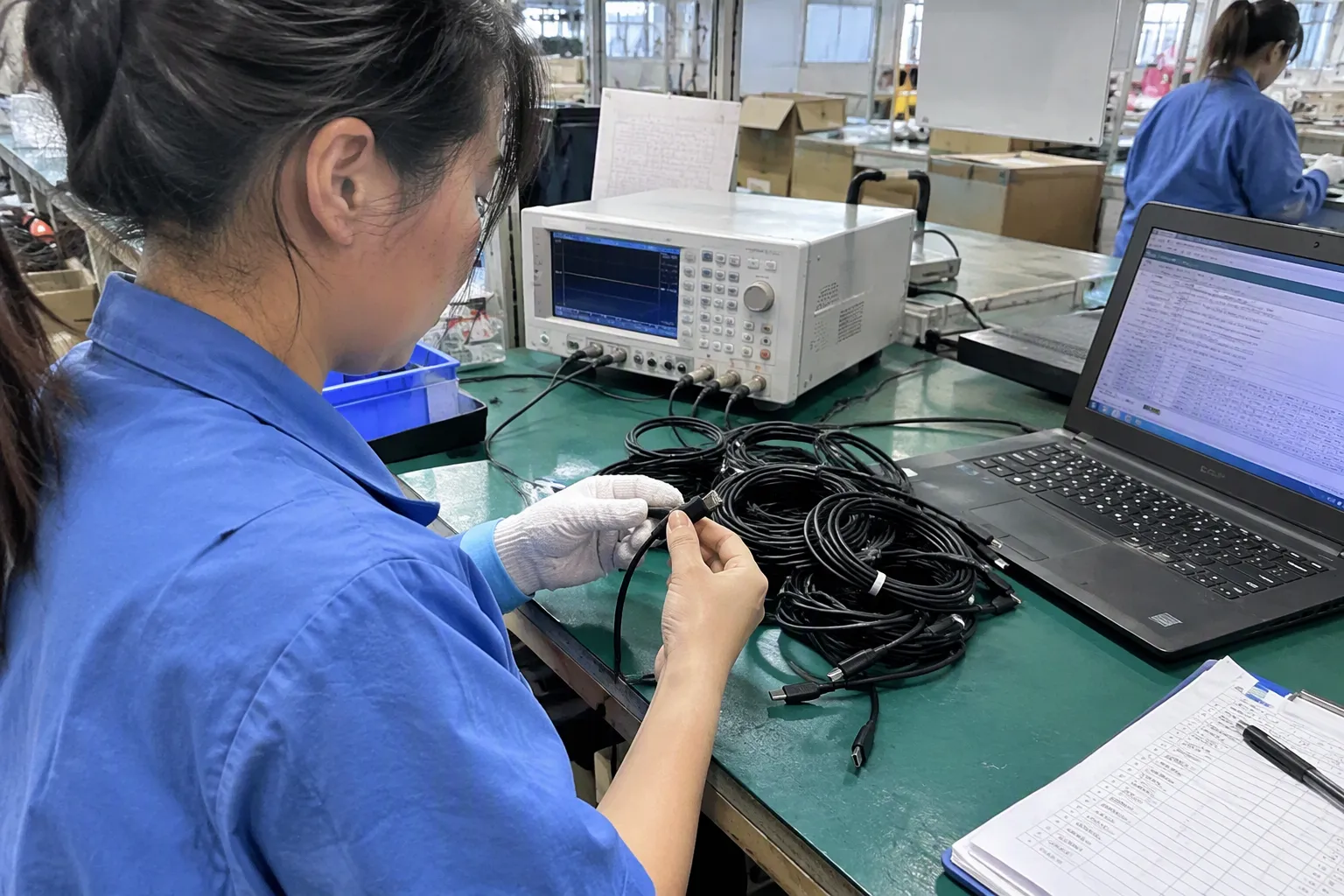
After-sales support should not begin only when a problem appears. I ask what evidence the supplier needs for a claim, how the buyer should report a problem, and what resolution options may be available under the agreed terms.
What Questions Should I Ask an Online Bulk Cable Company?
I ask an online bulk cable company for exact model information, specifications, sample availability, documents, MOQ, lead time, packaging options, inspection arrangements, and claim procedures. I use the answers to identify assumptions before they become order problems.
Product and application questions
- Which exact model matches my connector and device requirements?
- Is the model intended for charging, data, or both?
- What information defines the product specification?
- Which features are standard, and which require customization?
- Can you provide a sample from the proposed production specification?
- What limitations should I explain to my customers?
Quality and document questions
- What checks are performed during production?
- Can you provide documents for the exact model?
- Which market and configuration does each document cover?
- Can I arrange an inspection before shipment?
- How will you identify the approved sample and batch?
- What is the process if the delivered goods do not match the agreed specification?
Commercial questions
- What is the MOQ for the standard product?
- What is the MOQ for logo, color, and custom packaging?
- What is included in the quoted price?
- Which Incoterms and payment terms are available?
- When does the lead time begin?
- Can you support repeat orders with the same packaging and model?
Communication questions
- Who is my main contact after the order?
- How quickly can I expect answers to technical or packaging questions?
- How will you report production progress?
- What information do you need from me to confirm delivery timing?
- Can you provide a formal quotation and pro forma invoice?
Frequently Asked Questions
Is an online bulk cable company suitable for a retail chain?
An online bulk cable company can suit a retail chain if it can provide the required specification, packaging, documents, quantity, delivery planning, and after-sales process. I recommend a sample review and a written supplier assessment before a chain-wide rollout.
What is the best MOQ for wholesale USB cables?
The best MOQ depends on expected sales, cash flow, packaging customization, and replenishment frequency. I usually suggest that buyers compare a manageable trial quantity with the MOQ required for a lower unit cost or custom packaging.
Should I request samples before placing a cable order?
Yes. I recommend requesting samples before bulk production. The buyer should check connector fit, appearance, length, flexibility, packaging, labeling, and application suitability. If the use is technically sensitive, qualified testing should support the buyer’s decision.
Do cable certifications apply to every product from a supplier?
No. Buyers should verify the model, configuration, market, document scope, and available records. A certification or test document for one model does not automatically prove that every other cable or production batch has the same status.
How can I reduce the risk of receiving inconsistent cable quality?
I recommend using an approved sample, a written specification, clear packaging artwork, defined inspection points, batch records, and an agreed claim process. A buyer can also arrange pre-shipment inspection through an appropriate internal or independent quality resource.
Conclusion
Choosing an online bulk cable company requires more than comparing unit prices. I first confirm the intended use, connector combination, performance expectations, packaging, destination market, quantity, and delivery plan. I then compare supplier evidence, sample quality, documents, MOQ, lead time, customization, inspection, and after-sales support. A carefully defined inquiry gives both sides a better chance of reaching the right commercial fit. If you are a European or American retailer, wholesaler, chain, or e-commerce seller, send me your product requirements, estimated volume, packaging needs, destination, and target timing. I can help assess the available USB cable supply options more accurately.
Sources
- USB Charger (USB Power Delivery)", The USB Implementers Forum describes USB Power Delivery as a negotiated system in which charging capabilities are communicated among compatible power sources, cables, and devices, supporting the view that observed charging performance is not determined by the cable in isolation
- Advances in Manufacturing a New Cable Coating Resistant to ...", Studies of cable-jacket and protective-braid materials report that polymer composition and outer reinforcement influence flexibility, abrasion resistance, and handling behavior, supporting a general distinction between PVC and braided constructions
- Supply chain disruptions and resilience: a major review ... - PMC", Supply-chain quality research shows that defective or unreliable inputs can generate indirect costs through rework, claims, customer returns, disruption, and lost commercial opportunities, supporting evaluation of a quotation on a total-cost basis rather than unit price alone
- chapter 4: quality in customer – supllier relationships", Quality-management literature links recurring nonconformities and process variation with greater corrective-action, inspection, and failure-management burdens than isolated defects, supporting the distinction between a single defect and unstable production
- Role of supply chain intermediaries in steering hospital ... - PMC", Research on global sourcing finds that direct manufacturers and intermediary suppliers can provide different combinations of production capability, coordination, product breadth, and accountability, supporting evaluation by requirement rather than by business label alone
- DOJ Guide to Procurement Procedures", Public procurement guidance commonly requires solicitations to define technical requirements, quantities, delivery conditions, and applicable compliance criteria so that supplier offers can be compared on an equivalent basis
- ISO 9001 and 9002 Requirements by Section", Quality-management standards describe controls for externally provided inputs, production processes, conformity verification, and release of finished outputs, providing a framework consistent with staged incoming, in-process, functional, packaging, and final inspections
- The role of product development practices on new ... - PMC", Research on customization and manufacturing configuration indicates that additional customization generally introduces specification, setup, coordination, and approval activities, which can make standardized offerings more suitable for an initial market test