Bulk USB-C Cables and Accessories can look simple to buy because the connector appears familiar. However, a low unit price can hide incompatible devices, unclear charging performance, unsuitable packaging, or delayed delivery. I help buyers reduce these risks by starting with the intended use, then matching technical specifications with MOQ, customization, quality documents, and sales timing.
Quick Answer
Bulk USB-C Cables and Accessories should be selected according to the connected devices, charging power, data-transfer needs, market requirements, and commercial conditions. I recommend confirming the USB-C cable’s intended use, construction, protocol, packaging, MOQ, lead time, and supplier documentation before comparing prices. The connector alone does not confirm fast charging, high-speed data, or universal compatibility.
- Confirm the devices, chargers, power requirements, and data applications first.
- Separate charging cables from data, video, and specialized cables.
- Compare total landed cost instead of unit price alone.
- Review samples, inspection procedures, documentation, and labeling requirements.
- Match MOQ, packaging, customization, and lead time to your sales plan.
- Ask the supplier to confirm the exact SKU and test scope in writing.
I have seen many purchasing discussions become easier after the buyer explains the sales channel and final use. A European retailer may need attractive retail packaging and predictable replenishment. A wholesaler may prioritize carton efficiency and price tiers. A private-label seller may need artwork approval and a controlled production process. The right product depends on that context.
Bulk USB-C Cables Accessories: What Should I Confirm Before Ordering
The phrase “USB-C accessory” covers many different products, so buyers can create risk when they treat every SKU as interchangeable. I usually begin with a short product brief. That brief should identify the connected devices, expected use, target market, packaging format, order quantity, and required delivery date.
Before placing a bulk order, I recommend confirming the exact cable or accessory type, device compatibility, charging and data requirements, construction, packaging, destination-market documentation, MOQ, lead time, and after-sales process. A supplier quotation should describe the specific SKU rather than relying only on the general term “USB-C.”
Start with the buyer’s task
- Which devices will the cable connect?
- Will the product be used mainly for charging, data transfer, video, or several purposes?
- Which charger, power bank, laptop, tablet, phone, or accessory will be used?
- Does the buyer require a particular charging protocol or data standard?
- Will the item be sold in a retail store, online shop, wholesale carton, or bundle?
- Does the buyer need private labeling or standard packaging?
- What quantity does the buyer expect to sell each month?
- What delivery date does the buyer need?
These questions often reveal that the original request was too broad. A customer may ask for a “fast USB-C cable,” but that phrase does not identify the required power, data speed, length, connector arrangement, or device combination. Another customer may request a “USB-C to USB-C cable” for phones, while the actual use involves a laptop, monitor, or docking station.
Build a product brief
| Item to confirm | Example of a useful description |
|---|---|
| Cable type | USB-C to USB-C, USB-A to USB-C, or another configuration |
| Primary use | Charging only, charging plus data, video-related use, or mixed use |
| Length | Required length and acceptable tolerance |
| Construction | PVC, braided, reinforced, slim, angled, or other design |
| Device group | Phones, tablets, laptops, power banks, accessories, or mixed devices |
| Commercial format | Retail box, paper card, polybag, bulk carton, or private label |
| Quantity | Trial order, monthly forecast, or annual purchasing plan |
| Destination | Country or region where the product will be sold |
| Timing | Sample approval date, production window, and required arrival date |
Why the connector is not enough
USB-C describes a connector and physical interface family[1]. It does not automatically describe the complete performance of the cable[2]. The final result depends on the cable design, electronic components where applicable, connected devices, charger, protocol, and use conditions.
I tell buyers to avoid statements such as “all USB-C cables support fast charging” or “all USB-C cables work with every USB-C device.” Those statements can lead to returns and customer complaints. The buyer should confirm the exact intended combination and ask the supplier what has been verified.
For additional background, I recommend reviewing the USB Implementers Forum USB Type-C documentation, while remembering that supplier marketing material and product documentation still need to be matched to the actual SKU being purchased.
How Do I Match Bulk USB-C Cables to Charging and Data Requirements?
The main technical mistake I see in bulk sourcing is the assumption that one cable can satisfy every customer. Charging power, data transfer, video use, connector arrangement, and cable length can all affect the product choice[3]. I recommend matching the cable to a defined task instead of selecting the most impressive-looking parameter sheet.
To match a USB-C cable correctly, I first identify the device combination and intended function. I then confirm the required power, charging protocol, data capability, cable length, connector type, and any relevant electronic marking or identification requirements. I ask for written confirmation and sample testing before approving a large order.
Charging use is not the same as data use
A cable used beside a power bank may primarily need dependable charging and convenient handling. A cable used with a laptop may need different power and data characteristics. A cable used with a monitor, hub, or storage device may require capabilities that a basic charging cable does not provide.
| Intended use | Questions I would ask |
|---|---|
| Basic charging | Which charger and device will be connected? What charging requirement must the cable support? |
| Charging and data | What type of data connection will customers use? Which devices require it? |
| Laptop charging | What laptop group and charger output are involved? |
| Monitor or video-related use | Which devices, display arrangement, and supported standard are required? |
| Power bank or travel use | What length, flexibility, durability, and packaging suit the customer? |
| Retail replacement cable | Does the cable need broad appeal or a clearly limited use description? |
Power claims need careful verification
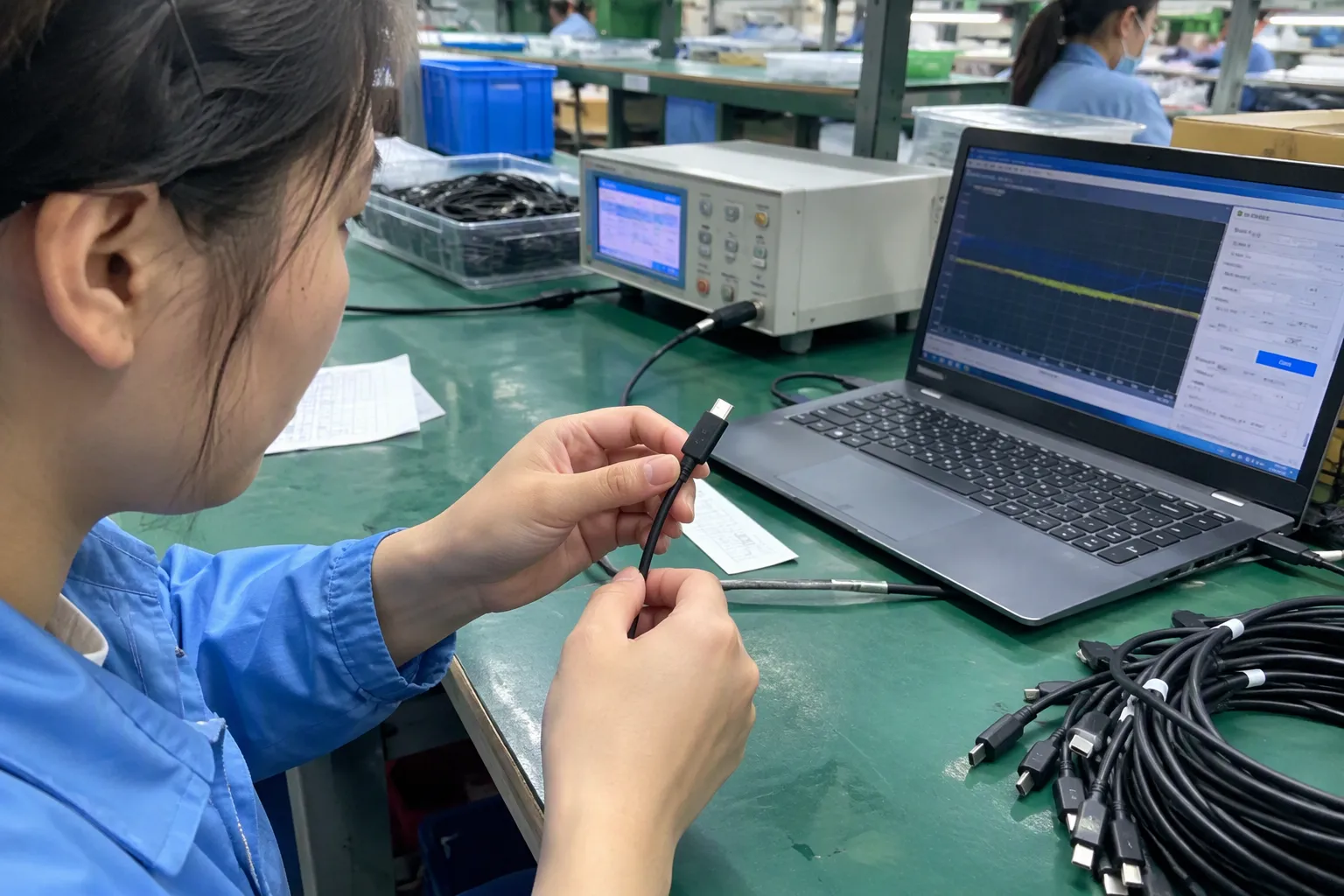
Buyers often use terms such as “high power,” “fast charging,” or “high wattage.” These terms can have different meanings in different sales channels. The buyer should identify the required electrical specification and charging protocol rather than relying on a general phrase.
I also recommend confirming whether the cable requires an electronic component or identification feature[4] for the requested application. The supplier should state the applicable specification for the proposed SKU and explain what the sample or inspection process verifies. The buyer should keep that written confirmation with the purchase record.
I do not present a supplier’s declaration as an independent laboratory result. A supplier document can be useful procurement evidence, but buyers should verify its scope, date, issuing organization, product reference, and relationship to the actual order.
Data performance requires a separate conversation
- What data capability does the exact cable support?
- Does the cable support the intended device connection?
- Does the cable support charging and data at the same time?
- Does cable length affect the proposed application?[5]
- Does the packaging state the limitation clearly?
- Has the supplier tested a production-equivalent sample?
I ask suppliers to avoid vague packaging such as “super speed” unless the claim has a clear technical basis and complies with the buyer’s market and labeling requirements. Clear product descriptions reduce customer confusion.
Cable design affects retail performance
- Jacket material and flexibility.
- Strain-relief design.
- Connector housing strength.
- Braided or smooth exterior.
- Color and finish.
- Length options.
- Storage convenience.
- Packaging protection.
- Private-label appearance.
I once reviewed a request where the buyer focused heavily on the cable’s charging description. After discussing the retail channel, the more important issue became the package size and hanging format. The product needed to fit an existing shelf display. That change did not alter the connector, but it changed the commercial specification.
How Should I Compare Bulk USB-C Cable Prices and Total Cost?
Unit price is important, but it is not the complete purchasing cost. A lower quotation can become expensive when it requires a larger MOQ, unsuitable packaging, extra rework, longer delivery, or more customer support[6]. I compare the whole order structure before I recommend a product.
A realistic bulk USB-C cable comparison includes unit price, MOQ, packaging, tooling, customization, inspection, freight, duties where applicable, payment terms, expected returns, and after-sales support. I also compare whether the quoted specification is identical. Two prices are not directly comparable when the cable construction, packaging, documentation, or test scope differs.
Use a total-cost worksheet
| Cost area | What I check |
|---|---|
| Product price | Exact SKU, length, material, connector configuration, and quantity tier |
| Packaging | Standard packaging, custom artwork, inserts, labels, and cartons |
| Development | Sample fees, tooling, molds, printing plates, or setup charges |
| Quality control | Supplier inspection, third-party inspection, sample retention, or testing |
| Logistics | Carton size, gross weight, shipping method, and destination |
| Import costs | Buyer’s applicable duties, taxes, and clearance costs |
| Commercial risk | Expected returns, replacements, complaints, and slow-moving stock |
| Payment terms | Deposit, balance timing, currency, and transaction costs |
The exact cost structure will differ by market and order. I do not calculate duties or tax without the buyer’s destination and customs information. I advise the buyer to confirm those items with a qualified customs or logistics professional.
MOQ should match the sales channel
A manufacturer may offer a lower price at a higher quantity. That price can look attractive, but the buyer needs to consider inventory turnover. A retailer with several stores may absorb a larger carton quantity more easily than a small online seller testing a new SKU.
- Sample or pilot quantity: This helps the buyer test the product and sales response.
- Initial commercial order: This supports a launch without creating excessive inventory.
- Repeat order quantity: This reflects the buyer’s realistic replenishment forecast.
Customization has a commercial cost
- Does the supplier use standard packaging with a label?
- Does the buyer need a new printed box?
- Does the box require a barcode or marketplace label?
- Does the buyer need multilingual instructions?
- Does the packaging need a particular recycled-material claim?
- Who approves the artwork?
- What happens if the printed packaging contains an error?
The cheapest product may create higher support costs
Cable returns can occur because customers buy the wrong cable, misunderstand the package description, or use an unsuitable charger or device. A supplier cannot eliminate every customer-use problem, but a clear product description and accurate packaging can reduce avoidable confusion.
What Should I Check in Bulk USB-C Supplier Quality and Compliance Documents?
A supplier’s documents can support procurement, but buyers should understand what each document proves. A certificate, test report, declaration, or inspection record may apply only to a specific product, component, model, factory, or date. I recommend checking the scope instead of treating a document as a universal guarantee.
I check whether each quality or compliance document identifies the relevant product, manufacturer, test scope, date, and issuing organization. I also compare the document with the actual SKU, destination market, label, and packaging. Buyers should verify regulatory requirements independently and request qualified professional review for application-specific or market-specific decisions.
Separate supplier quality from market compliance
Quality control asks whether the ordered goods match the approved specification. Compliance asks whether the product and commercial documentation meet the requirements of the destination market. These areas overlap, but they are not identical.
The destination market may also require specific documentation, labeling, environmental information, importer details, or other obligations[7]. The buyer should identify the applicable requirements for the product category and country before finalizing the order.
For European sales, I recommend buyers review current information from official sources such as the European Commission’s product safety information. Requirements can change[8], and a supplier should not be the buyer’s only source of legal advice.
Review documents item by item
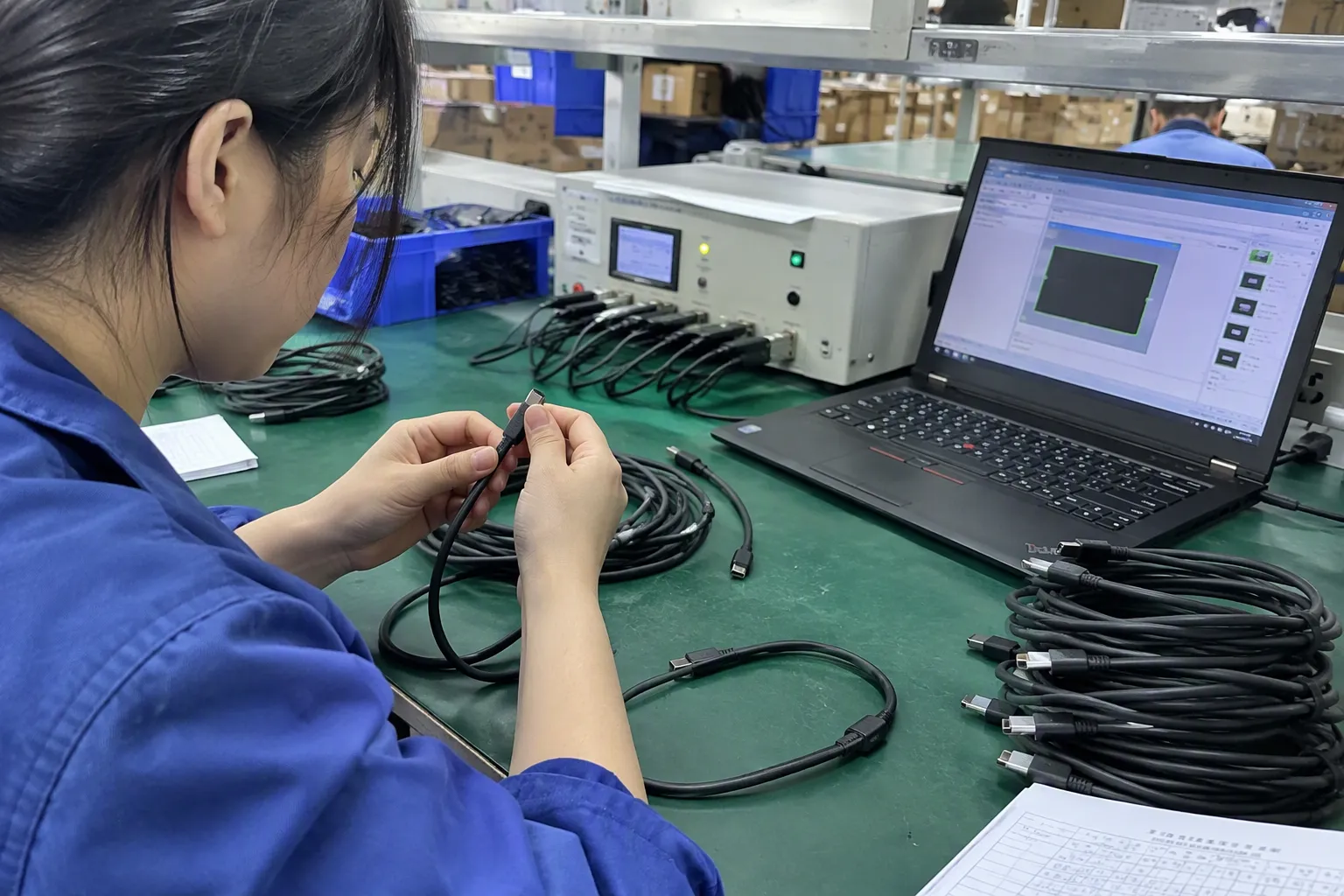
- Product specification sheet.
- Material or component information where relevant.
- Applicable test reports.
- Declaration documents where required.
- Packaging and labeling information.
- Factory quality-control procedures.
- Inspection records for the production batch.
- Correct model or SKU reference.
- Document validity and issuing organization.
- Any buyer-specific testing requirement.
Samples should represent production
A sample can show appearance, handling, connector fit, packaging, and basic function. However, a sample does not automatically prove that every future shipment will be identical. I ask the supplier whether the sample comes from normal production or a specially prepared development batch.
Use a written quality agreement
- Approved sample reference.
- Acceptable appearance standards.
- Functional checks.
- Packaging and label approval.
- Carton quantity.
- Defect classification.
- Inspection timing.
- Corrective action.
- Replacement or credit discussion.
How Can I Plan MOQ, Packaging, Customization, and Lead Time?
A product can meet the technical brief and still miss the buyer’s business plan. The wrong MOQ can tie up working capital. Unapproved packaging can delay a launch. A late sample can compress the production schedule. I treat operational planning as part of product selection, not as an issue to discuss after the quotation.
For bulk USB-C cable orders, I recommend confirming sample timing, artwork approval, production lead time, inspection timing, shipping plan, MOQ by variation, carton information, and repeat-order conditions before accepting the quotation. The buyer should include buffer time because approvals, production, inspection, and transport rarely follow the shortest possible schedule.
Break the schedule into stages
| Stage | Buyer’s decision |
|---|---|
| Requirement review | Confirm use, device group, market, and product type |
| Quotation | Compare exact specification and commercial terms |
| Sample | Check product and packaging |
| Artwork | Approve logo, label, barcode, and instructions |
| Purchase order | Confirm quantity, price, specification, and dates |
| Production | Track progress and resolve questions |
| Inspection | Review goods before shipment where appropriate |
| Shipping | Confirm cartons, documents, booking, and destination |
| After-sales | Record complaints and manage corrective action |
Packaging affects logistics and retail presentation
- Retail unit dimensions.
- Units per inner carton.
- Units per master carton.
- Carton dimensions and weight.
- Packaging material.
- Label location.
- Barcode format.
- Language requirements.
- Drop or handling expectations.
- Whether the packaging is suitable for e-commerce delivery.
Private label requires stronger approval control
Private-label orders need a clear approval chain. I recommend identifying one person on the buyer’s side who can approve the artwork and one person who can approve the final sample. The supplier should not rely on informal messages when the package carries the buyer’s brand.
- Who owns the artwork?
- Which file format is required?
- Who checks translations?
- Who supplies the barcode?
- Can the supplier reuse the packaging?
- What happens to excess printed materials?
- Does the buyer need a confidentiality or intellectual-property agreement?
Plan replenishment, not only the first order
- Can the supplier maintain the same component specification?
- Will the price change with copper, plastic, printing, or freight costs?
- How much notice does the supplier need?
- Can the supplier reserve materials?
- Does the MOQ apply separately to each color and length?
- What happens if the buyer changes the packaging?
How Do I Reduce Returns and Compatibility Problems?
Returns often begin before the customer opens the package. A vague product title, incomplete compatibility statement, or missing limitation can cause the customer to buy the wrong item. I reduce this risk by connecting the technical specification with the sales description and after-sales process.
I reduce USB-C accessory returns by defining the intended use, writing accurate packaging claims, checking representative devices, training sales staff, and recording complaint patterns. Buyers should not promise universal compatibility. They should describe the confirmed device group, function, limitations, and required setup in plain language.
Write product descriptions that customers can understand
- What devices can the customer connect?
- Is the product intended for charging, data, or both?
- Which connector is on each end?
- What length does the customer receive?
- Does the product support the advertised application?
- Does the customer need a compatible charger or adapter?
- Are there known limitations?
Test common customer combinations
| Customer use | Device or charger combination | Result to record |
|---|---|---|
| Phone charging | Representative phone and charger | Charging behavior and fit |
| Tablet charging | Representative tablet and power source | Charging behavior and fit |
| Laptop use | Representative laptop and charger | Intended function and limitations |
| Data transfer | Device and computer combination | Recognized function and stability |
| Accessory connection | Hub, power bank, or other accessory | Fit and intended operation |
Connect complaints to product and packaging
- An incompatible charger.
- A device with a different charging requirement.
- A cable that is suitable for charging but not the expected data function.
- A damaged port.
- A product that was incorrectly described.
- A cable from a different order.
Create an after-sales agreement
- How the buyer reports a problem.
- What evidence the supplier needs.
- The response time.
- Replacement, credit, or corrective-action options.
- Whether the supplier investigates samples.
- How recurring issues are handled.
How Do I Select a Reliable Bulk USB-C Accessories Supplier?
Supplier selection involves more than comparing a catalog. I look at how clearly the supplier answers questions, whether the quotation identifies the product, how the supplier handles samples and changes, and whether the commercial process fits the buyer’s needs.
A suitable bulk USB-C accessories supplier should provide clear specifications, realistic quotations, traceable samples, understandable quality procedures, relevant documentation, transparent MOQ and lead time, and a defined after-sales process. Buyers should evaluate the supplier’s communication and order controls alongside the product itself.
Evaluate the quality of the quotation
- Product code.
- Connector configuration.
- Length.
- Material or construction.
- Color.
- Packaging.
- Quantity tier.
- MOQ.
- Production lead time.
- Sample terms.
- Customization terms.
- Payment terms.
- Quotation validity.
- Shipping basis.
Watch how the supplier handles uncertainty
A responsible supplier should identify information that still requires confirmation. I consider this a positive sign. No supplier can responsibly guarantee every combination of device, charger, operating environment, market, and customer behavior without a defined test scope.
Compare supplier fit with buyer requirements
| Evaluation area | Supplier A | Supplier B | Supplier C |
|---|---|---|---|
| Exact specification confirmed | |||
| Sample quality and traceability | |||
| Relevant documents available | |||
| MOQ suitable for buyer | |||
| Custom packaging support | |||
| Lead time fits launch date | |||
| Communication clarity | |||
| After-sales process | |||
| Total landed cost |
Build a product range instead of one universal SKU
Frequently Asked Questions
Is USB-C the same as fast charging?
No. USB-C identifies the connector format, not the complete charging performance. Fast charging depends on the device, charger, cable, protocol, and required power. I recommend confirming the exact combination and avoiding a fast-charging claim unless the specification and verification scope support it.
Can one USB-C cable support every USB-C device?
No cable should be assumed to support every device or function. USB-C products can differ in charging, data, video, length, construction, and electronic features. I advise buyers to define the intended device group and use case before selecting a bulk SKU.
What should I request before placing a bulk cable order?
I recommend requesting a detailed quotation, product specification, sample, packaging information, MOQ, lead time, applicable documents, inspection approach, and after-sales terms. The buyer should ensure that each document and sample refers to the actual model being ordered.
How many USB-C cables should I buy for a first order?
The right quantity depends on the sales forecast, cash flow, MOQ, launch plan, and expected replenishment time. I usually suggest starting with a pilot or controlled initial order when the product or supplier is new, then increasing quantity after the buyer confirms sales and product performance.
Should I choose braided or PVC USB-C cables?
Neither construction is automatically better for every application. Braided cables may support a particular appearance or handling preference, while PVC cables may suit a different price and packaging position. I recommend comparing flexibility, strain relief, durability expectations, appearance, cost, and customer use before deciding.
Conclusion
Bulk USB-C Cables and Accessories require more than a connector and a unit price. I recommend starting with the buyer’s task, then confirming device use, charging power, data requirements, construction, packaging, documentation, MOQ, lead time, and after-sales support. A clear product brief and representative sample can reduce incompatibility, returns, and delivery surprises. My Shenzhen-based 3C trading company has 15 years of export experience, and I welcome retailers, wholesalers, importers, and private-label buyers to contact me for a practical product and quotation review.
Sources
- Universal Serial Bus Type-C Cable and Connector ...", The USB Implementers Forum defines USB Type-C as a connector and cable-interface specification; the designation alone does not constitute a complete statement of a cable's power, data, or display capabilities
- USB Type-C Cable Compatibility, Length, and Features", USB Type-C documentation distinguishes the common connector from optional or separately specified capabilities, including power delivery, USB data rates, and alternate modes; consequently, the connector label alone is insufficient to establish complete cable performance
- USB-C Signal Analysis Methodology", Technical studies and USB specifications describe cable length and construction as factors that can affect signal integrity and supported operating conditions, while power, data, and display functions are governed by distinct requirements
- Identifying USB-C E-Mark Cables", USB Type-C and USB Power Delivery specifications describe electronically marked cables as a means of communicating cable-related capability information in applicable configurations
- USB cable maximum length", High-speed electrical transmission research and USB specifications identify cable length and channel characteristics as constraints on signal integrity and supported data operation
- (PDF) Managing cost of quality in supply chain: a case study", Procurement and supply-chain research treats purchase price as only one component of total cost, with logistics, inventory, quality failures, rework, and service costs potentially changing the economic comparison
- EU - Labeling/Marking Requirements", European Union product-compliance guidance assigns market operators obligations concerning product identification, traceability, documentation, and safety information where the relevant legislation applies
- Basic Importing and Exporting", Official European Commission materials publish amendments, transitional provisions, and updated guidance for product-safety and market-compliance regimes, illustrating that applicable requirements are time-sensitive