Bone-conduction mics in TWS can look like a strong selling point, but the label alone does not solve poor call quality. I have seen buyers focus on microphone type or quantity while missing ear contact, fit pressure, movement, and algorithm tuning. A structured sample test helps me separate a meaningful product advantage from a claim that may increase returns.
Bone-conduction mics in TWS may improve voice pickup when the sensor maintains stable contact with the wearer’s skin, especially in selected noisy or moving scenarios. However, performance depends on ear shape, wearing position, contact pressure, microphone placement, and software tuning. Buyers should compare samples with different users and realistic call environments instead of relying only on component names, microphone counts, or supplier specifications.
Quick Answer
- I treat a bone-conduction microphone as a potential call-quality feature, not automatic proof of clearer voice transmission.
- I check whether the sensor keeps reliable contact across different ear shapes and wearing positions.
- I compare stationary, walking, outdoor, transport, and indoor retail environments.
- I ask suppliers to identify which claims come from verified testing and which claims are based on design intention.
- I connect test results with commercial risks, including complaints, product returns, misleading listings, and after-sales workload.
- I recommend a qualified acoustic or engineering evaluation when a product will carry strong performance claims.
The main question is not whether a TWS earbud contains a bone-conduction microphone. The more useful question is whether the complete product delivers stable call performance for the intended customer. In my experience with sample feedback and supply-chain communication, that distinction changes how a buyer should select, position, and approve a product.
Bone-Conduction Mics in TWS: What Benefits Are Realistic
Many buyers first notice bone-conduction microphones because suppliers present them as an answer to noisy calls. The attraction is understandable. Customers want to make calls from streets, stations, warehouses, and shared offices. Still, I avoid describing the technology as an automatic replacement for ordinary microphones.
A bone-conduction microphone can offer a different voice signal because it is designed to detect vibrations associated with the wearer’s voice through contact with the skin[1]. The practical benefit depends on whether the device maintains suitable contact and whether the product’s signal-processing system uses that input effectively.
A possible advantage in selected environments
A conventional microphone mainly captures sound pressure in the surrounding air.[2] A contact-based sensor may capture a different part of the voice signal. In theory, this can help the system distinguish some voice information from surrounding airborne noise.[3]
That does not mean the listener will always hear a clearer voice. Wind, traffic, voices from other people, loose fit, and poor placement can still affect the final call.[4] The earbud must also combine signals correctly and apply suitable noise-reduction and echo-control processing.[5]
- The design may provide an additional voice signal.
- The design may help in some noisy situations.
- The design may support a more consistent call experience when fit is stable.
- The design does not guarantee clear speech for every wearer or environment.
This wording matters for European and North American brands because product pages often convert engineering language into strong consumer promises. A supplier may say that the microphone “reduces noise” or “improves calls,” but I need to know the conditions behind that statement.
| Supplier statement | What I still need to verify |
|---|---|
| Bone-conduction microphone included | Sensor location, contact method, and role in the call algorithm |
| Better noise cancellation | Test environment, voice sample, background noise, and comparison model |
| Clear calls outdoors | Wind conditions, movement speed, phone model, and listener assessment |
| Suitable for sports | Retention, sweat exposure, movement, and contact stability |
| Multiple microphones | Function of each microphone and actual system-level benefit |
Why the technology is not automatically better
The sensor can only contribute useful information if the earbud sits correctly. A person with a smaller concha may place the sensor differently from a person with a larger ear.[6] A wearer may also adjust the earbud for comfort, changing the contact point.
The algorithm introduces another variable. The product may have a capable sensor but weak tuning. It may also have a good algorithm but inconsistent mechanical contact. I therefore evaluate the sensor, housing, firmware, phone connection, and microphone array as one system.
I have handled buyer discussions where the first question was, “How many microphones does this model have?” I understand why buyers ask it. Microphone quantity is easy to place in a comparison chart. However, the number does not tell me how the microphones work together[7] or whether the remote caller notices a meaningful improvement.
For a broader purchasing framework, I often connect this evaluation with our guidance on how to choose a reliable TWS earbuds supplier and how to compare TWS samples before placing an order. A call feature should fit the entire supplier and quality-control process.
How Does Ear Fit Create a Commercial Risk?
Fit is not only a comfort issue. For bone-conduction mics in TWS, fit can directly influence whether the sensor receives a stable signal. If the sensor touches one wearer firmly but barely touches another, the same sample may produce different call results. That variation can become a commercial problem after shipment.
I have seen customer feedback become difficult to interpret when one tester reports excellent calls and another reports weak voice pickup. Both comments may be honest. They may simply reflect different ear shapes, insertion angles, wearing pressure, or movement patterns.
The main fit variables
Why one wearer is not enough
I recommend using a small internal test group with clearly different ears and wearing preferences. This does not replace controlled laboratory work. It provides practical screening before a buyer invests in tooling, packaging, inventory, and marketing.
| Observation | Example record |
|---|---|
| Ear size | Small, medium, or large relative to the test group |
| Wearing position | Natural position and adjusted position |
| Contact stability | Stable, intermittent, or difficult to maintain |
| Comfort after extended use | Acceptable, pressure point, or loose |
| Activity | Sitting, walking, head turning, or exercise |
| Call result | Clear, acceptable, inconsistent, or poor |
| User adjustment | None, minor repositioning, or frequent repositioning |
Fit claims require careful wording
A safer product description might state that the design uses a contact-based voice pickup system intended to support calls in selected environments, subject to fit and device conditions. The final wording should be reviewed by the brand’s technical and legal teams.
For product claims and compliance documentation, buyers can consult official resources such as the Bluetooth SIG specifications and qualification information and relevant national or regional requirements. I treat supplier-provided certificates and reports as documents to review, not as automatic proof of every marketing claim.
Which Test Methods Help Compare Bone-Conduction Mics in TWS?
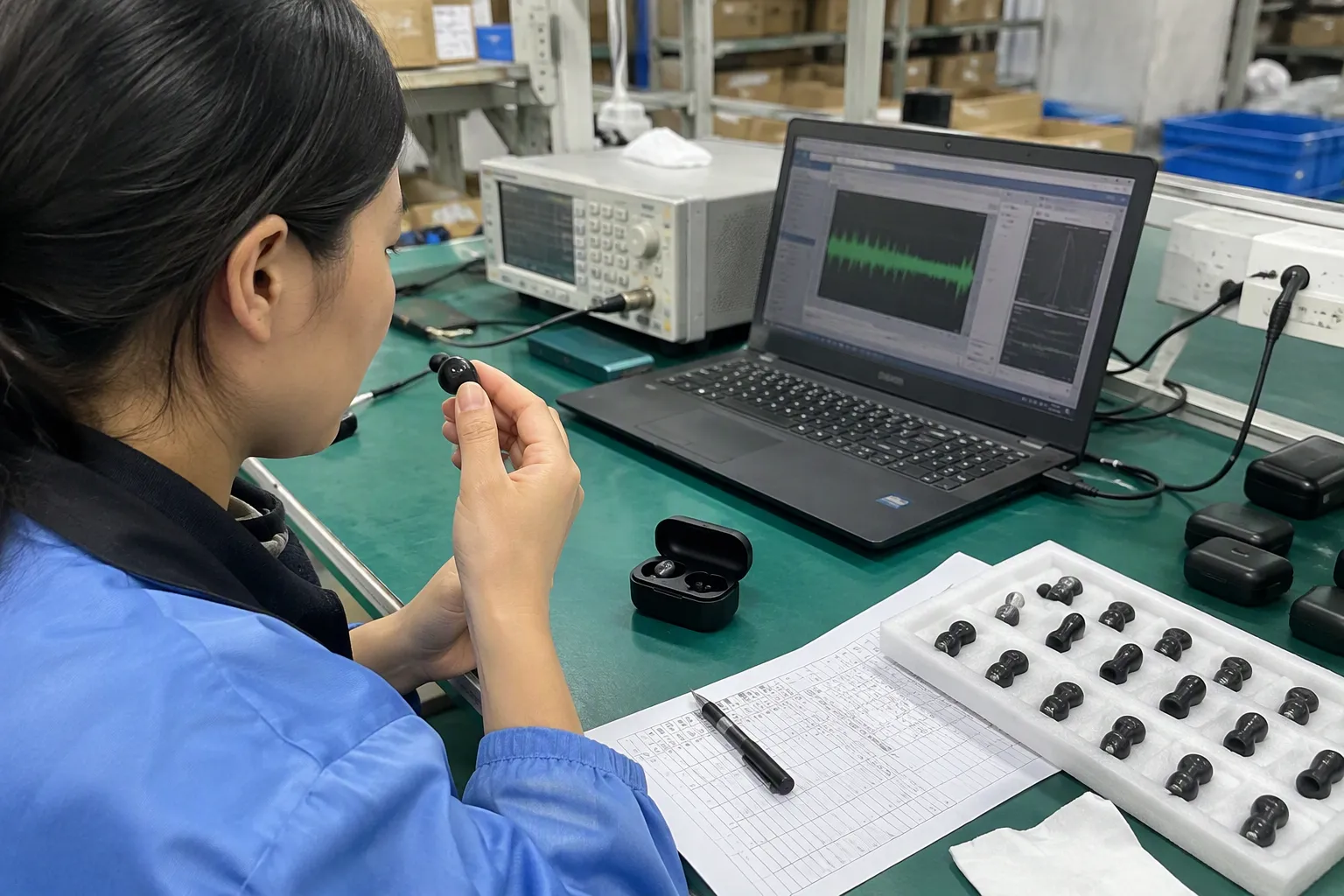
A specification sheet can tell me that a bone-conduction sensor is present. It cannot tell me whether the product performs consistently across users. I therefore use scenario testing as the first commercial filter. The aim is to compare samples under the same conditions and record repeatable observations.
A useful test method should include different wearers, wearing adjustments, environments, activities, phone models, and listeners. I do not present a small buyer test as a certified laboratory result. I use it to identify strengths, weaknesses, and questions for the supplier.
Start with a controlled baseline
- Whether the left and right earbuds produce the same result.
- Whether the wearer needs to adjust the earbud before speaking.
- Whether the remote listener hears speech naturally.
- Whether voice volume changes when the wearer turns the head.
- Whether the call has echo, clipping, delay, or dropouts.
- Whether the result differs between the first call and later calls.
Add realistic noise and movement
- Quiet room while sitting.
- Shared office with other speech.
- Retail or warehouse background noise.
- Outdoor street noise.
- Moderate wind exposure, where safe and repeatable.
- Walking at a normal pace.
- Head turning and natural conversation.
- Transit-adjacent noise without putting the tester in an unsafe situation.
I keep the test path and approximate duration consistent. I also use the same spoken sentences because spontaneous speech makes comparisons harder. The remote listener should not know which sample is being tested when possible. This reduces expectation bias.[8]
Use several wearers and adjustments
I record whether the recommended position is easy for an ordinary customer to find. If the product only performs well after precise positioning, that requirement may need to appear in the user guide. It may also reduce satisfaction for customers who expect simple “put on and use” operation.
Test the complete call chain
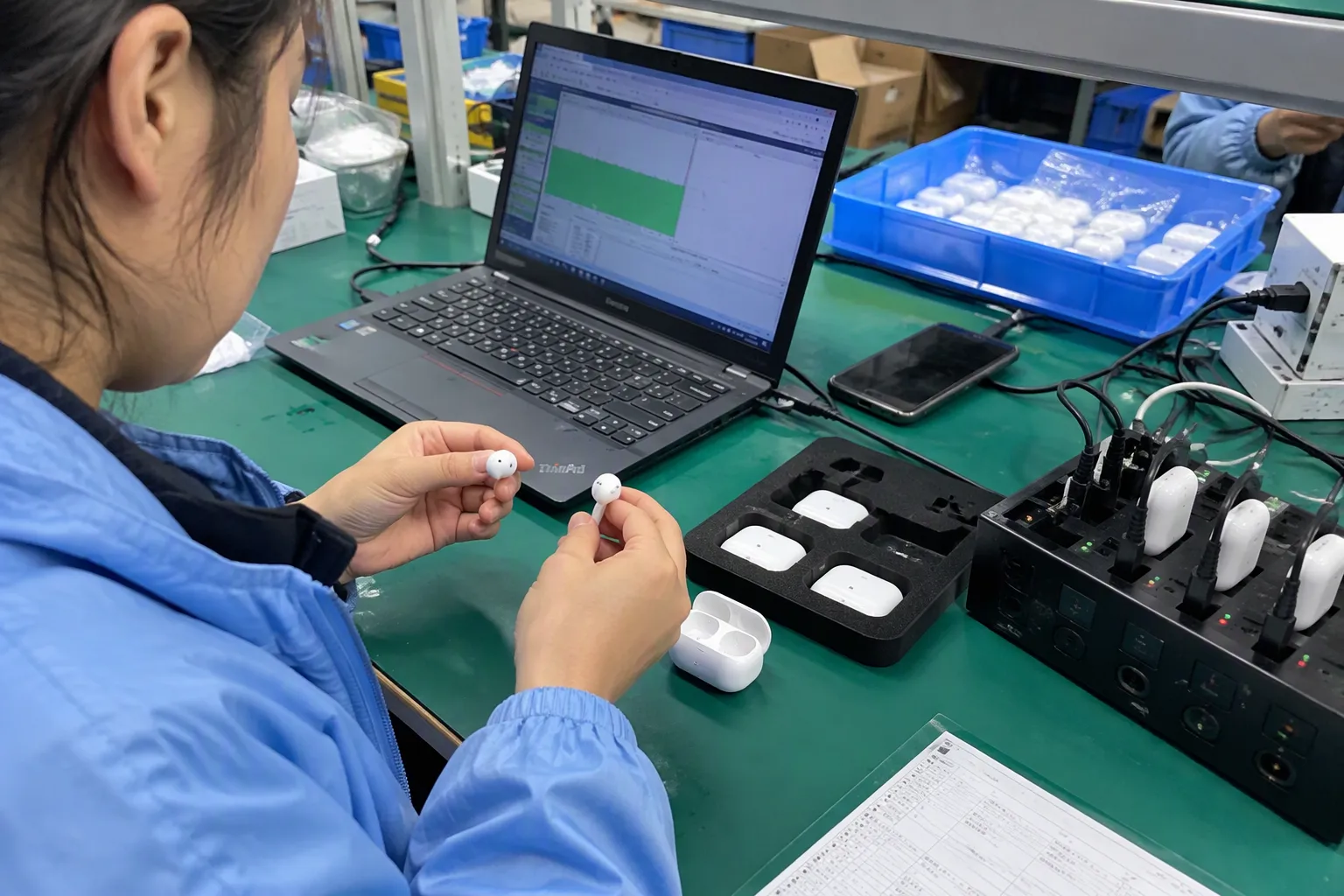
I also compare the same earbud with more than one phone model when the intended market is broad. I do not assume that one successful connection proves universal compatibility. The supplier should provide the supported Bluetooth profile information and any known limitations. Buyers can review the Bluetooth SIG guidance for Bluetooth technology as part of a wider technical review.
A practical scoring sheet
| Test item | Sample A | Sample B | Notes |
|---|---|---|---|
| Quiet-room speech | Natural voice, volume, echo | ||
| Shared-office speech | Background voices | ||
| Outdoor noise | Traffic and general noise | ||
| Walking stability | Contact and voice consistency | ||
| Ease of correct placement | Instructions needed | ||
| Comfort after extended use | Pressure or looseness | ||
| Performance across wearers | Consistency, not best result | ||
| Remote-listener preference | Blind comparison if possible |
I avoid inventing pass thresholds unless the brand has an established internal standard. Instead, I define a commercial decision such as “continue engineering review,” “approve for limited market testing,” or “do not use strong call-quality claims.”
How Should Buyers Compare Bone-Conduction and Conventional Microphones?
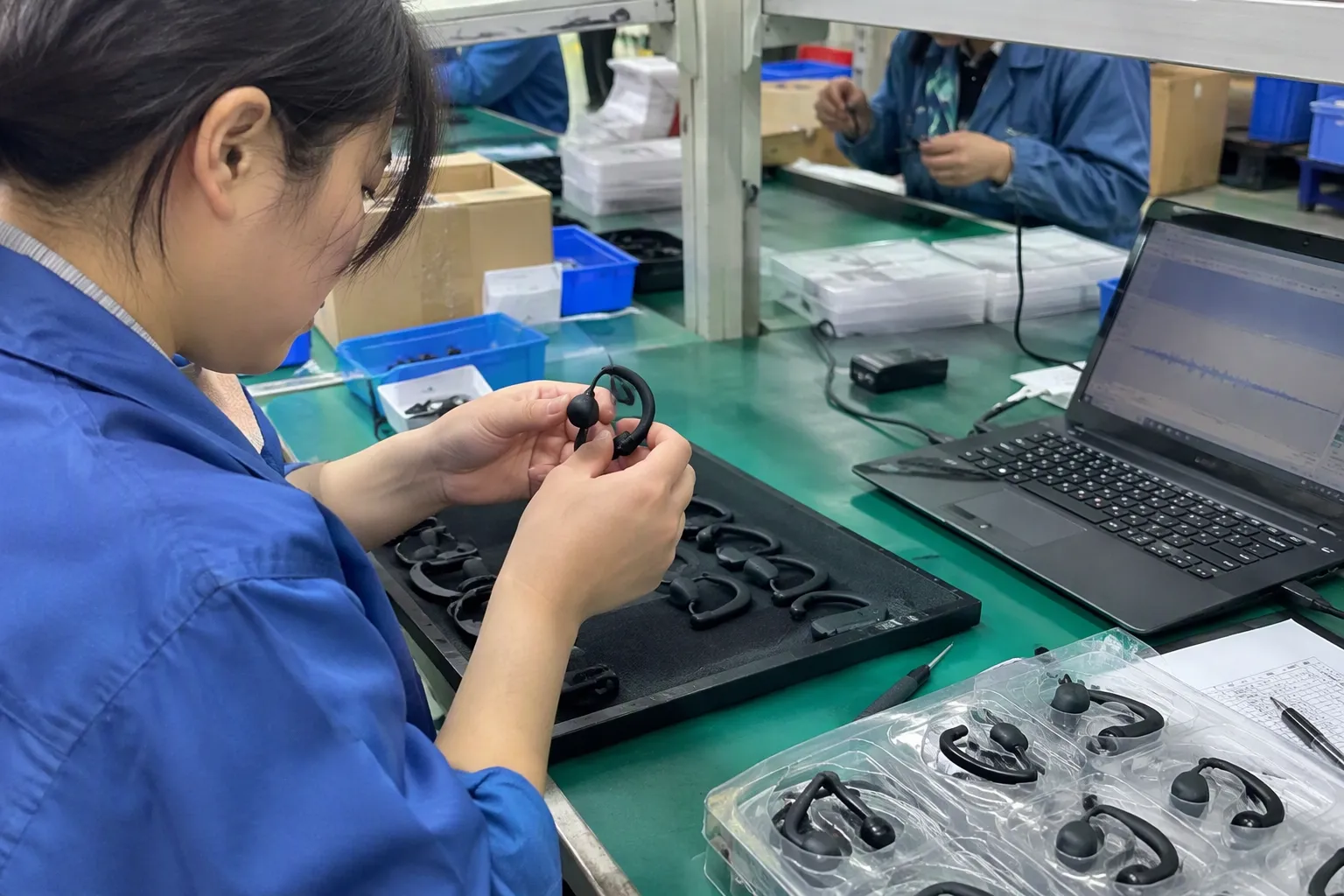
Buyers sometimes frame the decision as a choice between bone-conduction microphones and ordinary air-conduction microphones. That comparison is too narrow. Many TWS products use several microphones, and the final result depends on the complete acoustic and software architecture.
A practical comparison
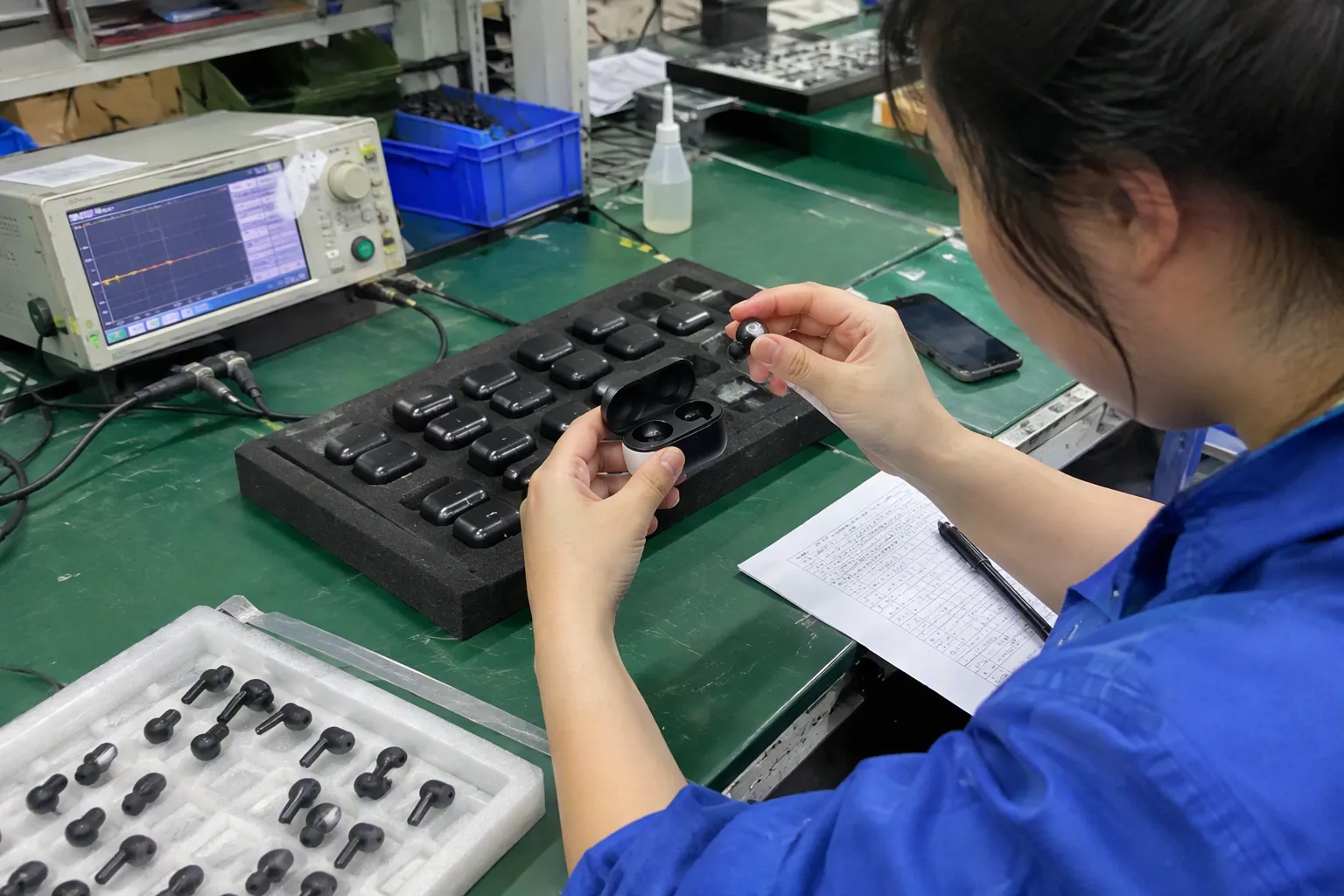
| Evaluation area | Bone-conduction approach | Conventional microphone approach |
|---|---|---|
| Main signal source | Contact or vibration-related signal plus system processing | Airborne sound captured near the ear |
| Dependence on fit | Often strongly dependent on contact and placement | Still fit-dependent, but contact may be less central |
| Potential value | May add voice information in selected noise conditions | Can provide familiar voice pickup with suitable placement |
| Main risk | Unstable contact across users | Wind and environmental noise entering the microphone |
| Buyer concern | Whether the sensor works consistently in real use | Whether the array and noise processing work consistently |
| Proof required | Scenario testing with different wearers | Scenario testing with different noise and movement |
| Marketing caution | Avoid automatic “clearer for everyone” claims | Avoid automatic “noise-free” or universal claims |
This table does not rank one approach as universally superior. I use it to structure questions. A product with a conventional microphone array may outperform a contact-based design in a particular use case. A bone-conduction design may offer useful results in another. The product team should compare actual samples under the same conditions.
Check the role of every microphone
- Which microphones handle voice pickup.
- Which microphones support environmental-noise detection.
- Whether a bone-conduction sensor is active during every call.
- Whether the algorithm changes between indoor and outdoor conditions.
- Whether the feature depends on a specific app, firmware version, or phone system.
- Whether both earbuds provide the same function.
- Whether the performance changes in single-earbud mode.
Consider the customer’s actual use case
A product for commuters may face wind, transport noise, and frequent repositioning. A product for office workers may need stable speech in shared indoor spaces. A product positioned for gaming may have different microphone and latency priorities. A sports-focused product may face sweat and movement.
- Primary call environment.
- Typical wearing duration.
- Expected movement.
- Customer age and ear-size diversity.
- Single-earbud use requirements.
- Acceptable comfort trade-offs.
- Return and warranty tolerance.
- Strength of the intended marketing claim.
What Supplier Questions Should I Ask Before Approval?
Technical and product questions
- What is the exact function of the bone-conduction sensor?
- Where does the sensor contact the user?
- Does the design require a particular wearing angle?
- What happens if the sensor loses contact during movement?
- Does the call algorithm use all microphones in every mode?
- Is single-earbud calling supported?
- Which firmware version was used for the sample?
- Which phone models were used during the supplier’s tests?
- Does the result change between Android and iOS devices?
- Are there known limitations for smaller or larger ears?
- Has the product been revised after sample feedback?
- What changes are possible before mass production?
I separate supplier statements from buyer observations. If the supplier says that the microphone delivers a specified improvement, I ask for the test conditions and supporting report. I do not treat an unverified presentation claim as a confirmed performance result.
Commercial and quality questions
- Is the sensor available from one source or multiple qualified sources?
- What is the approved component reference?
- What happens if the component changes during production?
- Is the housing geometry controlled by an approved drawing?
- Does the supplier inspect microphone placement?
- What is the sample-to-mass-production approval process?
- How will firmware changes be controlled?
- What is the replacement policy for call-quality complaints?
- Can the supplier support customized ear-tip sizes or fit adjustments?
- What is the lead time for a revised engineering sample?
- What is the MOQ for private labeling or packaging customization?
For a buyer comparing suppliers, I recommend reviewing our related guide to TWS earbuds MOQ, lead time, and quality control. Call performance is important, but it must fit the supplier’s wider production capability.
Request evidence without overclaiming
- Test date and firmware version.
- Earbud model and hardware revision.
- Phone and operating system.
- Noise source and approximate conditions.
- Number and characteristics of wearers.
- Call direction and remote-listener method.
- Comparison product, if any.
- Limitations and unexplained results.
Certification documents should be checked for scope, issuer, model identity, and validity. A document that supports radio, safety, or market compliance does not automatically certify the quality of voice pickup. I encourage buyers to consult qualified compliance professionals for the markets in which they sell. The European Commission’s CE marking information is a useful starting point, but it is not a substitute for product-specific assessment.
How Can Call Quality Affect Returns and Product Claims?
Call quality is often treated as a technical feature, but customers experience it as a trust issue. A buyer may accept a small cosmetic difference. A customer who cannot be heard during work, travel, or a personal call may quickly decide that the earbuds are defective.
In customer consultations and after-sales discussions, I have found that complaints often begin with a simple statement: “The other person cannot hear me.” The root cause may involve fit, wind, phone compatibility, firmware, or a hardware fault. That uncertainty makes returns harder to diagnose.
Translate test results into commercial risk
| Technical observation | Possible customer effect | Procurement response |
|---|---|---|
| Works only with precise contact | User reports weak or distant voice | Improve housing, tips, instructions, or claim wording |
| Large variation between wearers | Inconsistent reviews | Expand fit testing before launch |
| Good indoors but poor outdoors | Commuter complaints | Narrow the use-case claim |
| Voice changes while walking | Sports and transport returns | Test movement and retention |
| One earbud performs differently | Single-earbud dissatisfaction | Review left/right production control |
| Strong sample but weak production result | Post-launch complaints | Strengthen golden-sample and line inspection controls |
Avoid claims that create the wrong expectation
I would instead describe the design purpose and the tested scenarios. The final claim should be reviewed by the brand’s legal and technical teams. I also recommend keeping test notes so that marketing, sales, and after-sales teams use consistent language.
Build a feedback loop after launch
- Return reasons that mention calls or microphones.
- Reviews that mention walking, wind, or fit.
- Complaints by phone operating system.
- Complaints by left or right earbud.
- Complaints from specific markets or customer groups.
- Whether customers understand how to position the earbuds.
- Whether support agents can resolve issues through fit guidance.
I do not use early complaints to prove a universal technical failure. I use them to identify patterns that may justify more testing. If a recurring complaint appears, I ask the supplier for a structured root-cause review rather than accepting a general statement that the product passed inspection.
What Should a Buyer Include in the Final Approval Plan?
A buyer needs a decision process that is practical for procurement and strong enough to protect the product launch. I do not expect every retailer or wholesaler to own an acoustic laboratory. I do expect the team to document what it tested, what it did not test, and which claims remain conditional.
Recommended approval stages
Stage 1: Specification and design review
At this stage, I confirm the sensor type, microphone layout, housing design, firmware version, phone support, battery behavior during calls, and customization limits. I also ask which information is supplier-provided and which information has independent support.
Stage 2: Fit screening
Stage 3: Scenario comparison
Stage 4: Engineering feedback
Stage 5: Production-control planning
Stage 6: Claim and launch review
A simple approval matrix
| Decision area | Approve when | Hold or revise when |
|---|---|---|
| Fit | Most testers achieve stable placement with normal adjustment | Contact is difficult or highly wearer-dependent |
| Call quality | Results are acceptable in the target scenarios | Results vary sharply without a clear explanation |
| Comfort | The product remains acceptable for intended use | Pressure or looseness causes repeated adjustment |
| Supplier evidence | Test conditions and sample identity are clear | Claims rely only on slides or component names |
| Production control | Hardware, firmware, and inspection plans are defined | The supplier cannot explain change control |
| Marketing | Claims match the evidence and use case | Claims promise universal or guaranteed performance |
When I recommend outside evaluation
I recommend qualified professional testing when the buyer plans strong performance claims, large-volume distribution, regulated workplace applications, or a product position that depends heavily on call quality. An external evaluator can define a suitable method for the intended market and use case.
I also recommend specialist review when the product involves unusual sensor placement, hearing-related claims, medical or safety implications, or significant redesign. I do not present my commercial sample screening as laboratory acoustic testing, and buyers should keep that distinction clear.
Frequently Asked Questions
Are bone-conduction mics in TWS automatically better than normal microphones?
No. Bone-conduction mics in TWS may add a useful voice signal in selected conditions, but performance depends on contact, fit, microphone placement, firmware, and algorithm tuning. A conventional microphone array may perform better in a particular product or environment. I recommend comparing complete samples rather than component labels.
Do bone-conduction microphones work for every ear shape?
No. Ear shape, wearing pressure, insertion position, and movement can change contact quality. A sample that performs well for one wearer may perform differently for another. I recommend fit screening with several users and recording whether the product remains stable without frequent adjustment.
How should I test a TWS earbud before placing a bulk order?
I start with a quiet baseline, then test shared indoor noise, outdoor sound, walking, and natural head movement. I use several wearers, the same phone and firmware, consistent spoken sentences, and a remote listener who compares samples where possible. I document observations instead of relying on one personal impression.
Should I advertise “clear calls” when a product has a bone-conduction microphone?
I would use that claim only when the evidence supports the exact wording and conditions. A supplier specification or certification document does not automatically prove universal call clarity. I prefer scenario-based language that explains the intended benefit without promising performance for every user and environment.
Can a bone-conduction microphone reduce TWS returns?
It may help reduce returns if the complete design performs consistently and the product information sets realistic expectations. It can also increase returns if fit is unstable or marketing promises are too strong. I connect the feature with fit testing, supplier quality control, customer instructions, and post-launch complaint monitoring.
Conclusion
Bone-conduction mics in TWS can provide a meaningful design option, but the “bone-conduction” label and microphone count do not prove real-world call quality. I evaluate contact stability, ear diversity, movement, noise, firmware, supplier evidence, and customer expectations together. I also separate personal sample observations from verified technical claims. If you are selecting or customizing TWS earbuds for European or North American markets, I can help you compare samples, review supplier information, and build a practical procurement test plan before mass production.
Sources
- Improvement of voice quality and prevention of deafness by a ...", Speech-sensing research describes bone-conduction microphones as contact-based transducers that detect mechanical vibrations associated with vocalization rather than relying solely on airborne sound pressure
- Calibration of Pressure and Gradient Microphones", Acoustics references describe conventional microphones as transducers that convert variations in air pressure into an electrical signal
- The effect of bone conduction microphone locations on ...", Speech-processing studies indicate that bone-conducted or body-conducted signals can provide speech information with reduced exposure to some airborne environmental noise
- Use of a Deep Recurrent Neural Network to Reduce Wind Noise", Research on wearable and earbud speech capture identifies wind, competing acoustic sources, and microphone placement as factors that can alter transmitted speech quality
- Active Noise Cancellation with MEMS Resonant Microphone ...", Hands-free communication guidance and signal-processing literature describe microphone combination, noise suppression, and acoustic echo cancellation as system components used to manage environmental noise and reproduced-signal feedback
- Anthropometric Assessment of the Normal Adult Human Ear", Anthropometric studies of the external ear report substantial inter-user variation in auricular and conchal dimensions, which can affect the positioning of ear-worn devices
- Microphone Array Generalization for Multichannel ...", Microphone-array research treats channel count as one design variable among several, with geometry, spacing, calibration, and beamforming or enhancement algorithms also influencing speech performance
- Bias in Auditory Perception - PMC - NIH", Methodological research on perceptual evaluation supports blinding participants to test conditions as a means of limiting expectancy-related influences on subjective judgments