Quick Answer
The EU Right to Repair Directive 2024/1799 is already raising practical questions for electronics importers selling into Europe. The difficult part is not simply watching one date on a calendar. The real risk is discovering too late that a supplier cannot provide repair support, product information, spare parts, or a workable after-sales process for the countries where you sell.
The EU Right to Repair Directive 2024/1799 does not create one identical EU-wide compliance switch on 31 July 2026[1]. That date is the deadline for Member States to transpose the Directive into national law, so importers should verify rules country by country. Before placing new orders, buyers should also collect supplier evidence covering product scope, repair support, spare-part supply, technical information, warranty handling, and responsibility allocation.

In my 15 years of exporting 3C products from Shenzhen, I have seen European buyers ask detailed questions about certifications, quality consistency, warranties, and delivery plans. I now see more buyers adding a new layer of questions: “If a customer needs a repair, what happens next?” That question should be answered before a purchase order is issued, not after a marketplace complaint arrives.
Why Is the EU Right to Repair Directive 2024/1799 Deadline Not One EU-Wide Compliance Switch?
Many importers see the 31 July 2026 date and assume that every EU country will follow the same rules on the same day. That assumption can create expensive planning mistakes. Different sales markets, product categories, national procedures, and enforcement approaches may affect what an importer needs to do.
The EU Right to Repair Directive 2024/1799 requires Member States to transpose the Directive into national law by 31 July 2026, but importers should not treat that date as a single uniform operational deadline across Europe. Each business should verify the national implementation measures, applicable product coverage, and local obligations in every country where it sells.[3]
Start With the Difference Between an EU Directive and National Rules
The first point is simple but important: an EU Directive is not the same thing as one directly identical rulebook for every importer in every Member State[2].
A Directive sets objectives that Member States must implement through their own national legal systems. The 31 July 2026 transposition deadline is therefore a major planning milestone. However, an importer should still check the national measures adopted in the countries where products are sold.
I recommend treating the date as the start of a structured review, not as a day when every operational requirement suddenly becomes identical across all EU markets.
For example, a retailer selling charging accessories into Germany, France, Italy, Spain, and the Netherlands should not rely on a single generic statement from a supplier. The retailer should review each target market with qualified local legal advisers or compliance professionals.
A country-by-country review should consider:
- The current national law implementing the Directive
- The date national requirements apply in practice
- The product categories covered in that market
- The relationship between repair rights, legal guarantees, and commercial warranties
- Consumer information requirements
- Whether local rules affect repair service arrangements or communication
- The enforcement authority and potential consequences of non-compliance
- Marketplace-specific policies that may go beyond the legal minimum
Important: I am writing from a supplier-side trade and documentation perspective, not as an EU lawyer or regulator. Importers should verify the current Directive text, national implementing measures, product scope, and legal consequences with official sources and local counsel.
Product Scope Must Be Checked Product by Product
A second mistake is assuming that all consumer electronics face the same repair obligations. They do not necessarily do so.
The EU Right to Repair Directive 2024/1799 connects to broader EU product rules and repairability requirements. Product scope may depend on the relevant category, applicable legislation, and national implementation.[4] A USB cable, GaN charger, TWS earbud, smart watch, power bank, or other connected device may not be treated in the same way.[5]
For importers, this means product classification matters. A business should build a product-by-product inventory instead of using one general statement such as “our products are repair compliant.”
A practical internal list can include:
| Product family | Example questions for the importer | Supplier evidence to request |
|---|---|---|
| USB cables | Is the product covered by any repair-related requirement? Is replacement more relevant than repair? | Product specification, batch traceability, warranty process |
| Wall chargers | Are key components serviceable? What happens with a failed unit? | Repair or replacement workflow, failure analysis process |
| GaN chargers | Can the supplier identify common failure modes and safe handling requirements? | Technical support contact, repair feasibility statement, return procedure |
| TWS earbuds | Are batteries, charging cases, and individual earbuds separately supportable? | Spare-part list, replacement-unit policy, pairing instructions |
| Smart watches | What is the support route for straps, charging accessories, displays, batteries, and software issues? | Product support information, spare-part availability, service responsibility matrix |
This table is not a legal classification tool. It is a procurement tool. Its purpose is to expose unanswered questions before stock enters the EU market.
In my experience, buyers often start with product price, MOQ, lead time, packaging, and certification documents. These are still essential. However, the right-to-repair conversation adds another commercial question: Can this supplier support the product after the sale in a way that fits my target market?
Treat Repair Readiness as a Procurement Risk
The most useful way to approach the EU Right to Repair Directive 2024/1799 is not as a document-only compliance exercise. It is an after-sales and supplier-management issue.
A product can arrive with correct packaging, relevant test documents, and a commercial warranty statement. Yet the importer may still face problems if the supplier cannot answer basic questions about returns, technical support, spare parts, or repair coordination.
“Certified” does not automatically mean “repair-ready.”[6]
Likewise, “one-year warranty included” does not explain:
- Who receives a defective unit
- Who evaluates the fault
- Whether the unit is repaired, replaced, credited, or scrapped
- Whether parts are available
- How long support will continue
- Whether a local service partner is needed
- Which party pays for freight, inspection, replacement, or disposal
- What technical information is available to support a repair decision
For an e-commerce seller, poor after-sales planning can quickly become a margin problem. A low-cost charger may look attractive at sourcing stage, but repeated replacement shipments, customer refunds, platform claims, and stock write-offs can erase the expected savings.
For a chain retailer or wholesaler, the risk may appear differently. The buyer may need predictable return authorization procedures, quality reports, stock segregation instructions, and a clear contact person. Large customers often need evidence before they approve a new supplier.
I recommend that importers place repair support beside the usual supplier-selection factors:
- Product quality and consistency
- Commercial pricing
- MOQ and replenishment capacity
- Delivery lead time
- Compliance documentation
- Warranty terms
- Repair and return support
- Clear allocation of responsibilities
A supplier does not need to promise everything. In fact, vague promises are less helpful than a realistic written process. A supplier should state what it can provide, what it cannot provide, and what the importer must arrange locally.
Ask Suppliers for Evidence, Not Broad Assurances
When European buyers ask me whether a product is “fully compliant,” I believe the better conversation starts with evidence. Broad assurances create risk because they are difficult to audit later.
For the EU Right to Repair Directive 2024/1799, importers should request documented answers that match their product range and sales countries. The goal is not to force a supplier into giving legal opinions. The goal is to understand operational capability.
Here is a practical supplier due-diligence questionnaire.
Product and Support Coverage
Ask the supplier:
- Which exact models are included in the proposed support arrangement?
- Which parts of the product can be replaced, if any?
- Which components are not intended to be repaired?
- Does support differ between standard models and customized versions?
- Can the supplier provide model-specific product information?
- Can the supplier identify product revisions by SKU, production date, or batch code?
This level of detail matters because many 3C products change over time. A charging cable may receive a new connector, chipset, plug, packaging, or material revision. A TWS earbud may have a revised charging case or firmware version. A generic promise about “spare parts available” is not enough if the part does not match the sold version.
Spare Parts, Replacement Units, and Lead Times
Ask for a written list of available parts or replacement items. The list may include accessories, housings, charging cases, straps, cables, adapters, batteries where appropriate, or complete replacement units.
Then ask commercial questions:
| Due-diligence point | Why it matters |
|---|---|
| Spare-part availability period | Helps the importer assess support continuity |
| Standard lead time | Affects customer service promises and stock planning |
| MOQ for parts or replacement units | Determines whether support is commercially practical |
| Unit price and freight terms | Shows the real cost of after-sales support |
| Stock location | Affects delivery time and customs planning |
| Product revision compatibility | Reduces the risk of receiving incompatible parts |
| End-of-life notice process | Gives the importer time to plan final purchases |
A supplier may have a technically available part but require a high MOQ. That may still work for a large retailer, but it may not work for a smaller marketplace seller. The importer needs to know this before committing to a product line.
Build a Repair, Return, and Warranty Workflow Before Launch
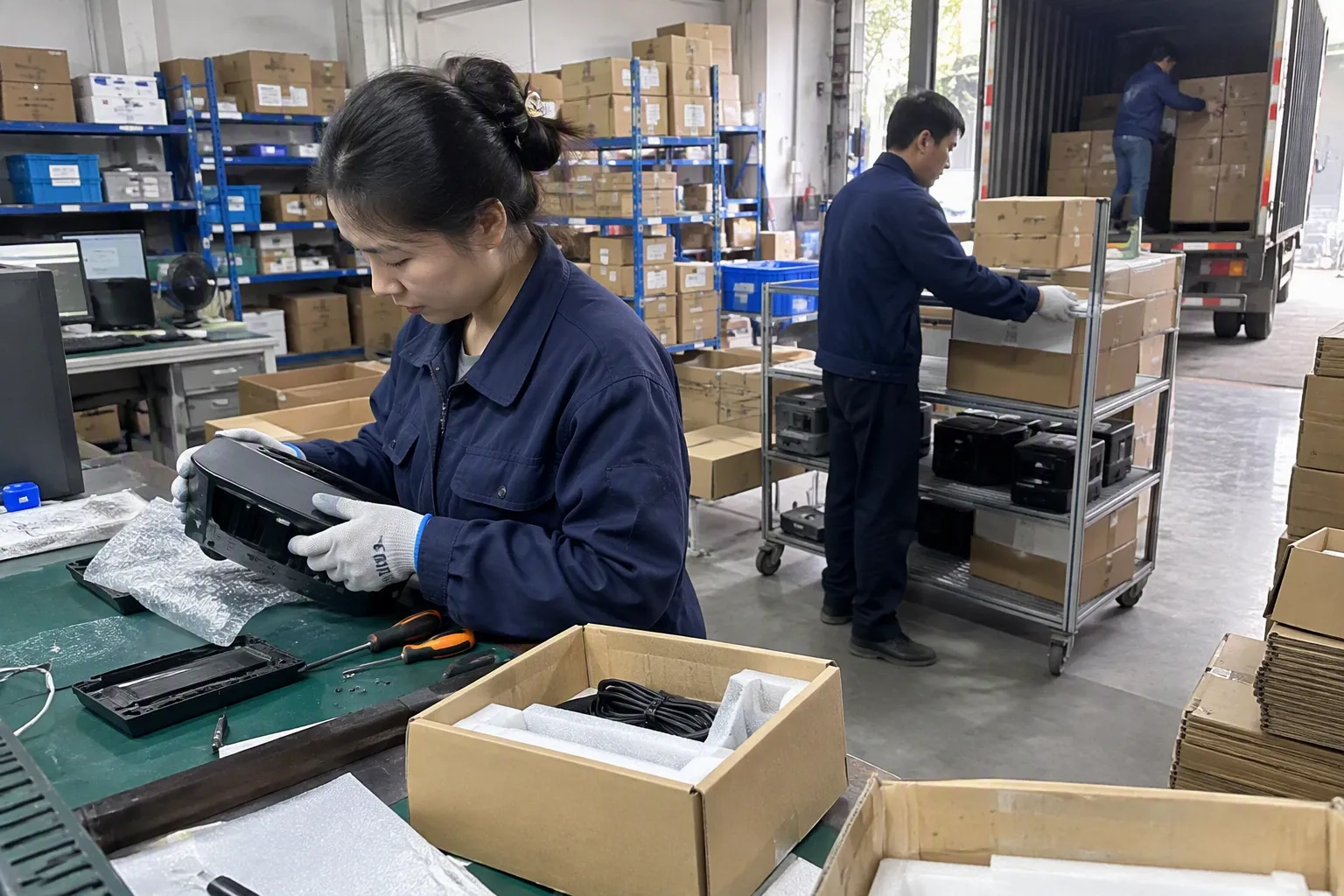
A repair-ready supply arrangement needs a workflow. Without one, every defect becomes a negotiation.
The workflow does not need to be complicated. However, it should show who does what at each stage. This is especially important for cross-border sourcing, where freight costs and handling time can make return-to-China repair uneconomical for lower-value products.
A useful workflow should cover the following stages:
-
Customer reports a fault
The retailer, seller, or service team receives the claim and records the model, order date, issue, and evidence. -
Initial troubleshooting
The seller uses approved guidance, such as a charging check, cable test, reset instruction, pairing procedure, or visual inspection. -
Fault classification
The issue is classified as possible user setup, transport damage, apparent manufacturing defect, or uncertain fault. -
Repair or replacement decision
The parties decide whether repair is practical, whether a replacement part is available, or whether replacement is the appropriate route. -
Supplier coordination
The importer sends required information to the supplier, such as photos, videos, batch codes, and quantity data. -
Commercial settlement
The contract defines whether the supplier provides replacement goods, credit notes, spare parts, freight support, or another agreed remedy. -
Quality feedback loop
The supplier reviews recurring defects and provides corrective-action information where appropriate.
For many low-value 3C accessories, an importer may decide that local replacement is more practical than cross-border repair.[7] That decision may be commercially sensible, but it should not be assumed to satisfy every applicable legal requirement.[8] The importer should obtain country-specific advice before building a customer-facing policy.
I have found that buyers benefit from separating two questions:
- What is legally required in the sales country?
- What is operationally realistic for this product and supply chain?
The first requires current legal verification. The second requires honest supplier discussions and clear contract terms.
Make Technical Information Part of Supplier Selection
Repair support often fails because product information is missing, not because a component is unavailable.
A retailer may receive a return for a smart watch that will not charge. The issue could involve the charging cable, contact cleanliness, battery condition, firmware, user setup, or a hardware fault. Without basic troubleshooting guidance, the seller may replace every returned unit even when some issues could be resolved through clear instructions.
Importers should ask suppliers what technical information they can provide for each model. Depending on the product and the supplier’s actual capability, this could include:
- User manuals and quick-start guides
- Troubleshooting instructions
- Product photos and component identification
- Model and batch identification guidance
- Charging and storage instructions
- Basic fault-report templates
- Packaging and accessory checklists
- Safety handling instructions
- Firmware or pairing guidance for applicable products
- Contact details for technical escalation
The importer should also check language needs. A supplier may provide English material, but the retailer may need customer information in German, French, Italian, Spanish, Dutch, Polish, or other languages depending on the market.
Technical information should be controlled. The importer should not create unsupported repair instructions or authorize unsafe work. This is particularly important for products involving batteries, mains power, charging circuits, or sealed components. Application-specific repair decisions should be assessed by qualified professionals.
Put Responsibility Allocation Into the Purchase Contract
A supplier questionnaire is useful, but a questionnaire alone is not enough. The answers should be reflected in the commercial agreement, purchase order terms, quality agreement, or another written document accepted by both parties.
The contract should avoid vague wording such as “supplier provides after-sales support.” Instead, it should define the support scope.
A practical responsibility matrix may look like this:
| Topic | Importer or seller | Supplier | Points to define |
|---|---|---|---|
| Customer communication | Usually responsible | Provides support materials where agreed | Response time, languages, escalation route |
| Initial fault screening | Usually responsible | Provides troubleshooting guide | Required photos, videos, order details |
| Spare parts | Holds local stock if agreed | Supplies parts or replacement items | MOQ, lead time, compatibility |
| Product quality investigation | Sends defect data | Reviews evidence and production records | Batch traceability, response timeline |
| Warranty settlement | Manages local customer remedy | Provides agreed credit, replacement, or other support | Claim limits, freight, evidence threshold |
| Repair network | May appoint local provider | May provide product information if available | Approval process, cost responsibility |
| End-of-life support | Plans stock and customer communication | Gives advance notice where agreed | Final order opportunity, remaining parts |
No template fits every business. A large EU distributor may negotiate different terms from a small Amazon seller. The key is that responsibilities should be visible before launch.
Create a Country-by-Country Readiness File
The EU Right to Repair Directive 2024/1799 is easier to manage when the importer creates one readiness file for each sales country.
This does not need to be a large legal report. It can begin as an internal spreadsheet with links to verified official sources and notes from local advisers. The important point is that the file identifies assumptions and open questions.
I suggest including these columns:
- Sales country
- Sales channel
- Product category and SKU
- National implementation status
- Verified application date
- Relevant local requirements or guidance
- Product-scope assessment
- Customer communication requirements
- Repair, replacement, or service arrangement
- Spare-part availability status
- Supplier evidence received
- Contract clauses completed
- Internal owner
- Next review date
This approach is helpful for businesses selling across several EU countries. It prevents one employee from relying on an outdated general statement while another team launches the same product in a new market.
It also gives procurement teams a better basis for supplier comparison. If Supplier A offers a lower price but cannot provide model-level support details, while Supplier B provides documented lead times, replacement procedures, and batch traceability, the apparent price gap may not represent the true commercial cost.
What Importers Should Do Before 31 July 2026
I would not wait until the final months before the transposition deadline. Supplier information, contract amendments, translations, and local service arrangements can take time.
A practical preparation plan may look like this:
1. Map Your EU Sales Footprint
List every country where you currently sell or plan to sell. Include direct website sales, marketplaces, wholesale customers, retail chains, and distributors.
2. Sort Products by Category and Risk
Identify the products that generate the highest sales volume, highest return rate, highest customer complaint rate, or greatest technical complexity. Start there.
3. Verify National Developments
Check official national sources and consult qualified local advisers. Do not rely only on general online summaries, old legal articles, or supplier marketing material.
4. Collect Supplier Evidence
Request written replies, product documents, support procedures, available-part information, MOQ details, lead times, and warranty settlement terms.
5. Test the Workflow Internally
Run a simple test case. Ask: if a customer reports a failed charger or TWS earbud tomorrow, who receives the claim, who makes the decision, and how long does each step take?
6. Update Contracts and Customer Policies
Make sure the purchase terms, distributor agreements, customer-facing warranty language, and internal return procedures do not contradict each other.
7. Keep Reviewing
National rules, product portfolios, supplier capacity, and marketplace expectations can change. A readiness file should be reviewed regularly, not stored and forgotten.
For importers sourcing from China, early communication is especially valuable. Production schedules, component supply, packaging changes, and replacement-stock planning all need lead time. If repair-related support requires additional documentation or separate parts inventory, the supplier needs clear forecasts.
Frequently Asked Questions
Does the EU Right to Repair Directive 2024/1799 apply automatically in every EU country on 31 July 2026?
Not necessarily in one identical way. The date is the transposition deadline for Member States, but importers should verify each country’s national implementation measures, application dates, product scope, and enforcement approach. Current official sources and local legal advice are important.
Do CE documents and product certifications prove repair readiness?
No. Certifications and test documents may be important for product compliance, but they do not automatically prove that a supplier can provide spare parts, technical information, repair coordination, return handling, or clear warranty responsibility. Importers should request separate operational evidence.
What should an importer ask a Chinese electronics supplier about repair support?

An importer should request written information on supported models, available parts or replacement units, lead times, MOQ, product revisions, technical documents, fault-report procedures, warranty settlement, quality investigations, and who pays for freight or replacement stock.
Are all electronics products subject to the same repair obligations?
No. Product coverage and requirements may vary by product category, relevant EU rules, and national implementation. Importers should not assume that USB cables, chargers, earbuds, smart watches, and other consumer electronics have identical obligations or support expectations.
Is replacement always an acceptable alternative to repair?
The answer can depend on the product, the applicable national rules, the customer situation, and contractual arrangements. Replacement may be commercially practical for some lower-value products, but importers should not treat it as a universal legal solution without country-specific verification.
Conclusion
The EU Right to Repair Directive 2024/1799 should push electronics importers to improve supplier due diligence, not simply mark 31 July 2026 on a calendar. I recommend a country-by-country and product-by-product review supported by written supplier evidence. Check national implementation, confirm product scope, document spare-part and support capability, and define warranty and return responsibilities in contracts. If you source USB cables, chargers, GaN chargers, TWS earbuds, smart watches, or related 3C products from China, speak with us early about product documentation, stable supply, customization, and practical after-sales support arrangements.
Sources
- Directive - EU - 2024/1799 - EN - EUR-Lex", Directive (EU) 2024/1799 requires Member States to adopt and publish the laws, regulations and administrative provisions necessary for compliance by 31 July 2026
- Types of legislation | European Union", Under Article 288 TFEU, a directive is binding, as to the result to be achieved, upon each Member State to which it is addressed, while national authorities choose the form and methods of implementation
- Directive - EU - 2024/1799 - EN - EUR-Lex", Directive (EU) 2024/1799 is to be transposed by Member States and applies within the scope specified by the Directive and related Union repairability requirements; national implementing measures determine the domestic legal route of application
- [PDF] Directive (EU) 2024/1799 of the European Parliament ... - EUR-Lex", Directive (EU) 2024/1799 establishes repair-related rules for the product groups listed in Annex II, which are linked to repairability requirements under specified Union legal acts
- [PDF] Directive (EU) 2024/1799 of the European Parliament ... - EUR-Lex", EU repairability rules are established through product-specific legislation; for example, ecodesign requirements for smartphones and slate tablets address availability of spare parts, access to repair information, and related design requirements for those product groups
- CE marking – obtaining the certificate, EU requirements - Your Europe", CE marking indicates that a manufacturer declares a product's conformity with applicable Union requirements; it is not, in itself, evidence of a supplier's repair network, spare-parts programme, or warranty-administration process
- Investigating the Drivers of the Reverse Logistics ...", Research on repair and reverse logistics finds that the economic viability of repair depends on factors including product value, diagnostic and labour costs, transport, and the availability of parts, which can make replacement commercially preferable in some cases
- Directive - EU - 2024/1799 - EN - EUR-Lex", Directive (EU) 2024/1799 promotes repair within the legal guarantee framework and requires producers to repair certain products upon a consumer's request outside that period, subject to the Directive's conditions and scope