Quick Answer
EU common charger unbundling is creating a practical problem for importers[1]: a charger decision can affect compliance, packaging, inventory, and customer expectations at the same time[2]. I have seen European buyers focus first on the icon, while the bigger risk is often a mismatch between the SKU, included accessories, product page, and actual use case[3]. **For importers, charger unbundling in 2026 means making a product-by-product and market-by-market decision about whether to
Buyers should verify the applicable product scope, implementation date, labeling details, and member-state requirements against current official sources or qualified compliance advice before finalizing artwork or inventory.**
The correct approach is not to remove every charger automatically[4]. I recommend starting with the product’s intended use, the target EU market, the sales channel, and the customer’s likely expectations. Then I align the SKU structure, packaging, included contents, technical information, and retail listing so that the buyer sees one consistent offer.
How should importers handle EU common charger unbundling and charger-not-included labeling in 2026?
Many importers treat charger labeling as a graphic design task. That approach can create confusion when the product page promises one configuration and the carton contains another. I recommend using the labeling decision as part of a wider SKU and procurement review.
Importers should first confirm whether the specific product falls within the applicable EU common-charger requirements and which date applies to that product category. They should then choose a bundled or unbundled SKU based on use case and channel, make the included contents clear, and ensure that the package, manual, product listing, and sales documents use the same information.
Why the product decision comes before the label
The first question is not “Which icon should I print?” The first question is “What exactly am I selling?”
A buyer may be purchasing:
- A device with a charging port.
- A cable-only product.
- A product with a proprietary charging accessory.
- A product that can use a customer’s existing USB power adapter.
- A retail bundle designed for first-time users.
- A replacement or add-on item for customers who already own compatible equipment.
These cases can require different commercial decisions. A TWS earbud set for a discount retailer may need a simple, easy-to-understand offer. A replacement charging cable sold through an online marketplace may not need the same bundle logic as a complete starter product. A private-label buyer may also want two SKUs: one with a charger and one without.
I do not treat “charger not included” as automatically better[5]. It may reduce duplicate accessories for some customers[6], but it may also create questions at the shelf, increase returns, or make a product less attractive in a channel where shoppers expect a ready-to-use package.
A practical product and market checklist
I normally ask the buyer to confirm the following points before I discuss packaging artwork:
-
What is the product’s intended use?
I distinguish between a complete consumer device, an accessory, a replacement item, and a professional or specialized product. -
Which EU market will receive the product?
I check the target countries, local language expectations, retailer requirements, and the intended launch date. I do not assume that one artwork decision answers every market question. -
Which sales channel will be used?
A supermarket shelf, electronics chain, B2B wholesale carton, marketplace listing, and direct-to-consumer website can create different communication needs. -
What does the customer already own?
A customer may already have a compatible USB charger, but I should not assume compatibility without checking the required interface, voltage, current, and power information. -
Will the buyer sell one SKU or several?
A single unbundled SKU can simplify inventory in one situation. A bundled and unbundled range can serve different price points and customer groups in another.
“No charger” does not mean “cannot be used”
This is one of the most common customer questions I hear in discussions with European retail buyers. They sometimes ask whether removing the power adapter makes the device unusable.
The answer depends on the product documentation and charging requirements. A product without an included charger may still be usable with a suitable charger that the customer already owns[7]. However, the customer may need the correct cable, connector, output capability, and safety characteristics[8]. The package should not leave the buyer to guess.
For example, a product may include a USB charging cable but no wall adapter. That offer is different from a product sold without both items. The product page should state the difference plainly:
“USB charging cable included. Power adapter not included. Use a compatible adapter according to the product instructions.”
I would only use wording that matches the verified product configuration and technical documentation. I would also ask the product and compliance teams to review claims about compatibility. My experience is in supplier communication, SKU selection, and packaging coordination. It is not a substitute for engineering validation or legal advice.
Bundled and unbundled SKU options
Importers can compare the commercial choices before approving a design.
| SKU approach | Possible benefit | Possible risk | Best question to ask |
|---|---|---|---|
| Charger included | Easier first use and simple shelf message | Higher cost, more components, possible duplicate chargers | Does the target buyer expect a ready-to-use set? |
| Charger not included | May suit customers who already own a compatible charger | More customer questions and possible returns | Can the product page explain the required charger clearly? |
| Two separate SKUs | Serves different channels or customer groups | More inventory and artwork control | Can the forecast support two stock-keeping units? |
| Optional accessory sold separately | Gives the customer a choice | Accessory availability must be reliable | Will the separate charger be easy to find and identify? |
The table does not produce an automatic answer. I use it to show that regulatory applicability and commercial configuration are related but separate decisions.
Packaging must match the complete offer
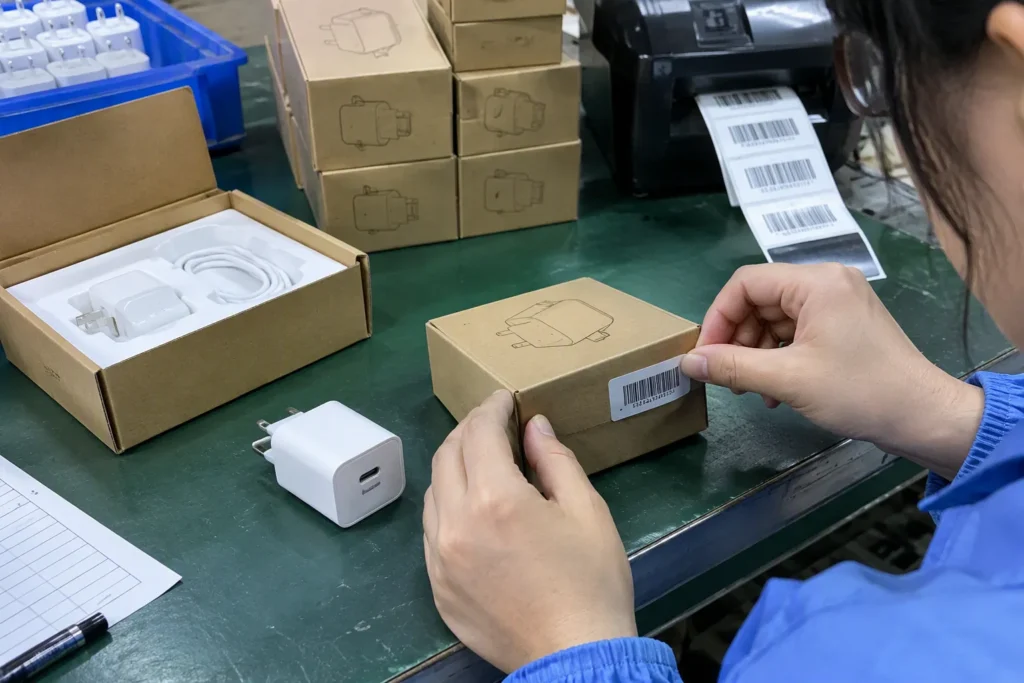
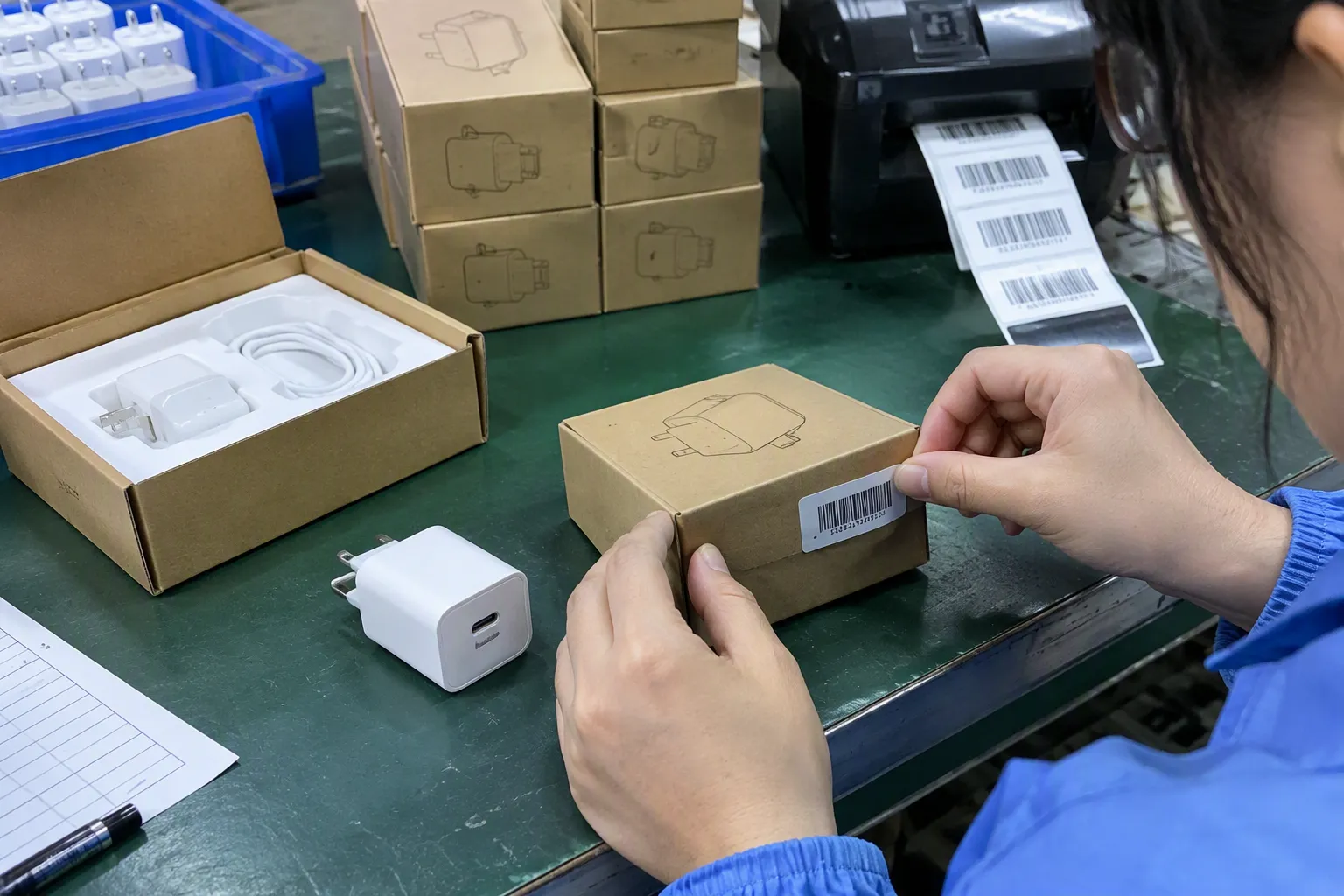
The front panel, side panel, contents list, manual, barcode record, carton marking, and online listing should not contradict one another. If the front of the box suggests a complete set while the contents list excludes the charger, the customer may feel misled even if a small label is present.
I recommend checking these items together:
- Product name and model number.
- Included charging cable.
- Included or excluded power adapter.
- Charging interface and basic requirements.
- Product images that do not show accessories sold separately unless they are clearly marked.
- “What is in the box” information.
- SKU and barcode records.
- Marketplace title, bullet points, and specification fields.
- Retailer planograms or shelf-ticket requirements.
- Translations for each intended market.
A packaging icon can support communication, but it cannot repair a confusing SKU structure. I would also avoid designing one generic carton and changing only a small sticker unless the buyer has confirmed that the sticker is durable, visible, accepted by the channel, and consistent with all other information.
The 2026 implementation question
Importers should treat implementation dates as a verification task. The applicable date may depend on the product category, placing-on-the-market situation, and the current interpretation of official requirements. I do not recommend relying on a supplier’s memory or an old packaging file.
Before production, I would create a short compliance record containing:
- The product category and model.
- The intended EU countries.
- The expected placing-on-the-market date.
- The official source reviewed.
- The responsible compliance contact.
- The packaging version approved.
- The evidence supporting the included-contents statement.
- Any open questions requiring specialist advice.
I would also separate three decisions in the internal workflow:
- Regulatory scope: Does this exact product fall under the relevant requirement?
- Product configuration: Will I offer a charger, no charger, or both?
- Commercial execution: How will I manage cost, MOQ, lead time, inventory, retail presentation, and after-sales support?
This separation prevents a common mistake. A buyer may decide not to include a charger for commercial reasons and then assume that the same choice automatically satisfies every regulatory or customer-communication need. The product scope and documentation still require case-by-case review.
How the choice affects procurement
The charger decision changes more than the box. It can affect:
- Factory purchase orders.
- Component testing and documentation.
- Product weight and carton dimensions.
- Sea and air freight calculations.
- Warehouse picking.
- Retailer item setup.
- Warranty and replacement procedures.
- MOQ for separate configurations.
- Forecast accuracy.
- Promotional pricing.
- Customer service scripts.
When I work with a buyer on a new 3C item, I encourage the buyer to freeze the configuration before final quotation. A charger can change the ex-works price, packaging size, carton quantity, and inspection checklist. If the buyer changes from bundled to unbundled after production planning, the supplier may need to revise the carton, insert, contents list, and barcode data.
I also recommend asking for separate quotations where practical:
- Device with cable only.
- Device with cable and wall charger.
- Device without cable and charger.
- Optional compatible charger as a separate SKU.
- Individual packaging and master-carton costs.
- MOQ and lead time for every configuration.
This approach gives the importer a clearer landed-cost comparison. It also exposes hidden costs. A lower unit price may not remain lower after adding a separate charger purchase, new marketplace content, extra inventory, or customer-service handling.
Quality control for bundled and unbundled products
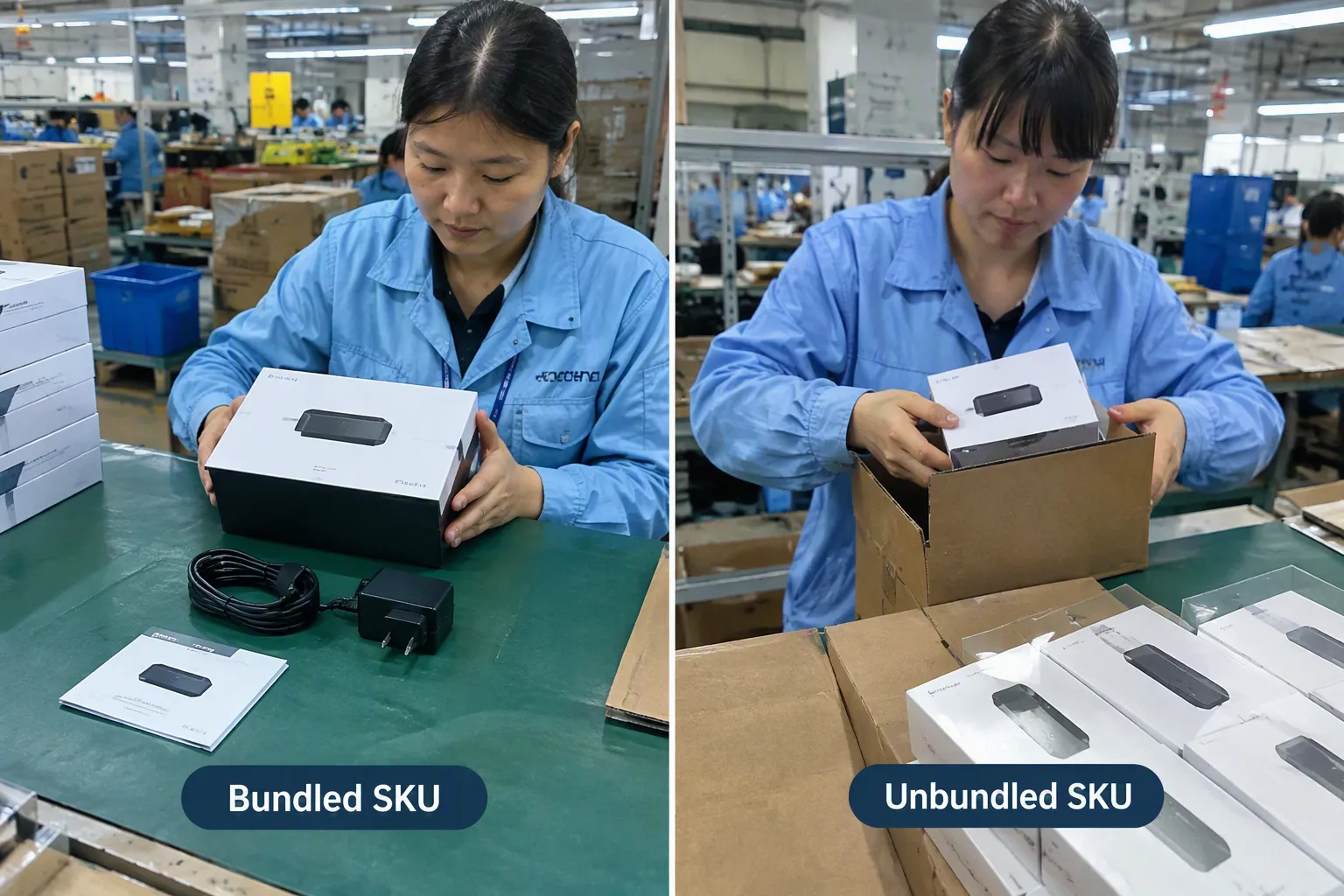
The inspection checklist should reflect the chosen SKU. I would not use the same checklist for a charger-included and charger-free product.
For a bundled SKU, the inspection may confirm:
- Correct charger model.
- Correct plug version for the destination market.
- Correct markings and documents.
- Cable presence and length.
- Charging performance according to the approved specification.
- Packaging contents and accessory count.
- Separation between approved and rejected components.
For an unbundled SKU, the inspection may confirm:
- No charger is packed by mistake.
- The correct cable is included or excluded.
- The box contents match the artwork.
- The manual explains the charging requirement.
- Product images and contents labels are accurate.
- The SKU and barcode correspond to the correct configuration.
I would ask the supplier to provide a golden sample for each version. I would keep the approved sample, packaging proof, contents list, and inspection standard together. This simple control helps prevent mixed cartons, especially when the same device is sold in several configurations.
Retailer and marketplace communication
A shelf label may have limited space, but online listings usually allow more explanation. I recommend using the first few product bullets to answer the practical question that customers are likely to ask: what is included, and what does the customer need to use the product?
A clear listing can include:
- “Power adapter not included.”
- “USB charging cable included,” if accurate.
- “Use with a compatible charger according to the instructions.”
- “Check the required charging specification before use.”
- A contents image with accurate labels.
- A separate link or SKU for a compatible accessory, where appropriate.
I would avoid saying “works with all chargers” unless the product team has verified that claim. I would also avoid presenting an excluded charger as a benefit in every market. Some buyers may appreciate reduced duplication. Others may see the product as incomplete.
In my discussions with European retail customers, the most useful conversation usually concerns the entire customer journey. The retailer wants to know what the shopper sees, what the shopper takes home, what the shopper needs to provide, and what happens if the shopper misunderstands the offer. That is a packaging and product-information issue as much as a compliance issue.
How to build a pre-2026 decision workflow
I suggest that importers use the following sequence:
-
Map the product range.
List all devices with charging functions, including TWS earbuds, smartwatches, small electronics, and accessories. -
Group products by actual use case.
Separate starter products, replacement products, add-ons, and products with proprietary charging systems. -
Confirm the regulatory scope.
Review current official information and obtain qualified advice for uncertain products or markets. -
Define the customer offer.
Choose bundled, unbundled, or dual-SKU treatment based on customer expectations and channel needs. -
Confirm technical information.
Verify compatible cable, charger output, interface, and instructions with the product or engineering team. -
Create a packaging brief.
Include the exact SKU, contents, wording, icon or label requirements, languages, and artwork version. -
Align commercial records.
Update the quotation, purchase order, barcode, ERP record, product listing, and retailer data. -
Inspect the first production.
Check both the physical contents and the printed communication. -
Review customer feedback.
Track returns, questions, and retailer comments after launch. Use the findings for the next packaging revision.
This workflow is deliberately practical. It does not replace official review. It gives the importer a way to organize the information before artwork and production become difficult to change.
What importers should ask a Shenzhen 3C supplier
A supplier should answer configuration questions in writing. I would ask:
- Which exact accessories are included in each SKU?
- Can the factory produce bundled and unbundled versions separately?
- What are the MOQ and lead time for each version?
- Can the factory maintain separate barcodes and carton markings?
- Which product documents support the charging information?
- Has the packaging artwork been checked against the physical contents?
- Can the factory provide a pre-production sample?
- How will the factory prevent mixed packing?
- What inspection points will be used?
- Which certifications and declarations are available for buyer verification?
Our company has 15 years of export experience with USB cables, chargers, GaN chargers, TWS earbuds, smartwatches, and other 3C products. I use that background to help buyers compare configurations and packaging options for European and U.S. channels. I still tell buyers to verify certifications and regulatory documents themselves or through qualified professionals. A supplier’s document package should be evidence for review, not an automatic approval.
Frequently Asked Questions
Is EU common charger unbundling required for every electronic product?
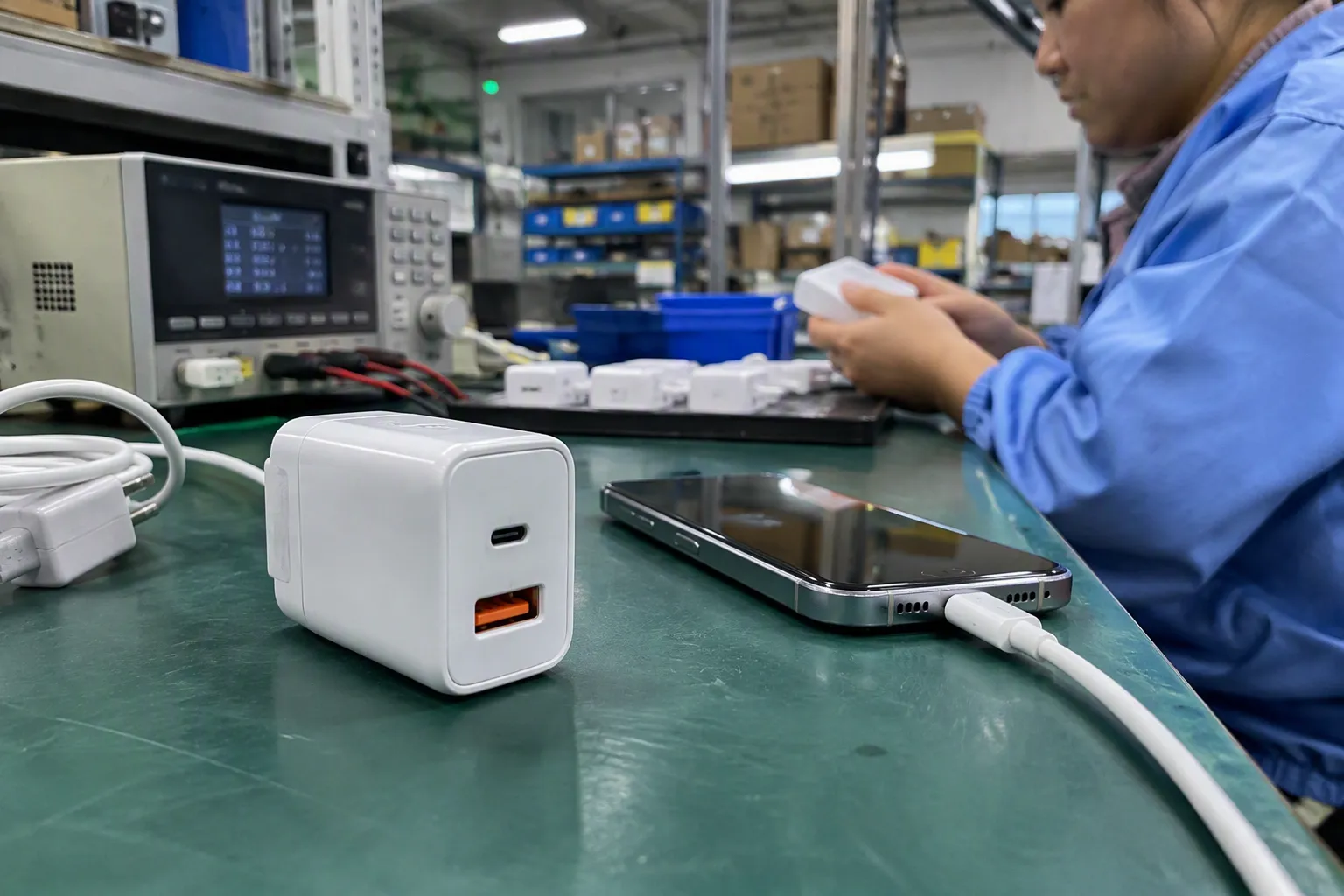
No. The applicable scope depends on the product category, charging interface, market, and current EU requirements. I recommend checking the exact model and implementation date against official sources or qualified compliance advice. Importers should not assume that every USB-powered or rechargeable product follows the same rule.
Does “charger not included” mean that the product cannot be used?
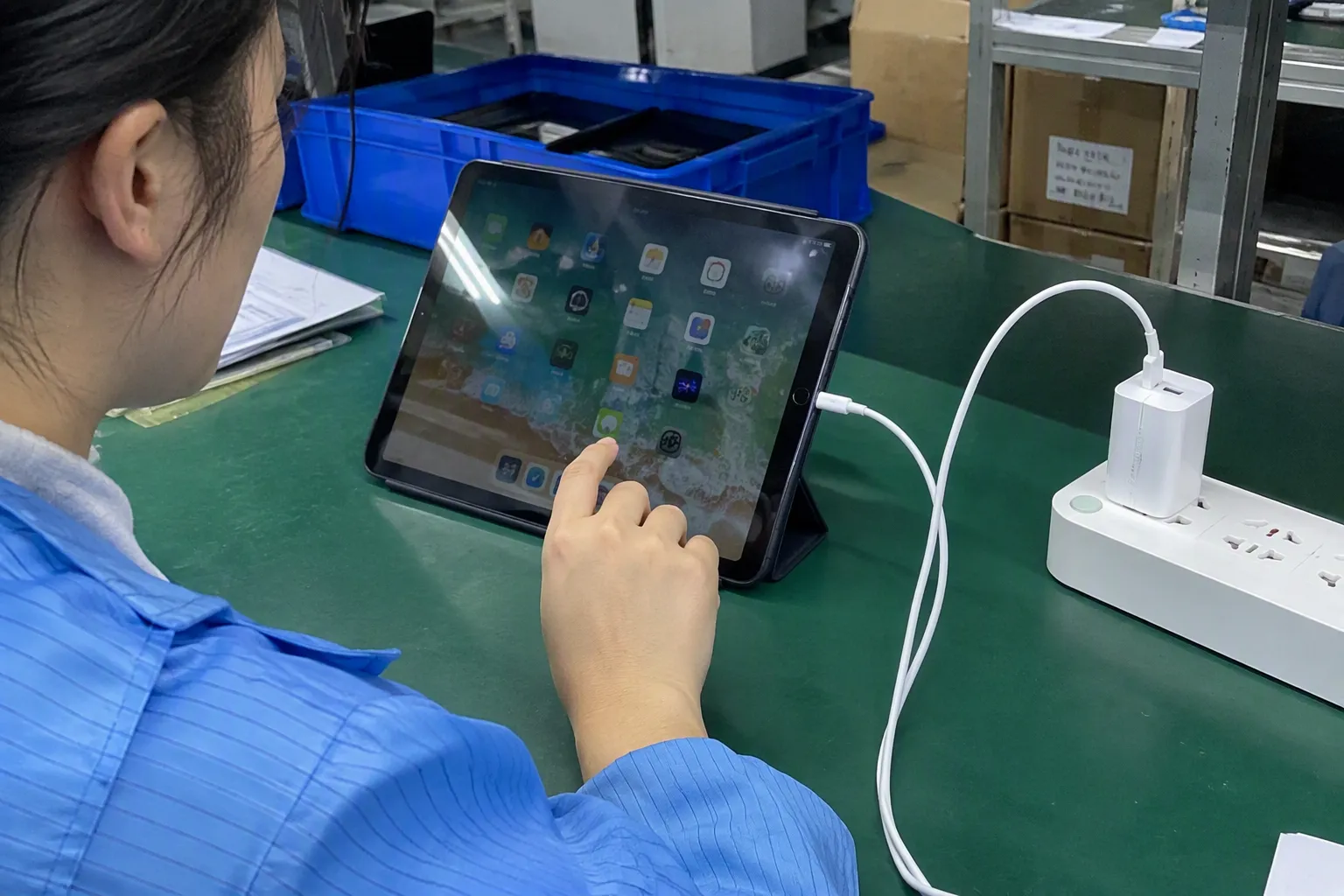
No. A product may work with a customer’s existing compatible charger, but compatibility depends on the product’s interface, cable, output requirements, and instructions. I recommend stating clearly whether a cable is included and what type of power adapter the customer needs.
Should I create both bundled and unbundled charger SKUs?
A dual-SKU strategy can help serve different channels and customer expectations, but it also increases inventory, artwork, forecasting, and inspection work. I would compare expected volume, MOQ, retailer requirements, landed cost, and return risk before approving two versions.
Can I use one generic package and add a charger-not-included sticker?
Sometimes a supplementary label may be useful, but I would not rely on it as the only control. The SKU, contents list, product images, manual, barcode data, and online listing should all communicate the same configuration. The label format and placement should also be verified for the relevant market and channel.
What should I confirm with a supplier before approving packaging?
I would confirm the exact contents, charging requirements, SKU separation, MOQ, lead time, barcode, artwork version, inspection process, and supporting product documents. I would also request a production sample. These checks help prevent a package from promising a charger that the factory does not actually pack.
Conclusion
EU common charger unbundling and charger-not-included labeling in 2026 should be handled as a complete SKU and product-communication decision. I recommend that importers verify the product scope and timeline, then choose the right configuration for each use case and sales channel. The packaging, product listing, contents, technical information, and supplier records must match. Our Shenzhen 3C team can help European importers compare bundled and unbundled options, coordinate packaging, and review supplier documentation before production.
Sources
- [PDF] Requirements for placing radio equipment (under Directive 2014/53 ...", An EU legislative or Commission source supports the existence of common-charger requirements affecting product configuration and consumer information, although it does not by itself demonstrate the extent of each importer’s operational burden
- Sustainable Paper-Based Packaging: A Consumer's Perspective", Research on product bundling and consumer expectations can support the proposition that accessory configuration affects both commercial presentation and purchasing responses, but such studies may not address the EU common-charger regime specifically
- Consumer Protection | Federal Trade Commission", EU consumer-protection materials support the requirement that product descriptions and representations accurately reflect the goods supplied, which is relevant to consistency between SKU records, packaging, and online listings
- The EU common charger", The EU common-charger legislation defines its product scope and conditions rather than imposing an undifferentiated charger-exclusion rule on all electronic products
- Hidden Failures in Consumer Electronics Sustainability", EU impact-assessment research identifies reduced charger duplication and consumer convenience as competing considerations in charger unbundling policy
- The EU common charger", An EU impact assessment supports the mechanism by which charger standardization and optional charger bundling can reduce redundant accessories and related waste, subject to assumptions about consumer reuse and compatibility
- USB Power Delivery: The Technology 1", USB charging standards and engineering guidance support the conditional proposition that an unbundled device can use an existing adapter when the relevant connector, protocol, voltage, current, and power requirements are compatible
- An interchangeable charging solution for all consumer electronic ...", International charging and electrical-safety standards establish that connector configuration, cable capability, power characteristics, and protective requirements are relevant to safe and functional charging