Quick Answer
USB-C cable torsion tests matter because a cable can look durable in photos, pass a stated bend-cycle claim, and still perform poorly when users repeatedly twist it during normal charging or data use. That gap can lead to returns, negative reviews, and hard-to-explain failures. I recommend turning vague durability language into a documented sourcing requirement before placing an order.
USB-C cable torsion tests evaluate how a cable assembly performs when it is twisted under defined conditions, rather than simply bent back and forth. Buyers should request the twist angle, direction pattern, applied load, test location, cycle count, sample quantity, electrical checks, and pass/fail criteria. A supplier’s statement that a cable “passed testing” is not enough unless the underlying test protocol and results can be reviewed.
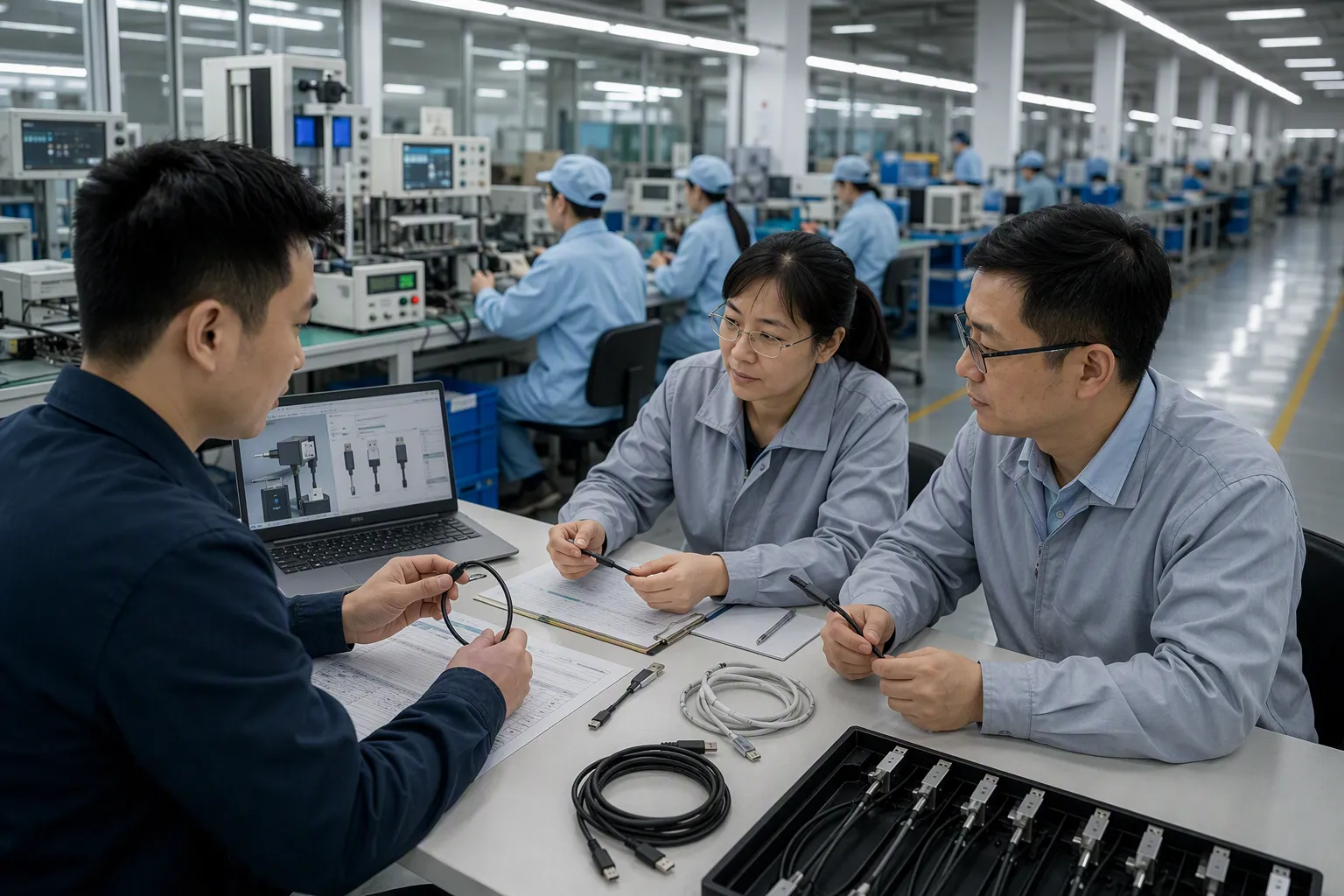
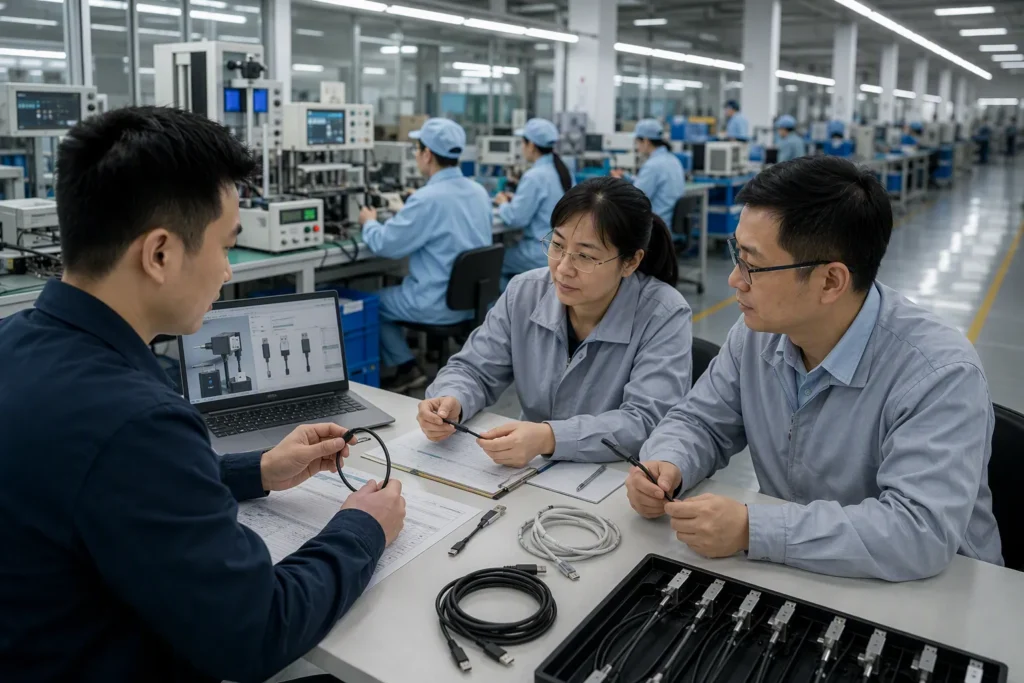
When I compare USB-C cable suppliers in China, I often find that durability claims sound similar while the evidence behind them is very different. One factory may provide a detailed internal report. Another may only show a product-page graphic. The difference matters because twisting stress can appear in real use long before a buyer sees obvious jacket damage.
USB-C Cable Torsion Is Not a Simple “How Many Bends Can It Survive?” Question
Many buyers ask suppliers for bend-test numbers because they are easy to request and easy to compare. The problem is that bending and twisting do not apply force in the same way[1]. If a cable will be used in cars, offices, travel kits, gaming setups, or charging stations, users may rotate, pull, coil, and twist it in ways a bend-only claim does not describe.
USB-C cable torsion tests should be evaluated as separate, task-relevant durability checks because bend-cycle results do not automatically show resistance to twisting[2]. Buyers need to understand where the cable is twisted, how far it rotates, whether the direction changes, whether a load is applied, and whether electrical function remains stable after testing. These conditions make the result meaningful for supplier comparison.
Bend testing and torsion testing answer different questions
A bend test usually focuses on repeated flexing. Depending on the method, the cable may move through a defined angle near the connector or along a chosen point in the cable body. This can help buyers assess one important type of mechanical stress.
Torsion concerns rotational movement. In a torsion scenario, the cable body, connector transition, or another defined section may be twisted around its axis. The test may alternate clockwise and counterclockwise movement, or it may use another stated direction pattern. The location of the twist is especially important.
For example, two suppliers may both claim that a USB-C cable passed a high number of “durability cycles.” That wording does not tell me whether:
- The supplier performed a bend test, a torsion test, or both.
- The cable was held at the connector, strain-relief area, or middle section.
- The cable was twisted through a small or large angle.
- The test alternated direction or repeatedly twisted in one direction.
- The cable carried a defined load during the test.
- The supplier checked charging, data transfer, continuity, or other electrical functions afterward.
- The cable passed because it still worked, or because it showed no visible damage.
- The result came from one sample or multiple samples.
Without those details, the two claims are not directly comparable.
Why visible jacket condition is not the full story
A cable jacket can remain visually intact while the cable assembly has experienced stress that deserves further evaluation. I have seen workmanship concerns during cable purchasing and inspection where the external finish looked acceptable, yet the connector transition, strain relief, plug fit, or internal assembly consistency still needed closer review.
I do not treat those observations as laboratory proof of a specific failure mechanism. A qualified laboratory, the supplier’s engineering team, or an independent testing provider should verify any technical conclusion. Still, from a procurement perspective, the lesson is practical: a visual check alone cannot validate torsion durability[3].
Buyers should ask what the supplier checks after USB-C cable torsion tests. A useful post-test review may include agreed electrical-function checks and a documented visual inspection. The exact checks should match the cable’s intended purpose.
| Buyer question | Why it matters | Evidence to request |
|---|---|---|
| Where was the cable twisted? | Stress near the connector may differ from stress in the cable body. | Fixture photos or diagram |
| What was the twist angle? | A cycle count has little meaning without movement range. | Written protocol |
| Was the cable loaded? | Hanging weight or tension can change the test severity. | Test setup details |
| Did the direction alternate? | Reversing rotation may represent a different use pattern. | Direction sequence |
| What defined a failure? | Cosmetic, mechanical, and electrical failures are not identical. | Pass/fail criteria |
| What function was checked afterward? | A cable should be assessed beyond appearance when applicable. | Test record or report |
The cable-and-connector transition deserves attention
For many USB-C cable buyers, the highest-risk area is not necessarily the center of the cable. The transition between the cable and connector is often a practical focus[4] because users commonly grip, rotate, pull, or bend the cable near the plug while connecting devices.
This does not mean every cable will fail at that point. It means buyers should make the test location explicit rather than assuming the supplier tested the most relevant area.
I suggest asking suppliers to identify:
- The exact clamping points used in the test fixture.
- The distance from the connector to the point where twisting was applied.
- Whether the connector was fixed or allowed to move.
- Whether the strain-relief area was included in the stressed section.
- Whether the cable was tested as a finished assembly with the intended plug, molding, jacket, and internal construction.
These questions also help uncover a common sourcing problem: a sample may use different materials or assembly controls from the planned production version[5]. If the approved sample has a specific overmolding shape, cable diameter, braided jacket, or plug shell, those features should be captured in the approved-sample record.
A practical USB-C cable torsion test request for suppliers
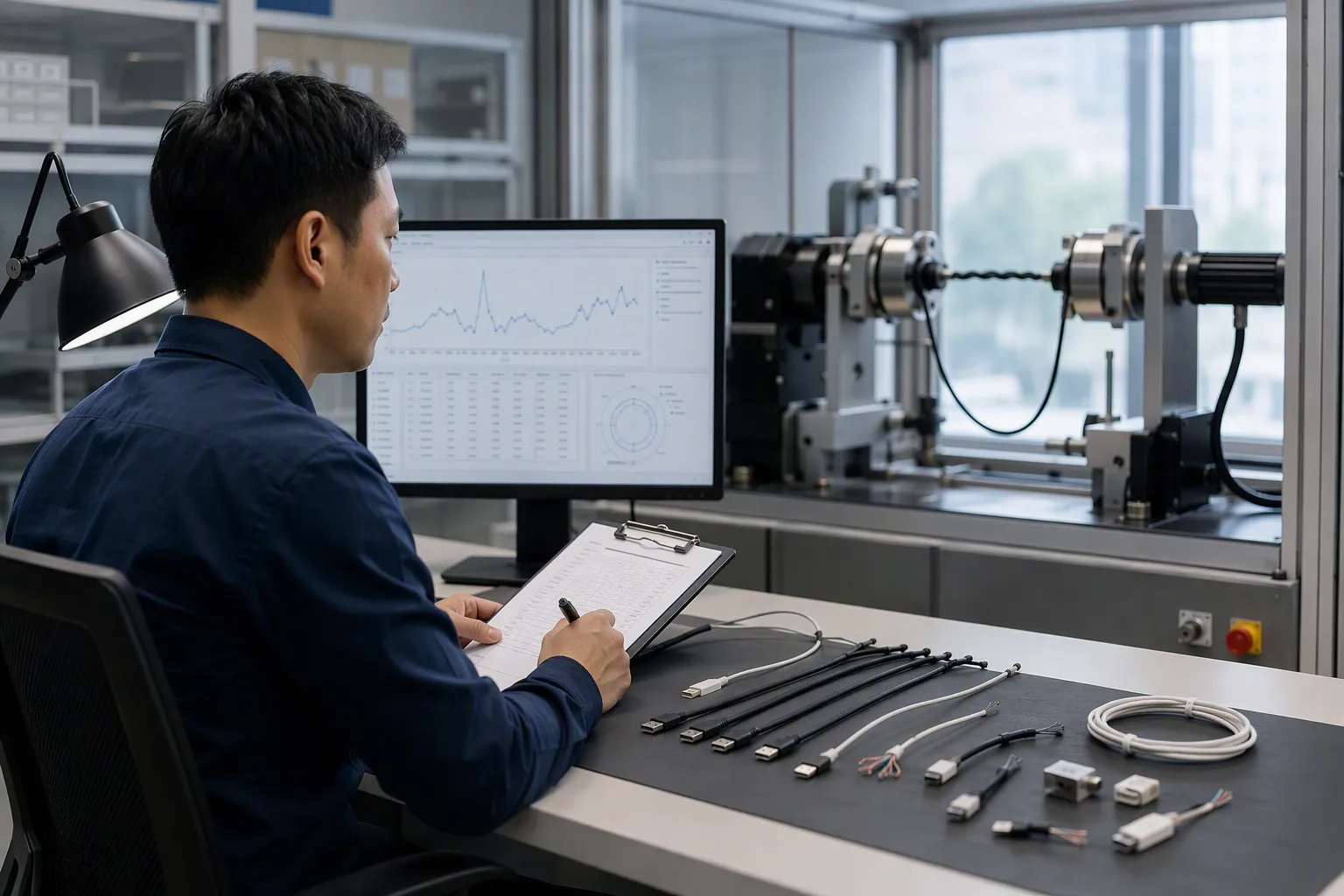
I do not recommend asking only, “How many torsion cycles can this cable pass?” That question invites an incomplete answer. A clearer approach is to issue a written requirement that asks suppliers to disclose their test conditions.
Here is a procurement-focused template that I would adapt to the intended product and market:
Please provide your USB-C cable torsion test protocol for the proposed cable model. The document should state the sample quantity, cable length, cable construction or model number, test location, fixture setup, twist angle, rotation direction pattern, cycle count, applied load or tension, test speed if recorded, pre-test condition, post-test electrical-function checks, visual inspection criteria, and pass/fail definition. Please include dated photos or video of the setup where available.
The wording does not force a factory to claim compliance with a standard it has not followed. Instead, it asks for transparency. That is useful when comparing supplier A, supplier B, and supplier C.
Do not confuse a marketing graphic with a test protocol
Some cable listings display phrases such as “X times durable,” “extreme bend resistance,” or “long-life connector.” These phrases may be useful as marketing starting points, but I would not use them as purchasing approval criteria.
A marketing graphic usually leaves out the details that make USB-C cable torsion tests comparable[6]. It may not identify the product revision, sample size, failure definition, or test setup. It may also refer to a different cable length, connector design, or material configuration than the one quoted for a private-label order.
When I review a supplier’s durability statement, I separate it into three levels:
| Evidence level | What it may include | Procurement use |
|---|---|---|
| Marketing claim | Product-page statement or packaging icon | Initial screening only |
| Supplier test record | Internal protocol, photos, dated result sheet | Useful for comparison, subject to review |
| Independent evidence | Third-party report tied to the relevant product version | Stronger support where appropriate |
None of these levels removes the need for quality control. Even a well-documented sample test does not guarantee that every production lot will match the sample[7]. The buyer still needs a production-control plan.
Convert durability language into a purchase requirement
The strongest sourcing improvement is simple: write the durability requirement into the product specification, quotation comparison sheet, sample approval record, and production inspection plan.
For USB-C cable torsion tests, I recommend separating four documents or checkpoints.
1. Product specification sheet
The specification sheet should identify the exact cable version. It can include:
- Cable length and permitted tolerance
- Outer diameter and jacket material, if applicable
- Connector type and shell design
- Strain-relief or overmolding design
- Color, logo, packaging, and labeling
- Required charging and data functions, where relevant
- Torsion-test documentation requirement
- Agreed test location and functional pass/fail checks
The goal is not to create a laboratory standard from scratch. The goal is to ensure that suppliers quote the same product and the same evidence requirement.
2. Supplier comparison matrix
I find that a comparison table prevents vague claims from receiving too much weight. A supplier with the lowest unit price may provide the least usable evidence. That does not automatically disqualify the factory, but it should affect risk assessment.
| Evaluation point | Supplier A | Supplier B | Supplier C |
|---|---|---|---|
| Complete torsion protocol provided | Yes / No | Yes / No | Yes / No |
| Sample quantity stated | Yes / No | Yes / No | Yes / No |
| Twist angle and direction stated | Yes / No | Yes / No | Yes / No |
| Test location shown | Yes / No | Yes / No | Yes / No |
| Electrical checks defined | Yes / No | Yes / No | Yes / No |
| Pass/fail criteria defined | Yes / No | Yes / No | Yes / No |
| Sample and production model match confirmed | Yes / No | Yes / No | Yes / No |
| Price and MOQ | Record | Record | Record |
This approach helps a buyer avoid treating all “tested” claims as equal.
3. Approved sample record
An approved sample should be more than a package sent by courier. I recommend retaining photos, key dimensions, cable markings, plug appearance, packaging details, and the supplier’s identified model number. If torsion evidence influenced the buying decision, retain that documentation with the sample record.
For larger or repeat orders, the buyer can also seal or label a reference sample. The factory, sourcing team, and inspection provider should know which version is the approved benchmark.
4. Production inspection plan
A factory inspection does not replace a standardized durability test[8]. However, a quality-control plan can verify production consistency indicators that may affect durability risk.
Depending on the order, I may ask an inspection team to review:
- Cable jacket appearance and obvious surface defects
- Connector molding and strain-relief consistency
- Plug alignment and assembly finish
- Cable length, color, branding, and packaging
- Random functional checks under the agreed inspection scope
- Whether production materials appear consistent with the approved sample
- Whether the supplier can provide the agreed batch or model documentation
Any application-specific electrical, mechanical, safety, or compliance evaluation should be performed by qualified professionals using the appropriate method. Buyers should also verify any claimed certifications, reports, and test documents directly with the issuing organization or testing provider where necessary.
Match the test request to actual customer use
The right question is not “What is the highest torsion number available?” The right question is “What twisting stress is realistic for this product’s intended use, and what evidence can the supplier provide for that requirement?”
A short USB-C cable for a power bank may face different handling from a long desktop cable, a vehicle charging cable, or a braided cable sold as a travel accessory. A cable bundled with a magnetic organizer or cable-management clip may also be handled differently from a loose retail cable.
Before requesting USB-C cable torsion tests, I would define the use case with the product team:
- Will users connect and disconnect the cable many times each day?
- Will the cable be carried in bags, cars, or travel pouches?
- Is the cable likely to be used while a phone is held and rotated?
- Is the product positioned as a premium, heavy-duty, or gaming accessory?
- Does the cable include a thick jacket, braided exterior, or reinforced connector design?
- Is the biggest business risk low price, marketplace returns, brand reputation, or all three?
This discussion does not create a universal testing target. It gives the supplier and buyer a reason to agree on a relevant protocol. If the commercial risk is high, independent testing may be worth considering before a large production commitment.
What I would ask during supplier selection
For a new USB-C cable project, I would keep the supplier conversation direct. The following questions tend to reveal whether the factory understands the request or is repeating generic marketing language:
- Can you provide the written protocol for your USB-C cable torsion tests?
- Which cable model and connector construction did you test?
- Can you show the fixture setup and identify the test location?
- What twist angle and direction pattern did you use?
- Did you apply load, tension, or a hanging weight?
- How many samples did you test?
- What counted as a failure during or after testing?
- Which electrical functions did you check after the test?
- Does the report apply to the same cable length, jacket, plug, and overmolding quoted to us?
- Can the same requirement be referenced in our purchase order and retained for production records?
A supplier does not need to have the perfect answer immediately. A capable supplier should, however, be willing to clarify the method, provide documents, and explain differences between sample construction and mass production.
A useful supplier is not simply one that says “yes, passed.” A useful supplier is one that can show what was tested, how it was tested, and whether the tested sample matches the cable you plan to sell.
Frequently Asked Questions
Are bend-cycle claims enough to evaluate USB-C cable torsion?
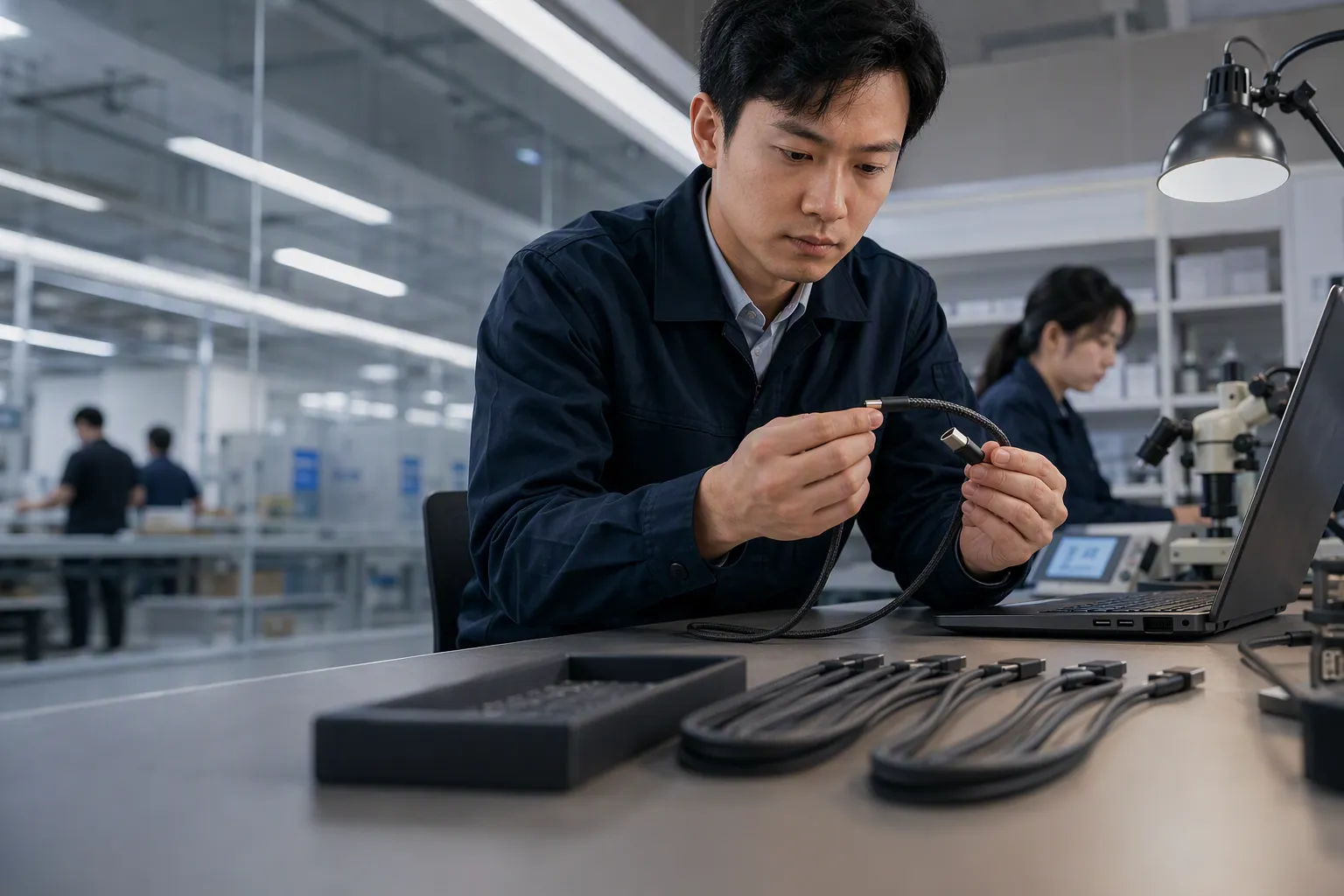
No. Bend-cycle claims can provide useful information about repeated flexing, but they do not automatically demonstrate torsion resistance. Buyers should request separate details for twisting conditions, including the test location, twist angle, direction pattern, load, cycle count, and electrical or visual pass/fail criteria.
What should a USB-C cable torsion test report include?
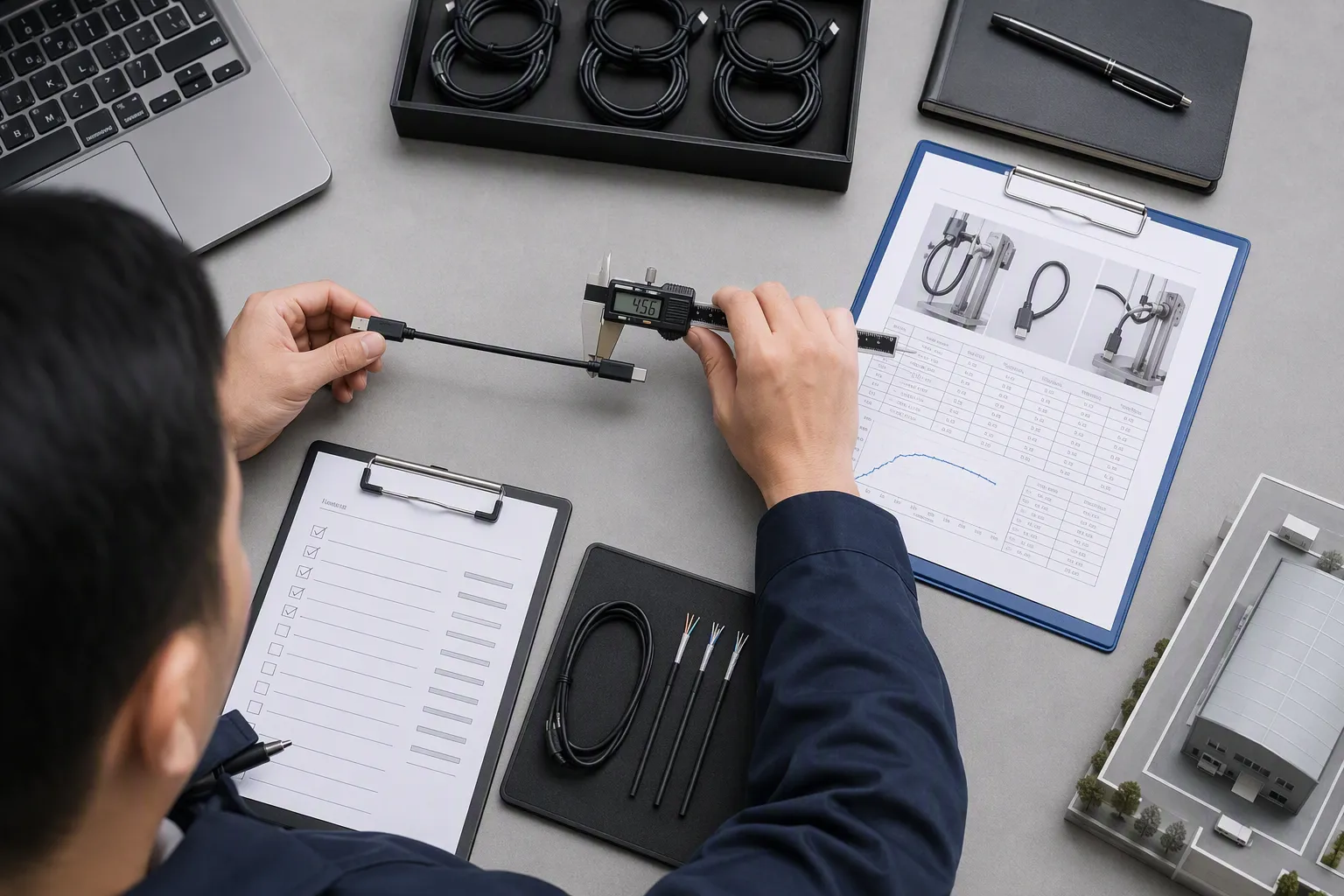
A useful USB-C cable torsion test report should identify the tested cable model, sample quantity, fixture setup, test location, twist angle, direction pattern, applied load if any, cycle count, and failure definition. It should also state what functional checks were completed after testing and provide dated supporting records where available.
Can I rely on a supplier’s “passed test” statement?
I would treat a “passed test” statement as a starting point, not final proof. The statement becomes more useful when the supplier provides the underlying protocol, sample details, and pass/fail criteria. For higher-risk products or larger orders, buyers may consider qualified independent evaluation.
Should torsion requirements be included in a purchase order?
Yes. If torsion durability influenced your supplier decision, include the agreed documentation requirement in the product specification or purchase order. You should also retain approved sample records and clarify how production lots will be checked for consistency with the agreed cable construction and quality standard.
Can a pre-shipment inspection prove torsion durability?
A pre-shipment inspection can check visible workmanship, packaging, dimensions, labeling, and selected functional items within its agreed scope. It does not automatically replace a standardized torsion test. Buyers should use inspection together with documented supplier testing and, where appropriate, qualified third-party evaluation.
Conclusion
USB-C cable torsion tests help buyers move beyond broad durability claims and ask for evidence that can actually be compared. Bend-cycle marketing alone does not explain how a cable behaves when users twist it near the connector or along the cable body. I recommend defining the intended use, requesting a written torsion-test protocol, retaining approved-sample records, and linking production checks to the agreed specification. At KingSourcing, we help overseas buyers compare China cable suppliers, verify samples, manage production quality, and reduce avoidable sourcing risk before shipment.
Sources
- [PDF] 9 Stresses: Beams in Bending", Mechanical-engineering references distinguish bending, which creates flexural stresses and moments, from torsion, which creates shear stresses when a member is twisted about its longitudinal axis
- Bend Testing of Cables and Wires", Cable-test standards commonly specify flexing and torsion as distinct test conditions, indicating that performance under repeated bending alone does not establish performance under rotational loading
- [PDF] Nondestructive Testing (NDT) and Sensor Technology for Service ...", Visual examination can document observable surface conditions, but nondestructive-evaluation guidance recognizes that it may not reveal internal damage or establish the continued functional performance of an assembly
- [PDF] POWER CABLE", Reliability literature on cable terminations identifies the connector and strain-relief transition as a mechanically significant region because cyclic handling loads can concentrate near changes in stiffness and geometry
- [PDF] QUALITY AND CONFIGURATION MANAGEMENT REQUIREMENTS", Manufacturing quality-management guidance treats configuration control and verification of production conformity as necessary because an approved prototype or sample does not, by itself, demonstrate that subsequent production will remain equivalent
- Reporting Results from Studies Evaluating Diagnostic Tests", Laboratory-reporting guidance generally requires identification of the test method, specimen or sample, test conditions, results, and applicable evaluation criteria so that results can be interpreted and compared
- Metrological Traceability: Frequently Asked Questions and NIST Policy", Statistical quality-control guidance explains that sample-based inspection and qualification provide evidence about sampled material rather than a guarantee that every unit or future production lot conforms to requirements
- [PDF] 1C. Quality Assurance vs. Quality Control", Conformity-assessment terminology distinguishes inspection from testing: inspection evaluates specified characteristics through observation and judgment, while testing determines characteristics using a defined technical procedure